 Quran
Quran
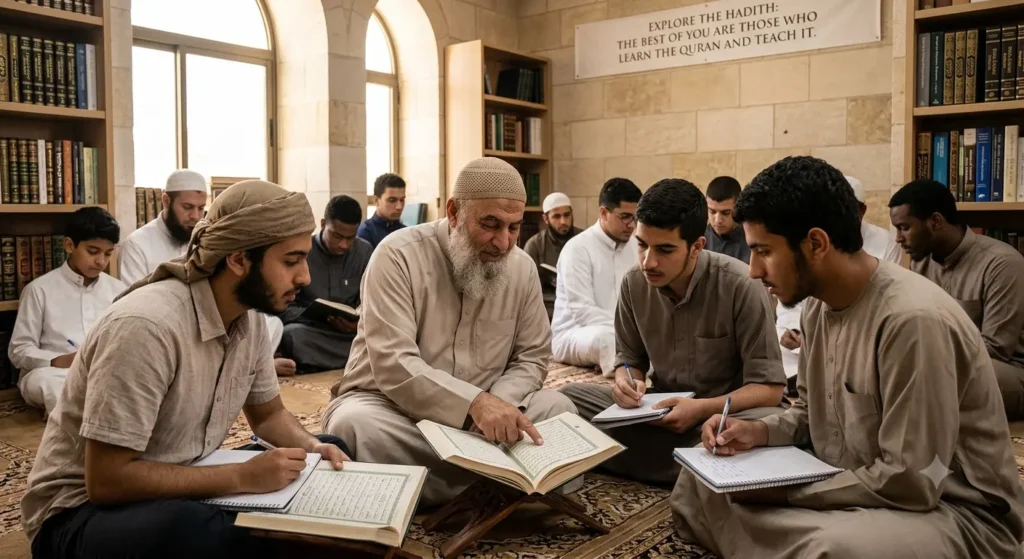
There is a single sentence from the Prophet Muhammad ﷺ that defined the life’s work of entire generations of scholars.
One of his Companions, Abu Abd al-Rahman al-Sulami, heard the hadith in the time of ‘Uthman ibn ‘Affan and spent the next several decades teaching the Quran to Muslims across the Muslim world, all the way until the era of al-Hajjaj. When asked why he devoted so many years to this seat of instruction, he pointed to the words he had heard and said: That is what placed me here.
The hadith he was referring to is this:
“The best of you are those who learn the Quran and teach it.”
(Narrated by ‘Uthman ibn ‘Affan, recorded in Sahih al-Bukhari, no. 5027)
It is one of the most authentic and widely cited narrations in Islamic scholarship — graded sahih by Imam al-Bukhari and confirmed by al-Albani in Sahih al-Tirmidhi (no. 2907). And its meaning cuts deeper than it first appears.
Understanding The Hadith “The Best Of You Are Those Who Learn The Quran And Teach It”
This narration is more than praise — it is a ranking. The Prophet ﷺ used the superlative: khayrukum — “the best among you.” Not “good people,” not “among the righteous,” but the best.
Ibn Uthaymin explained that this address is to the entire Muslim ummah, and that the title goes to whoever combines both qualities: learning the Quran and teaching it. The learning covers recitation, memorization, and understanding of meaning. The teaching covers transmitting all three to others.
Al-Maz’hari clarified the logic behind the ranking: since the best of all speech is the speech of Allah, the best of all people after the Prophets are those who dedicate themselves to learning and conveying that speech. The connection is direct and rational.
Ibn Taymiyyah added a dimension that many overlook: the teaching of meaning (tafsir) is the primary purpose of teaching the words. Correct recitation of letters is the vehicle — but what the Quran says, what it commands, what it illuminates — that is the intended destination.
1. Why “Learn” Comes Before “Teach”?
The structure of the hadith is deliberate. Learning is listed first — because no one can give what they have not received. A teacher who has not genuinely learned the Quran transmits form without substance. The hadith requires both, in order.
This is a practitioner’s principle: the scholar who teaches from a place of real knowledge and sincere practice is fundamentally different from the one who merely performs transmission. The Arabic word ‘allama — “taught” — carries the sense of deliberate, structured, repeated instruction. It is not casual mention; it is commitment.
The one who brings both qualities together, as al-Qurtubi noted, benefits himself and extends that benefit to others — combining what scholars call al-naf’ al-qasir (personal benefit) with al-naf’ al-muta’addi (benefit that reaches beyond oneself). That completeness is precisely why this person ranks highest.
2. The Quran Itself Elevates Those Who Teach It
The status the Prophet ﷺ described is not isolated — it reflects what Allah ﷻ stated directly in the Quran.
In Surah Fussilat (41:33), Allah says:
“And who is better in speech than one who calls to Allah and does righteous deeds and says: ‘Indeed, I am of the Muslims.’
The scholars of tafsir consistently include Quran teachers among the foremost examples of this verse. The Quran teacher calls people to the words of Allah themselves — there is no higher call.
And in Surah Al-Imran (3:79), Allah praises the Rabbaniyyeen — those who teach the Book and study it. This is not a passive description. It is a station.
3. The Teacher Who Is Prayed For by All of Creation
The Prophet ﷺ also said:
“Indeed, Allah and His angels, and the inhabitants of the heavens and the earth — even the ant in its hole and even the fish in the sea — send prayers upon the one who teaches people goodness.” (Sunan Abi Dawud 3641)
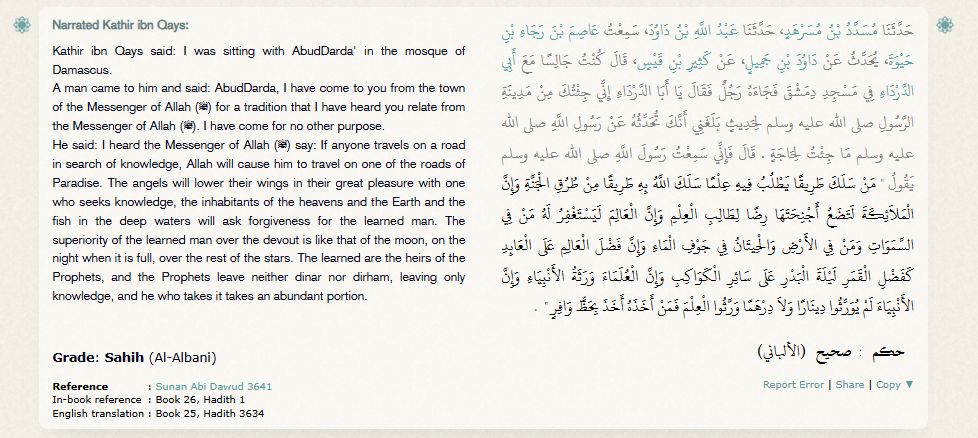
Ibn Kathir and others noted: is there anyone who teaches better goodness than the one who teaches the Quran? The mercy that descends upon the Quran teacher is not metaphorical — it is the literal intercession of creation itself.
At Online Quran Teachers, our certified Quran teachers carry this responsibility with full awareness. Teaching is not a job here — it is an act of ‘ibadah with consequences that outlast the lesson.
Read Also: Best Practices for Teaching the Quran Online
The Reward Of Learning And Teaching The Quran In This Life, In The Grave, And In The Hereafter
What makes this hadith exceptional is that the honor it describes is not deferred to the next life alone. It operates across three phases of existence and understanding this is central to grasping the full importance of learning and teaching the Quran.
1. Leadership and Priority In This Life
The Prophet ﷺ instructed in a narration recorded by Ibn Majah that when a group gathers for prayer, the one most knowledgeable of the Quran leads them. The hafiz — the one who has memorized — takes precedence over others in rank and in leading the congregation. This is a worldly, social dignity attached to Quran knowledge.
The story of Abu Abd al-Rahman al-Sulami is itself the evidence. Teaching the Quran for decades brought him to a seat of lasting honor and influence that no other pursuit could have secured.
2. The Quran As Companion In The Grave
Jabir ibn ‘Abdillah (رضي الله عنه) narrated that after the Battle of Uhud, the Prophet ﷺ would ask — before placing the martyrs in the grave — which of them had memorized more of the Quran. Whichever was indicated, the Prophet placed him first in the lahd. (Bukhari)
Even in death, the carrier of the Quran holds a higher rank. The memorization that was carried in the heart in this life determines the position of the body in the grave. This is not symbolism — it is a physical, documented priority the Prophet ﷺ practiced personally.
3. Rising With Every Verse In The Hereafter
‘Abdallah ibn ‘Amr (رضي الله عنه) narrated that the Prophet ﷺ said:
“The one who was devoted to the Qur’an will be told on the Day of Resurrection: ‘Recite and ascend (in ranks) as you used to recite when you were in the world. Your rank will be at the last Ayah you recite.”(Abu Dawud and al-Tirmidhi)
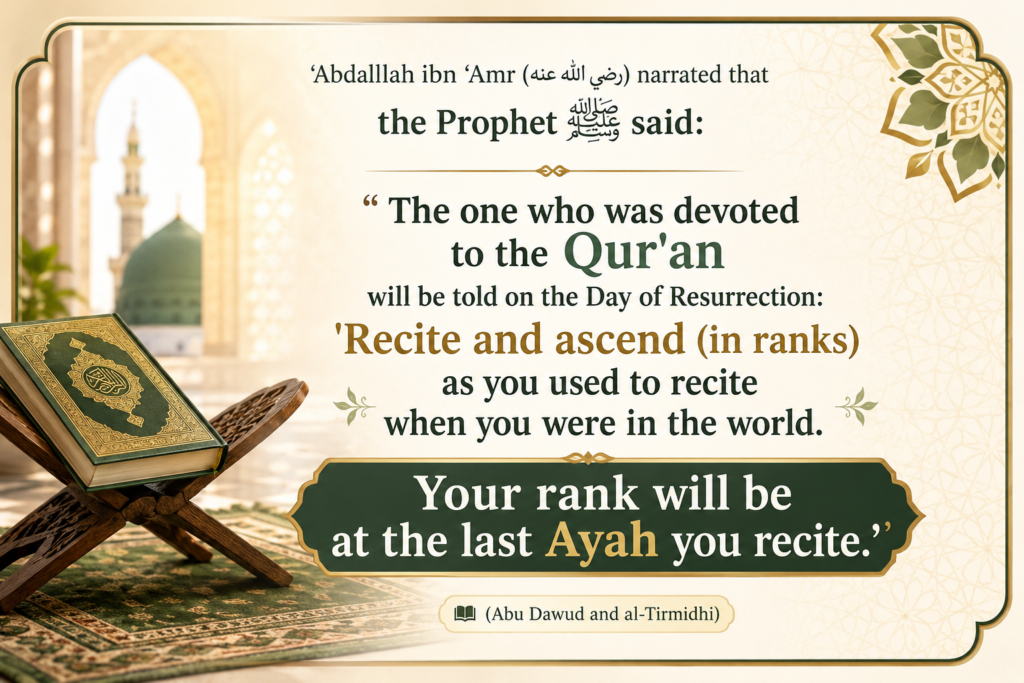
This is a Jannah with levels determined by Quran. The more a person recited, learned, and memorized in this life, the higher they rise in the next. There is no ceiling — only the limit of what they put in.
The parent who teaches their child the Quran shares in this elevation too. The Prophet ﷺ described the parents of a Quran reader being crowned with light on the Day of Judgment, with that light described as equivalent to the brightness of the sun — a reward given specifically because they raised a child who carried the Quran.
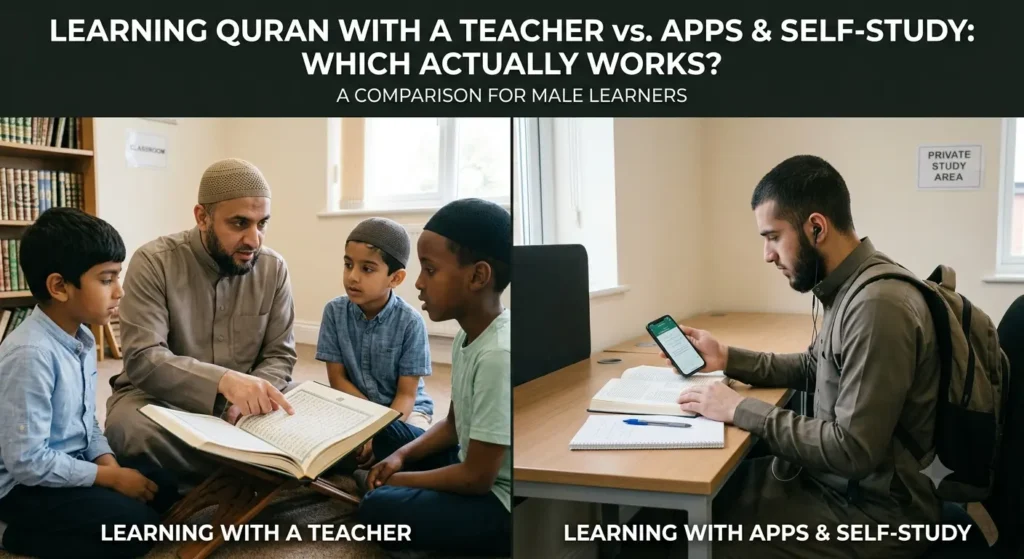
Read Also: Learning Quran with a Teacher vs Apps & Self-Study
Experience a Real Classroom
Curious about how we teach? This video offers a glimpse into a real class, showcasing our interactive approach, qualified teachers, and child-friendly learning experience.
Fun & Engaging Islamic Classes for Kids
Start your child’s journey today with interactive lessons designed to make learning Islam loved and easy.
Get Your Child a Free TrialRead also: Why Learn Quran With A Native Arab Teacher?
What “Learning the Quran” Actually Means and Why Most People Stop Too Soon?
The scope of ta’allum al-Quran — learning the Quran — is broader than recitation, and narrower than many assume.This distinction matters enormously when we consider the full importance of learning and teaching the Quran as the hadith intends.
Ibn Uthaymin identified two dimensions that must both be present for the hadith to apply fully:
1. Learning The Words
It means correct pronunciation, Tajweed, memorization — the verbal dimension that allows the Quran to be transmitted accurately from one generation to the next.
2. Learning The Meaning
It means tafsir, understanding the commands and prohibitions, reflecting on the wisdom — the intellectual and spiritual dimension that makes the Quran transformative rather than merely recited.
A common mistake among motivated learners is to stop at the first level. They memorize the words correctly and feel they have achieved their goal. But Ibn Taymiyyah was explicit: the primary purpose of teaching the letters is to arrive at the meaning. The words are the path; the understanding is the destination.
This is why a genuinely qualified Quran teacher does more than correct your makhraj. They draw your attention to what the verse says, why it appears where it does, and what it asks of you.
Female Quran teachers at Online Quran Teachers and male Quran teachers are specifically trained to engage both dimensions in every lesson.
Read also: One-On-One Vs Group Quran Classes – Which Format Actually Gets Results?
The Importance Of Learning And Teaching The Quran For Children
Ibn Khaldun wrote that teaching the Quran to children is a distinguishing marker of Islamic civilization — one that every Muslim community in every era established as foundational.
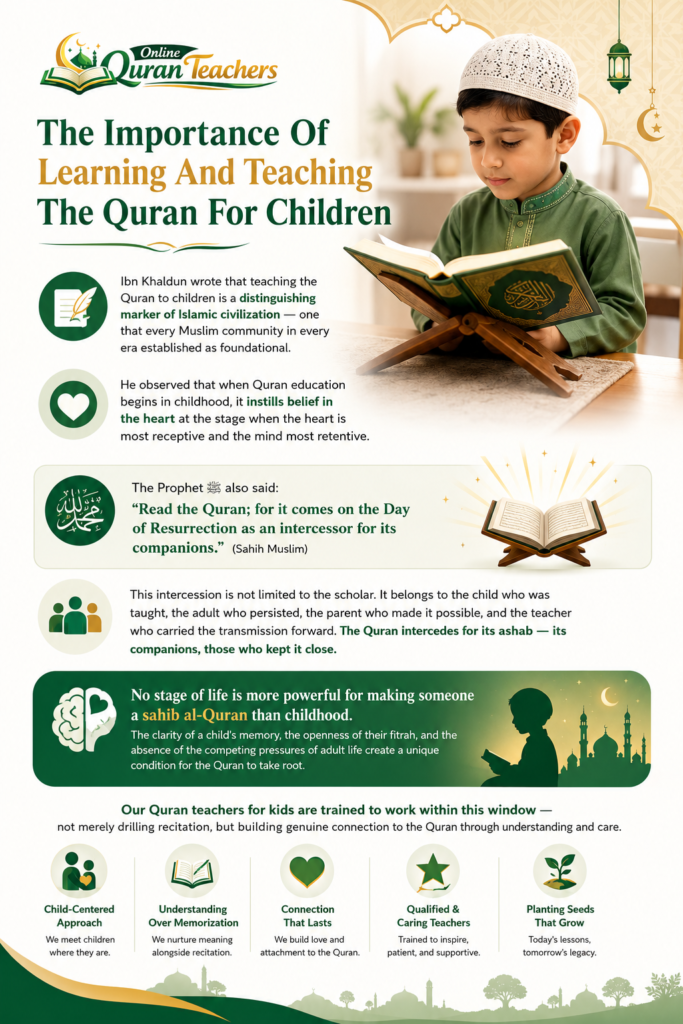
He observed that when Quran education begins in childhood, it instills belief in the heart at the stage when the heart is most receptive and the mind most retentive.
The Prophet ﷺ also said:
“Read the Quran; for it comes on the Day of Resurrection as an intercessor for its companions.” (Sahih Muslim)
This intercession is not limited to the scholar. It belongs to the child who was taught, the adult who persisted, the parent who made it possible, and the teacher who carried the transmission forward. The Quran intercedes for its ashab — its companions, those who kept it close.
No stage of life is more powerful for making someone a sahib al-Quran than childhood. The clarity of a child’s memory, the openness of their fitrah, and the absence of the competing pressures of adult life create a unique condition for the Quran to take root.
Our Quran teachers for kids are trained to work within this window — not merely drilling recitation, but building genuine connection to the Quran through understanding and care.
Fun & Engaging Islamic Classes for Kids
Start your child’s journey today with interactive lessons designed to make learning Islam loved and easy.
Get Your Child a Free TrialWatch a Sample Lesson from Our Academy
Get a firsthand look at how our students learn Islamic values, Quran, and essential knowledge through engaging and interactive online classes. See why families trust Islamic Studies for Kids Academy.
Start Learning and Teaching the Quran Today
At Online Quran Teachers, every teacher we list is vetted for both recitation qualification and teaching quality.
Whether you are looking to learn as an adult, find instruction for your children, prefer a private one-on-one class, or study via Skype or Zoom from anywhere in the world — the right teacher is here.
The hadith tells you where the best people put their time. This is that time.
Our Islamic Studies Courses for Kids:
- Quran for Kids
- Noorani Qaida for Kids
- Quran Recitation for Kids
- Tajweed for Kids
- Quran Memorization (Hifz) for Kids
- Quran for Toddlers
- Quranic Arabic for Kids
- Quran Stories for Kids
Connect with a Quran teacher whose work is an act of worship, not just instruction.
Conclusion
The hadith “the best of you are those who learn the Quran and teach it” is not praise reserved for scholars or sheikhs. It is an open invitation — extended to any Muslim willing to sit with the Quran as a learner, and then turn and offer what they’ve received to someone else.
The reward for doing so is documented across this life, in the grave, and in Jannah. The scholars who explained this hadith — al-Maz’hari, Ibn Taymiyyah, Ibn Uthaymin — all converged on the same point: this excellence comes from combining personal benefit with benefit extended to others, in the service of the highest possible speech.
Abu Abd al-Rahman al-Sulami heard the hadith once and taught for fifty years. What will you do with it?
Frequently Asked Questions
Questions about this hadith come from people at every stage — new Muslims trying to understand their obligation, parents deciding when to start their child’s Quran education, and adults wondering whether it’s too late to begin. The answers below address the most common of them, drawn directly from the scholarly tradition.
1. What does “the best of you are those who learn the Quran and teach it” mean?
It is a hadith of the Prophet Muhammad ﷺ narrated by ‘Uthman ibn ‘Affan and recorded in Sahih al-Bukhari (no. 5027). It means that the highest-ranking Muslims — in the sight of Allah — are those who both learn the Quran (its recitation, memorization, and meaning) and then teach it to others. The excellence comes from combining personal gain with benefit extended to the wider community.
2. Is this hadith authentic?
Yes. It is graded sahih by Imam al-Bukhari, who recorded it in his Sahih (no. 5027), and confirmed as authentic by Imam al-Albani in Sahih al-Tirmidhi (no. 2907). It is among the most well-established narrations on the virtues of the Quran.
3. Does “learning the Quran” mean memorization only?
No. Ibn Uthaymin and Ibn Taymiyyah both clarified that ta’allum al-Quran includes both the verbal dimension — correct recitation, Tajweed, and memorization — and the meaning dimension, which encompasses Tafsir and understanding of the Quran’s commands. Ibn Taymiyyah specifically stated that learning the meaning is the primary purpose of learning the words.
4. What is the reward for the parents of someone who learns the Quran?
The Prophet ﷺ described the parents of a Quran reader being crowned with a garment of light and a crown of light on the Day of Judgment, given specifically because they raised a child who carried and acted upon the Quran. The parent who teaches or facilitates their child’s Quran education shares directly in this reward.
5. Can I learn the Quran as an adult, and does the hadith apply to me?
Yes. The hadith addresses the entire Muslim ummah — not children, not students, not scholars specifically. Any Muslim who learns the Quran sincerely and teaches it in any form — even teaching one verse to one person — enters into the meaning of this narration. It is never too late to begin.
6. How do I find a qualified Quran teacher online?
Online Quran Teachers connect you with vetted, qualified Quran teachers for kids, women, men, and learners of all levels — with options for private one-on-one sessions and online classes via Skype or Zoom.

Leave a Reply