 Quran
Quran
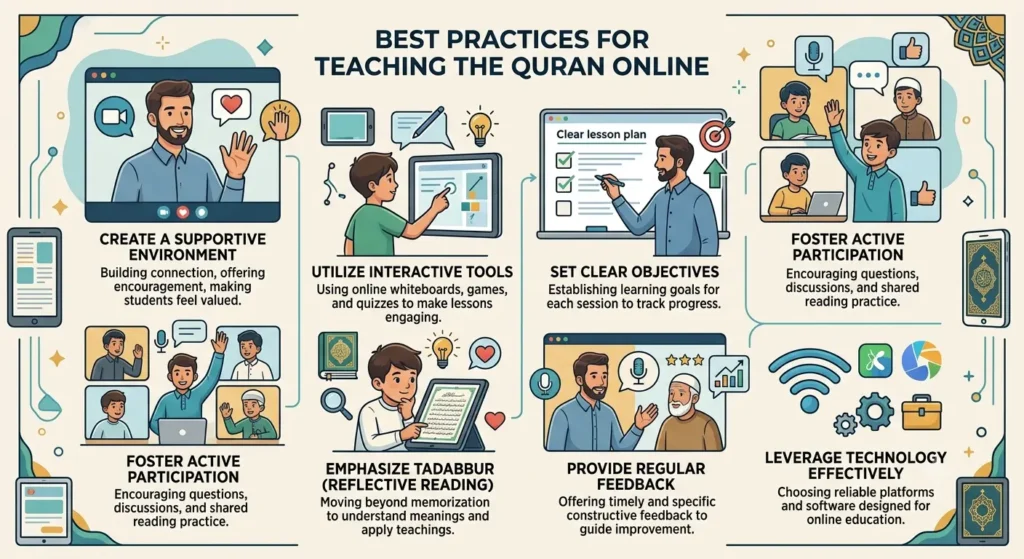
Most Quran teachers who move online make the same assumption: that the pedagogy stays the same and only the platform changes. Open Zoom, share the screen, recite, correct — how different can it be?
Very different. Teaching the Quran online to beginners, and especially to non-Arabic speakers, is a distinct discipline with its own sequencing requirements, technical demands, and teacher qualification standards.
A teacher who recites beautifully but cannot explain why a non-native student’s ق sounds like a “k” will produce a student who recites incorrectly for years — and never knows why.
This guide gives Quran teachers, online academies, and parents selecting instructors a practical, field-tested framework for best practices for teaching the Quran online — from lesson structure and phonological training to credential evaluation and session setup.
A. Match Your Teaching Approach To The Student’s Goal And Background
The single biggest predictor of whether an online Quran student makes real progress is whether the teacher’s method was designed for that specific student — not for a generic learner. Before choosing a method or curriculum, define what the student actually needs.
Each goal requires a different teaching structure. The practices that produce a strong Hifz student are not the same practices that build fluent Tajweed recitation in a beginner, and neither approach qualifies a student to receive Ijazah. Applying the wrong structure to the right student wastes both their time and yours.
1. Each Recitation With Phonological Training First
This student needs phonological training first — isolating the specific Arabic sounds that don’t exist in their native language — before any focus on rules or memorization. The teaching priority is ear training and articulation correction, not rule memorization.
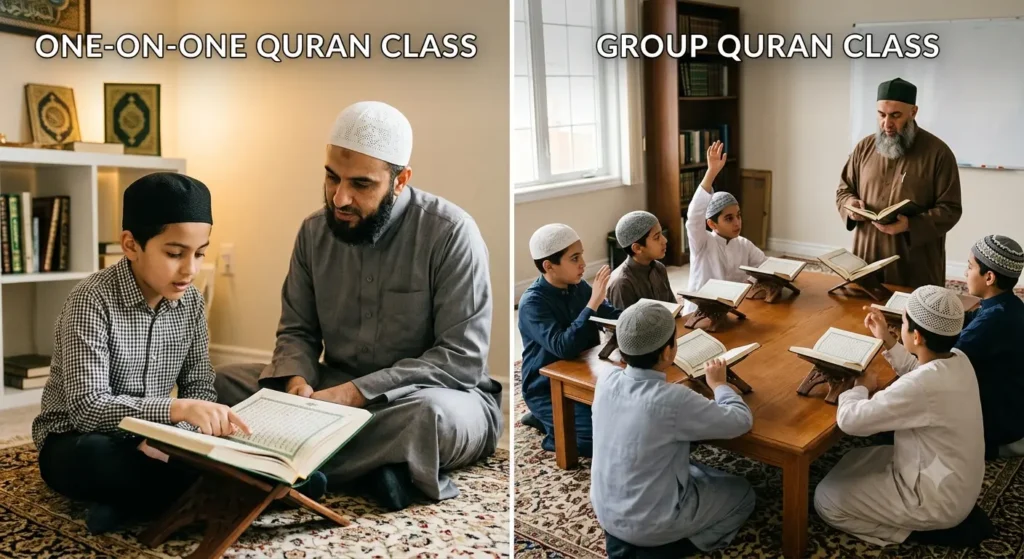
The teaching priority is ear training and articulation correction, not rule memorization. Private one-on-one Quran tutoring allows the instructor to focus entirely on this student’s specific phonological gaps without the pace pressures of a group setting.
2. Teach Hifz With Memorization Schedules And Spaced Repetition
This student needs a teacher experienced in memorization schedules, spaced repetition cycles, and retention review — combined with Tajweed correction at the sentence level. Session structures for Hifz are shorter, more repetitive, and require more frequent check-ins than general recitation classes.
3. Teach Complete Beginners Through Noorani Qaida Before Any Quranic Text
This student must start with Noorani Qaida — letter by letter, sound by sound — before any Quranic text is introduced. A teacher who skips this stage produces a student who recites memorized surahs phonetically but cannot read a single line they haven’t already heard.
4. Teach Ijazah Candidates Only With A Verified Sanad-Holding Instructor
This student needs a teacher who themselves holds a verified Ijazah with a connected Sanad (chain of transmission) back to the Prophet ﷺ. Self-issued certification or vague institutional claims are not sufficient for this goal.
Read Also: How To Become A Quran Teacher?
B. Apply the Sound-Before-Rules Sequence
Understanding how to teach Quran to non-Arabic speakers starts with one principle: the sequence that works for heritage learners will consistently fail a native English, French, or Urdu speaker.
The most consequential error in teaching Quran online to non-Arabic speakers is introducing Tajweed rule terminology before the student can hear the sounds those rules govern.
Teachers trained in Arabic-speaking contexts often follow a grammar-first approach that works for heritage learners — but fails non-native speakers consistently. The student memorizes the word “Ikhfa” without being able to produce the concealed nasal sound it describes, and stalls within the first two months.
The correct sequence: train the ear and mouth first, then name the rules. A student who has spent three sessions imitating نْ followed by فَ twenty times per session will understand Ikhfa the moment it is named. A student who memorized its definition on day two often recites it incorrectly for months.
These five Arabic letters have no equivalent in English or most European languages and require isolated drilling before appearing in Quranic words:
1. ع (Ayn) — Voiced Pharyngeal Fricative
Students commonly substitute a glottal stop or omit it entirely. No English equivalent exists.
2. ح (Ha) — Voiceless Pharyngeal Fricative
Distinct from ه (standard “h”). Most English speakers cannot hear the difference initially, let alone produce it.
3. خ (Kha) — Velar Fricative
Closest to the Scottish “loch.” Rarely encountered in any language a non-Arabic-speaking student knows.
4. ض (Dhad) — Emphatic Lateral Consonant
Unique to Arabic. Consistently mispronounced as a simple “d” or “dh” by non-native speakers.
5. ق (Qaf) — Uvular Stop
Produced further back in the throat than any English consonant. Students reliably substitute a “k” sound.
For each: isolate the sound, demonstrate via video with visible mouth positioning, have the student listen before any production attempt, then run listen-and-repeat cycles with immediate correction.
Do not introduce Quranic words containing these letters until the student produces them in isolation consistently.
Online Quran Teachers connects students with instructors who are trained specifically in phonological instruction for non-Arabic speakers. Browse teacher profiles and book a free trial session today.
C. Structure Every Beginner Lesson with a Clear Three-Stage Progression
A beginner lesson without a defined progression is a conversation, not a course. The following three-stage structure applies to online Quran classes via Skype and Zoom for non-Arabic speakers from session one through to independent surah recitation.
How to teach Quran to beginners online follows a non-negotiable three-stage progression — from letter recognition to short surah recitation — that cannot be shortcut without embedding errors.
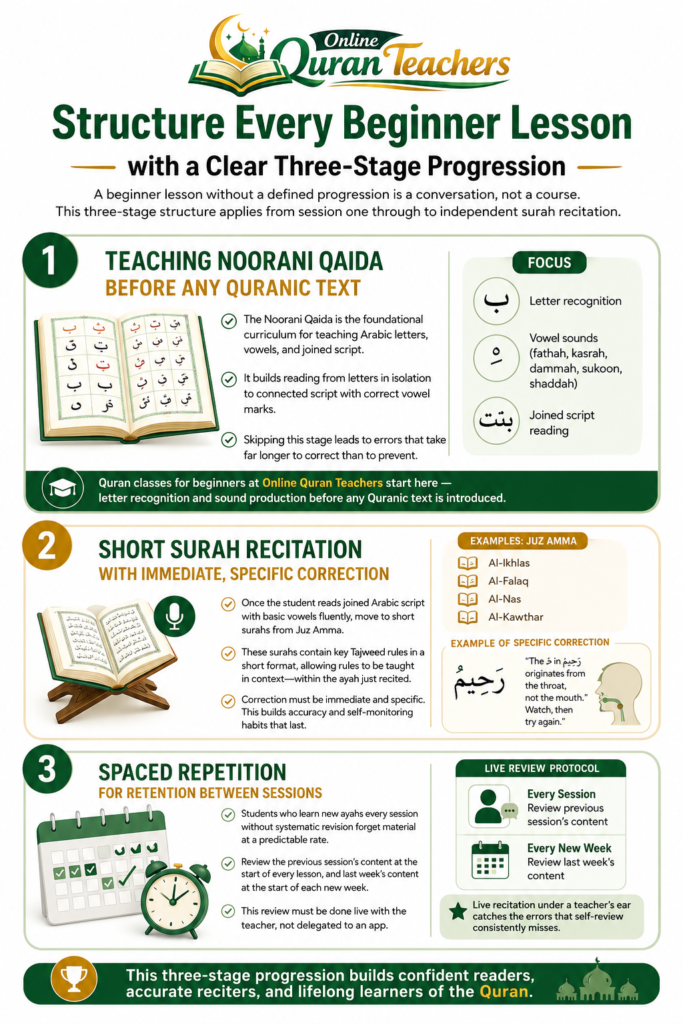
1. Teaching Noorani Qaida Before Any Quranic Text
The Noorani Qaida is the established foundational curriculum for teaching Arabic letters, vowels, and joined script to non-native learners.
It introduces individual letters in isolation, then with vowel marks (fathah, kasrah, dammah, sukoon, shaddah), then in connected form — replicating the phonics logic that effective reading programs use in any language.
Attempting Quranic recitation before completing Noorani Qaida produces a student who can recite memorized surahs phonetically but cannot read a single unfamiliar line. For non-Arabic speakers specifically, this stage is not optional. Skipping it produces errors that take significantly longer to correct than to prevent. Quran classes for beginners at Online Quran Teachers start exactly here — letter recognition and sound production before any Quranic text is introduced.
2. Short surah recitation with immediate, specific correction
Once the student reads joined Arabic script with basic vowels fluently, move to short surahs from Juz Amma: Al-Ikhlas, Al-Falaq, Al-Nas, Al-Kawthar.
These surahs contain a high concentration of the most common Tajweed rules in a short format — allowing the teacher to introduce rules contextually, in the ayah the student just recited, rather than abstractly in a terminology lesson.
Correction at this stage must be immediate and specific. Not “that was slightly off” — but “the ح in رَحِيمٍ originates from the throat, not the mouth. Watch, then try again.” Precision in correction at Stage 2 builds the self-monitoring habits students carry into independent practice.
3. Spaced repetition for retention between sessions
Students who learn new ayahs every session without systematic revision forget material at a predictable rate.
A simple spaced-repetition protocol — review the previous session’s content at the start of every lesson, and last week’s content at the start of each new week — prevents forgetting from compounding into discouragement.
This review must be conducted by the teacher in a live session, not delegated to an app. Live recitation under a teacher’s ear catches the errors that self-review consistently misses.
Experience an Online Quran Lesson
Take a look inside a live online Quran session and discover how students learn with personalized instruction, step-by-step guidance, and a supportive learning atmosphere.
Learn Quran Online with Expert Teachers
Start your personalized journey with qualified tutors today. Flexible schedules tailored to your routine.
Book Your Free TrialD. Verify the Teacher’s Credentials Using This Practical Checklist
“Certified Quran teacher” is not a standardized credential. It can mean a formal Ijazah with a documented Sanad — or a weekend course completion certificate. Before assigning any instructor to a student, apply this four-point evaluation framework:
1. Getting An Ijazah With A Connected Sanad
The instructor should hold an Ijazah in Hafs ‘an Asim (the most widely recited transmission) that traces through an unbroken chain of named scholars back to the Prophet ﷺ. This credential cannot be self-issued and should be verifiable by asking the teacher to name their certifying scholar.
2. Graduation From A Recognized Islamic Institution
Al-Azhar University is the globally recognized benchmark for Quranic and Islamic sciences. Graduates have studied Tajweed, Makharij, Qira’at, and Quranic sciences in a structured academic setting — not through a short online course or independent study. Ask for the institution name and the faculty or department of study.
3. Demonstrated Teaching Experience With Non-Arabic Speakers Specifically
Recitation mastery does not equal teaching ability for non-native students. A teacher who has spent their career with Arabic-speaking students may not know how to explain Qalqalah or Ghunnah to someone whose mother tongue is English. Ask directly: how many non-Arabic-speaking students have you taught, and for how long?
4. Target-Language Fluency Sufficient For Tajweed Explanation
If the student does not read Arabic, the teacher must explain Makharij, Ghunnah, and Madd in the student’s language — clearly, accurately, and without resorting to re-demonstration as a substitute for explanation. A teacher who cannot do this in English will lose non-Arabic-speaking students at precisely the moments they most need clarity.
One practical test: ask the teacher to explain a Tajweed rule — such as Idgham or Ikhfa — as if speaking to a complete beginner who has never seen Arabic. Their answer reveals both their linguistic ability and their pedagogical thinking.
For sisters who prefer to learn in a same-gender environment, female Tajweed teachers bring the same verified credentials with scheduling designed around women’s daily commitments.
E. Set Up the Online Session Environment for Recitation Accuracy
The technical environment of an online Quran session is not a secondary concern. Recitation is an auditory discipline, and instruction lives or falls on what the teacher can actually hear.
1. Require a headset for every session
A teacher who cannot clearly hear a student mispronounce ق as a soft “k” cannot correct it. Laptop microphones and built-in speakers compress audio quality and introduce delay.
Before any learning begins, confirm the student has a functioning headset with a microphone positioned close to the mouth.
2. Use screen sharing for visual tracking during recitation
Share the Mushaf page or Qaida page during every session so the teacher and student are looking at the same text simultaneously. This eliminates the common issue of a student reciting from memory while the teacher cannot identify which word produced a particular error.
Color-coded Tajweed Mushafs — where rules like Madd, Ghunnah, and Qalqalah are printed in distinct colors — give non-Arabic speakers a visual layer that accelerates rule recognition
A student who sees every Madd letter highlighted consistently begins associating the visual cue with the elongation sound without needing to be told each time.
3. Use supplementary tools as practice aids only
Apps like Tarteel provide useful between-session practice. They do not replace a qualified teacher.
AI recitation tools currently miss nuanced Makharij errors — particularly the pharyngeal sounds (ع، ح) that non-Arabic speakers struggle with most — and cannot adapt their correction approach to a specific student’s phonological background.
Use them between sessions to reinforce what was taught in a structured Tajweed course, not to deliver instruction.
F. Develop the Personal Qualities That Determine Long-Term Student Retention
Technical qualifications establish a competent teacher. The right personal qualities determine whether the student keeps showing up week after week.
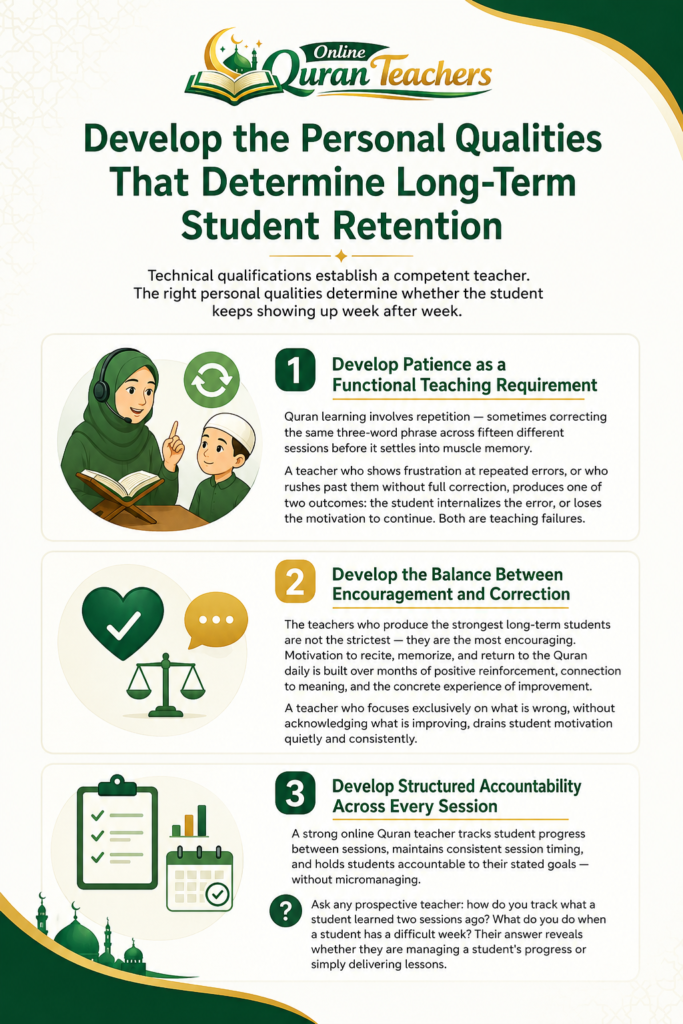
1. Develop Patience as a Functional Teaching Requirement
Quran learning involves repetition — sometimes correcting the same three-word phrase across fifteen different sessions before it settles into muscle memory.
A teacher who shows frustration at repeated errors, or who rushes past them without full correction, produces one of two outcomes: the student internalizes the error, or loses the motivation to continue. Both are teaching failures.
2. Develop the Balance Between Encouragement and Correction
The teachers who produce the strongest long-term students are not the strictest — they are the most encouraging. Motivation to recite, memorize, and return to the Quran daily is built over months of positive reinforcement, connection to meaning, and the concrete experience of improvement.
A teacher who focuses exclusively on what is wrong, without acknowledging what is improving, drains student motivation quietly and consistently.
3. Develop Structured Accountability Across Every Session
A strong online Quran teacher tracks student progress between sessions, maintains consistent session timing, and holds students accountable to their stated goals — without micromanaging.
Ask any prospective teacher: how do you track what a student learned two sessions ago? What do you do when a student has a difficult week? Their answer reveals whether they are managing a student’s progress or simply delivering lessons.
Watch a Real Online Quran Class
See how our online Quran lessons are conducted with this short class sample. Experience our interactive teaching approach, clear pronunciation guidance, and engaging learning environment before starting your own Quran learning journey.
Learn Quran Online with Expert Teachers
Start your personalized journey with qualified tutors today. Flexible schedules tailored to your routine.
Book Your Free TrialStart Learning with a Verified Quran Teacher Today
You now have a complete framework for what effective online Quran teaching looks like. The harder part — finding a teacher who actually meets these standards — is where most students lose time.
Our Online Quran Teacher & Course Options
- Quran Teachers for Kids & Quran Course for Kids
- Female Quran Teachers & Quran Classes for Ladies
- Male Quran Teachers & Quran Classes for Men
- Quran Teachers for Beginners & Quran Course for Beginners
- Quran Teachers for Adults & Quran Classes for Adults
- Native Arab Quran Teachers
- Egyptian Quran Teachers & Al-Azhar Course
- Private One-on-One Quran Tutors & Private Classes
- Quran Teachers on Skype & Zoom & Online Classes
Enroll today and start learning the Quran with a dedicated teacher who matches your goals, schedule, and learning style.

The Online Quran Teachers directory does that work for you. Every instructor has been evaluated on both recitation credentials and demonstrated teaching ability with English-speaking students — so you are not choosing blindly from a list of names.
Browse teacher profiles, read verified student reviews, and book a free trial session with no commitment. One session is enough to know whether the fit is right.
Browse verified Quran teachers and book your free trial.
Conclusion
The best practices for teaching the Quran online come down to a clear framework: identify the student’s goal and background first, apply the Sound-Before-Rules sequence rather than rule-first instruction, build lessons around the three-stage Noorani Qaida–to–surah progression, verify teacher credentials against four concrete criteria, and engineer the technical session environment to catch every recitation error.
A teacher who meets these standards is not just someone who can recite the Quran well. They are someone who can help a non-Arabic-speaking student — a beginner, a revert, or an adult who has tried and stopped — finally recite it the way it deserves to be recited.
Frequently Asked Questions
These are the questions Quran teachers and parents ask most before structuring an online Quran program — answered directly so you can apply them without guesswork.
1. What is the most important best practice for teaching the Quran online to non-Arabic speakers?
Apply the Sound-Before-Rules sequence: train the student’s ear and mouth to produce Arabic sounds accurately before introducing rule names and terminology. Introducing Tajweed rules before the student can hear the sounds those rules govern consistently stalls progress within the first two months of study.
2. Do I need a different teaching approach for beginners versus intermediate students?
Yes. Beginners who cannot read Arabic script must start with Noorani Qaida — letter by letter — before any Quranic text is introduced. Intermediate students who can read but have pronunciation errors need targeted phonological drilling and rule-application work, not a repeat of foundational reading instruction.
3. How can I tell if an online Quran teacher is genuinely qualified?
Ask for the name of the scholar who issued their Ijazah and the institution where they studied. Al-Azhar University graduates with a documented Sanad are the verifiable benchmark. Also assess teaching ability for your background specifically — a strong reciter is not automatically a strong teacher for non-Arabic speakers.
4. Which Arabic sounds cause the most difficulty for non-Arabic-speaking Quran students?
The five most consistently difficult sounds are ع (Ayn), ح (Ha), خ (Kha), ض (Dhad), and ق (Qaf). None of these exist in English or most European languages. Each requires isolated phonological drilling — listening and imitation in isolation — before being introduced in Quranic words.
5. What technical setup does an effective online Quran session require?
The student must use a headset with a microphone positioned close to the mouth — not laptop speakers. The teacher should screen-share the Mushaf or Qaida page during recitation so both parties are reading from the same text simultaneously. These two requirements are the difference between catching errors and missing them.
6. How many sessions per week should a non-Arabic-speaking Quran student attend online?
Two to three structured sessions per week, combined with 15–20 minutes of independent daily practice, produces consistent measurable progress for most adult learners. Students pursuing Hifz benefit from four to five sessions per week. Consistency across the week matters more than session length.






Leave a Reply