 Quran
Have you ever recited Surah Al-Fatiha and wondered if every letter was pronounced as revealed? Quran recitation with Tajweed is the discipline that ensures accuracy, protects verse meanings, and connects your reading to the Prophet ﷺ.
Tajweed is not about voice beauty; it is about precision: correct articulation points, proper letter qualities, and interaction rules. This guide explains what Quran recitation with Tajweed means, giving every letter its full right (Makhraj and Sifat) to perfect your reading and prevent errors (lahn).
You will discover its scholarly ruling, essential rules, common mistakes, and the most reliable steps to master it effectively.
Clear Errors Versus Hidden Errors When Learning Quran Recitation With Tajweed
Scholars divide recitation mistakes into two types. A clear error (lahn jali) changes a letter or a vowel, and can change the meaning of the word. A hidden error (lahn khafi) keeps the meaning intact but breaks the rules of proper delivery.
A well-known example of a clear error: reciting an’amta (You blessed) in Al-Fatiha as an’amtu (I blessed) changes who is giving the blessing. Swapping ق for ك turns qalb (heart) into kalb (dog). Hidden errors include shortening a nasal sound (ghunnah) or cutting a prolongation (madd) short.
What The Quran Says About Tarteel
Allah commands:
وَرَتِّلِ الْقُرْآنَ تَرْتِيلًا
“and recite the Quran with measured recitation”
(Surah Al-Muzzammil -4). Classical scholars explained Tarteel as reciting calmly and deliberately, with each letter articulated correctly, which is the practical substance of Tajweed.
Read also: Easily Get Your Quran Qira’aat Ijazah – 4 Proven Levels And 4 Core Requirements
What Is The Islamic Ruling On Tajweed?
The ruling on Tajweed has two levels, and understanding the difference removes a lot of anxiety for new learners.
1. The Obligatory Level – Correct Pronunciation
Reciting without clear errors that change letters, vowels, or meaning is obligatory (wajib shar’i) on every Muslim who recites the Quran. This is the minimum standard, and it applies whether you recite aloud or silently.
Imam Ibn al-Jazari, author of the classical Tajweed poem Al-Muqaddimah al-Jazariyyah, wrote that applying Tajweed is a binding requirement and that whoever does not recite with Tajweed is sinful. Scholars generally apply this warning most strongly to clear errors.
2. The Technical Level – Detailed Rules
The detailed rules, such as Idgham, Ikhfa’, and exact Madd lengths, are considered by the majority of scholars to be a technical requirement of the discipline (wajib sina’i) and strongly recommended for every reciter. Perfecting them is how you recite the Quran as it was revealed.
The practical takeaway: fix meaning-changing errors first, then refine the technical rules. Struggling while learning is not a sin. The Prophet ﷺ said: “The one who is proficient with the Quran is with the noble, righteous scribes, and the one who stumbles through it with difficulty receives a double reward” (Sahih Muslim, 798).
Watch our Real Online Quran Class
See how our online Quran lessons are conducted with this short class sample. Experience our interactive teaching approach, clear pronunciation guidance, and engaging learning environment before starting your own Quran learning journey.
Learn Quran Online with Expert Teachers
Start your personalized journey with qualified tutors today. Flexible schedules tailored to your routine.
Book Your Free TrialThe Core Rules Of Quran Recitation With Tajweed
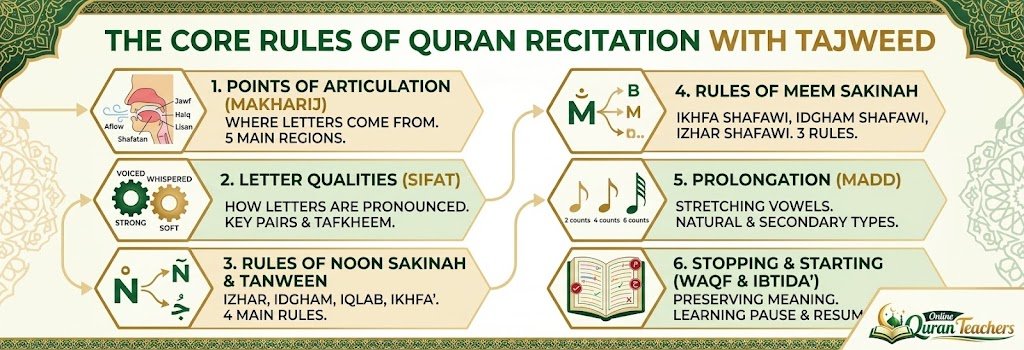
Tajweed rules fall into five main areas. Each one builds on the previous, so learning them in this order saves time.
1. Points Of Articulation (Makharij)
Makharij are the exact places each Arabic letter comes from. There are five main regions: the oral and throat cavity (al-jawf), the throat (al-halq), the tongue (al-lisan), the lips (ash-shafatan), and the nasal passage (al-khayshum).
For English speakers, the hardest letters are throat letters (ع ح غ خ) and letters with no English equivalent such as ض and ظ. A useful self-test: pronounce the letter with a sukoon after a hamza, like a’, aḥ, aḍ, and listen to where the sound stops.
2. Letter Qualities (Sifat)
Sifat describe how a letter is pronounced once it leaves its Makhraj. Key pairs include voiced versus whispered (jahr / hams), strong versus soft (shiddah / rakhawah), and elevated versus lowered (isti’la / istifal).
The seven elevated letters, gathered in the phrase خُصَّ ضَغْطٍ قِظْ, are always pronounced heavy (tafkheem). Another vital quality is qalqalah, a slight echo on the letters قُطْبُ جَدٍ (ق ط ب ج د) when they carry a sukoon.
3. Rules Of Noon Sakinah And Tanween
When a silent Noon or Tanween meets another letter, one of four rules applies:
| Rule | Letters | What happens |
| Izhar (clear) | ء ه ع ح غ خ | Noon pronounced clearly |
| Idgham (merging) | ي ر م ل و ن | Noon merges into the next letter |
| Iqlab (conversion) | ب | Noon becomes a hidden Meem |
| Ikhfa’ (concealment) | Remaining 15 letters | Noon is hidden with ghunnah |
A practical note: the ghunnah in Idgham and Ikhfa’ is held for about two counts. Cutting it short is one of the most common hidden errors teachers correct.
4. Rules Of Meem Sakinah
A silent Meem follows three rules. Before ب, it is hidden with ghunnah (Ikhfa’ Shafawi). Before another م, it merges (Idgham Shafawi). Before all other letters, it is pronounced clearly (Izhar Shafawi), with extra care before و and ف.
5. Prolongation (Madd)
Madd means stretching a vowel sound. The natural Madd (Madd Tabee’i) lasts two counts. Secondary types are longer: in the widely read narration of Hafs from ‘Asim, the connected Madd (Muttasil) is four to five counts, and the obligatory Madd (Lazim) is six.
The Madd caused by stopping (‘Arid lis-Sukoon) may be two, four, or six counts. The rule is consistency: choose one length and keep it throughout your recitation.
6. Stopping And Starting (Waqf And Ibtida’)
Waqf rules tell you where to pause and where to resume so the meaning stays intact. The Mushaf marks these: م means a stop is required, لا means do not stop, ج means stopping is permissible, and ∴ means stop at one of two marked spots, not both.
Stopping in the wrong place can distort meaning even when every letter is correct. That is why trained reciters treat Waqf as part of Tajweed, not an extra.[image: color-coded Tajweed Mushaf page with stop signs highlighted]
Mastering these five areas requires more than reading about them, because the ear must learn to hear the difference. At Online Quran Teachers Academy, every session includes live correction of Makhraj, Sifat, and Tajweed errors, so no mistake carries over to the next lesson.
Read also: Easily Earn Al-Jazariyyah Poem Ijazah – 6 Simple Proven Steps
Common Tajweed Mistakes And The Order To Fix Them
Most learners don’t fail because the rules are hard. They fail because they fix errors in the wrong order, polishing ghunnah while still mispronouncing letters.
These are the errors teachers hear most often from non-Arab students:
- Turning ع into a plain hamza or vowel sound
- Pronouncing ح as ه, or ق as ك
- Stretching short vowels into Madd, or cutting real Madds short
- Pronouncing heavy letters lightly (and vice versa)
- Skipping qalqalah on ق ط ب ج د with sukoon
Another quiet mistake: relying on a color-coded Mushaf as a substitute for a trained ear. Colors show which rule applies, but not how it should sound.
The Meaning-First Correction Order
A practical sequence for any learner is to fix errors by the damage they cause:
- Letters (Makharij): errors here change words.
- Vowels (Harakat): errors here change grammar and meaning.
- Noon and Meem rules: the most frequent rules on every page.
- Madd lengths: consistency across the recitation.
- Waqf: stopping in places that preserve the meaning.
This order moves you from obligatory accuracy to technical excellence, matching the two levels of the ruling.
Experience our Online Quran Lesson
Take a look inside a live online Quran session and discover how students learn with personalized instruction, step-by-step guidance, and a supportive learning atmosphere.
Learn Quran Online with Expert Teachers
Start your personalized journey with qualified tutors today. Flexible schedules tailored to your routine.
Book Your Free TrialHow To Learn Quran Recitation With Tajweed
There are several ways to learn Tajweed, but they are not equal. The right mix depends on your current level and how much correction you need.
1. Learn Directly From A Qualified Teacher
Receiving the Quran orally from a qualified teacher (talaqqi) is the original and most reliable method. The Quran was transmitted mouth to ear, and many errors are only noticed when someone trained listens to you.
When choosing a teacher, check three things: a verified Ijazah with a chain of transmission (sanad), whether they correct you live rather than at the end, and whether they can explain rules in a language you understand. Online Quran Teachers Academy assigns teachers who hold Al-Azhar certification and an Ijazah, explain every rule in clear English, and stay with the student from the first session to the last.
2. Listen To Master Reciters And Imitate Them
Regular listening trains your ear. Sheikh Mahmoud Khalil Al-Husary’s slow Murattal recitation is a favorite teaching reference because each rule is clearly audible. Sheikh Muhammad Siddiq Al-Minshawi and Sheikh Abdul Basit Abdul Samad are also widely used models.
A simple practitioner habit: record yourself reciting one page, then compare it line by line with Al-Husary. The gaps you hear become your next lesson.
3. Use Supporting Tools Wisely
A color-coded Tajweed Mushaf and dedicated Tajweed apps help you spot rules on the page. Use them to reinforce what your teacher corrects, not to replace correction.
4. Review Consistently
Tajweed fades without practice. A short daily recitation, even one page, keeps rules active. Allah says:
وَلَقَدْ يَسَّرْنَا الْقُرْآنَ لِلذِّكْرِ فَهَلْ مِن مُّدَّكِرٍ
“And We have certainly made the Quran easy to remember, so is there anyone who will be mindful?”
Not sure where to begin? The free trial at Online Quran Teachers Academy is a live recitation assessment: your teacher listens, identifies your Makhraj and Tajweed errors, and places you at the right starting level before you enroll.
Read also: Study Quran Online & Get Recitation Ijazah – 6 Easy Steps To Excellence
Book Your Free Tajweed Assessment And Recite With Confidence
You don’t need to guess which rules you’re getting wrong. A certified, Ijazah-holding teacher will hear your recitation, pinpoint your errors, and build a clear path from correct letters to complete Tajweed.
Learn from home in private one-on-one sessions, on a schedule that fits your week. Female teachers are available for sisters and girls, and you receive a written progress report after every completed level.
Our Online Quran Teacher & Course Options
- Quran Teachers for Kids & Quran Course for Kids
- Female Quran Teachers & Quran Classes for Ladies
- Male Quran Teachers & Quran Classes for Men
- Quran Teachers for Beginners & Quran Course for Beginners
- Quran Teachers for Adults & Quran Classes for Adults
- Native Arab Quran Teachers
- Egyptian Quran Teachers & Al-Azhar Course
- Private One-on-One Quran Tutors & Private Classes
- Quran Teachers on Skype & Zoom & Online Classes
Enroll today and start learning the Quran with a dedicated teacher who matches your goals, schedules, and learning style.
Learn Quran Online with Expert Teachers
Start your personalized journey with qualified tutors today. Flexible schedules tailored to your routine.
Book Your Free TrialConclusion
Quran recitation with Tajweed means giving every letter its correct articulation and qualities, so the Quran is recited as it was revealed. Avoiding meaning-changing errors is obligatory, while perfecting the detailed rules is the path to excellence.
The core areas are Makharij, Sifat, Noon and Meem Sakinah rules, Madd, and Waqf. Fix errors in order of their impact, listen to master reciters, and above all, learn with a qualified teacher who corrects you live. The Prophet ﷺ said, خيركم من تعلم القرآن وعلمه”
“The best of you are those who learn the Quran and teach it” (Sahih Al-Bukhari).
Frequently Asked Questions
Is Quran Recitation With Tajweed Obligatory?
Yes, at the basic level. Reciting without errors that change letters or meaning is obligatory for every Muslim, while mastering detailed technical rules is strongly recommended by the majority of scholars.
Can I Read The Quran Without Knowing Tajweed?
Yes, you can and should keep reading while you learn. A learner who struggles receives a double reward, but you should work steadily toward correcting your pronunciation.
What Is The First Tajweed Rule To Learn?
Start with the points of articulation (Makharij). Correct letter pronunciation prevents the clear errors that change meaning, and every other Tajweed rule depends on it.
Can I Learn Tajweed Online?
Yes. Live one-on-one online classes with an Ijazah-holding teacher allow real-time correction, which is the essential element of learning Tajweed, from anywhere in the world.
Is Tajweed The Same As Having A Beautiful Voice?
No. Tajweed is about accurate pronunciation and applying rules correctly. A beautiful voice enhances recitation, but Tajweed is what makes it correct.







[…] Read also: Quran Recitation with Tajweed […]
[…] Read also: Quran Recitation with Tajweed […]
[…] Read also: Quran Recitation with Tajweed […]
[…] Read also: Quran Recitation With Tajweed – 5 Critical Steps To Avoid Mistakes […]
[…] Read also: Quran Recitation with Tajweed […]
[…] Read also: Quran Recitation With Tajweed – 5 Critical Steps To Avoid Mistakes […]