 Quran
Quran
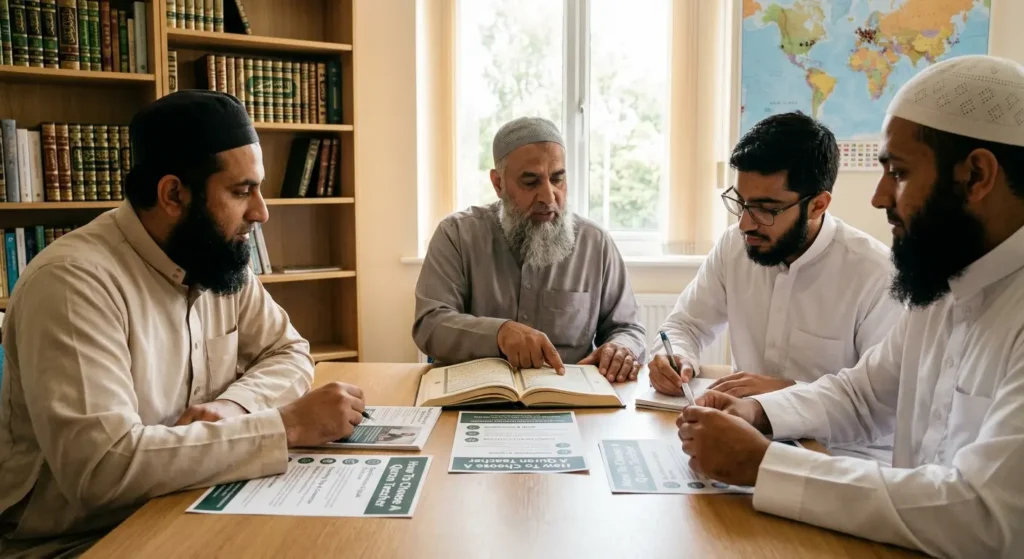
Most people searching for a Quran teacher focus on one thing: can this person recite well? That’s necessary — but it’s not enough. A teacher who recites beautifully may still be unable to explain why your pronunciation is wrong, adapt their pace to your learning speed, or build your connection to the Quran over months of study.
Choosing the right Quran teacher is a decision that shapes your entire learning experience. Get it right, and the Quran becomes accessible, meaningful, and something you return to every day. Get it wrong, and progress stalls, errors get embedded, and motivation fades.
This guide gives you a clear, practical framework for making that decision well — whether you’re looking for an in-person teacher or an online Quran tutor.
A. Ensure That Your Teacher Matches The Four Main Quran Learning Goals
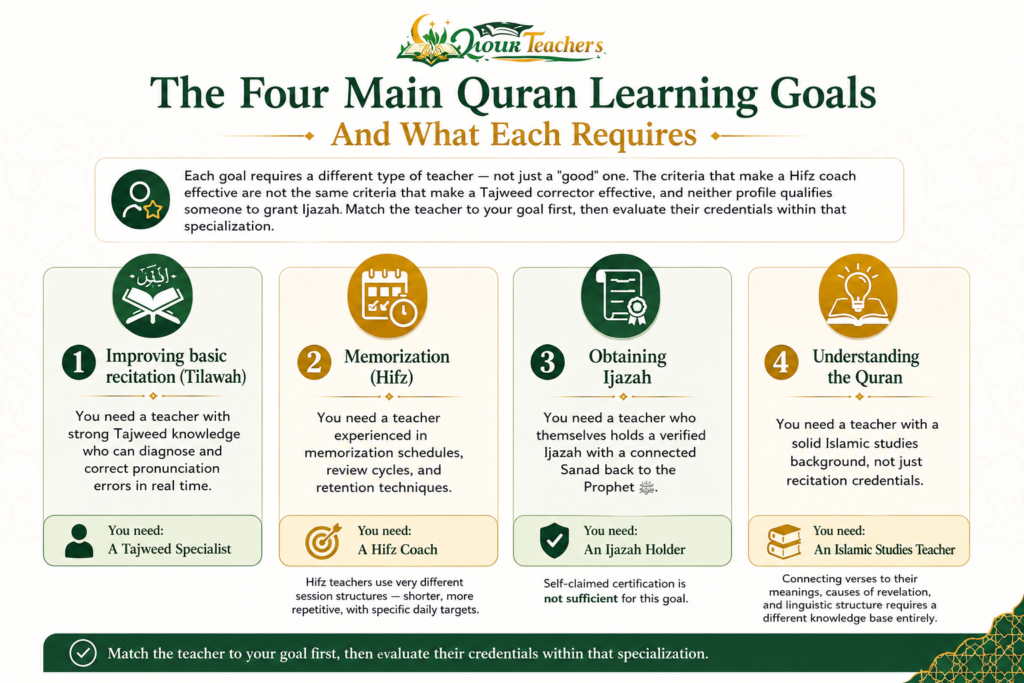
Each goal requires a different type of teacher — not just a “good” one. The criteria that make a Hifz coach effective are not the same criteria that make a Tajweed corrector effective, and neither profile qualifies someone to grant Ijazah. Match the teacher to your goal first, then evaluate their credentials within that specialization.
1. Improving basic recitation (Tilawah)
You need a teacher with strong Tajweed knowledge who can diagnose and correct pronunciation errors in real time.
Parents looking for a teacher for their child will find dedicated Quran teachers for kids who specialize in age-appropriate instruction and engagement methods.
2. Experienced In Memorization (Hifz)
You need a teacher experienced in memorization schedules, review cycles, and retention techniques. Hifz teachers use very different session structures — shorter, more repetitive, with specific daily targets.
3. The Teacher Holds An Ijazah
You need a teacher who themselves holds a verified Ijazah with a connected Sanad back to the Prophet ﷺ. Self-claimed certification is not sufficient for this goal.
4. Understanding the Quran
You need a teacher with a solid Islamic studies background, not just recitation credentials. Connecting verses to their meanings, causes of revelation, and linguistic structure requires a different knowledge base entirely.
B. Look At His Quranic Recitation Qualification
To ensure you are choosing a qualified teacher, look for one or more of the following verified qualifications — not just self-reported claims:
1. Ijazah With A Connected Sanad
This is the highest standard in Quranic recitation credentialing. It means the teacher’s recitation has been personally certified by a scholar whose chain connects, generation by generation, to the Prophet ﷺ — in a recognized recitation style such as Hafs ‘an Asim.
2. Graduation From A Recognized Islamic Institution
Al-Azhar University is the globally recognized benchmark. Graduates have studied Tajweed, Makharij, and Quranic sciences in a structured academic setting — not through a short online course or self-study.
3. Documented Certification From A Reputable Islamic Organization
The certifying body must be verifiable. Ask for the name of the scholar or institution that issued the certificate before accepting it as valid.
One practical test: ask the teacher to recite a short passage and follow along with a Mushaf. Errors in Makharij (letter articulation points) or Tajweed rules are audible even to a careful beginner.
Watch a Real Online Quran Class
See how our online Quran lessons are conducted with this short class sample. Experience our interactive teaching approach, clear pronunciation guidance, and engaging learning environment before starting your own Quran learning journey.
Learn Quran Online with Expert Teachers
Start your personalized journey with qualified tutors today. Flexible schedules tailored to your routine.
Book Your Free TrialC. Ensure The Teacher Has The Best Teaching Ability
This is where most students under-evaluate. Ask yourself and the teacher:
- Can they explain why a rule applies, not just that it does?
- Do they correct errors in a way you can understand and replicate or do they simply re-demonstrate the correct sound?
- Have they taught students at your level and background before?
- Can they adapt their pace if you’re slower to grasp a concept in one session?
For non-Arabic speakers especially, this second credential is often what determines whether real progress happens.
A certified scholar who has spent their entire teaching career with native Arabic speakers may not know how to explain Qalqalah or Ghunnah to someone whose mother tongue is English. That gap is real, and it matters.
At Online Quran Teachers, every instructor in the Quran teachers directory is evaluated on both dimensions — recitation qualification and demonstrated teaching ability with English-speaking students.
D. The Teacher enjoys Personal Qualities That Make a Quran Teacher Truly Effective
Technical qualifications get you a competent teacher. The right personality gets you a teacher you’ll actually learn from, week after week.
1. Patience As A Non-Negotiable
Quran learning involves repetition — sometimes repeating the same three-word phrase in fifteen different sessions before it settles into muscle memory.
A teacher who shows frustration at repeated errors, or who rushes past them without full correction, will cause one of two problems: you’ll internalize the error, or you’ll lose the motivation to keep trying. Patience isn’t a soft quality. It’s a functional requirement.
2. Balancing encouragement and strictness
The teachers who produce the strongest long-term students are not the strictest — they’re the most encouraging.
Motivation to recite, memorize, and return to the Quran daily is built over months of positive reinforcement, connection to meaning, and the experience of gradual improvement.
A teacher who focuses primarily on what’s wrong, without celebrating what’s improving, drains that motivation quietly.
3. Adherence to deadlines
A good Quran teacher shows up on time, maintains structured sessions, tracks your progress between sessions, and holds you accountable to the goals you’ve set — without micromanaging.
Ask prospective teachers how they track student progress and what they do if a student has a difficult week.
E. Put Clear Criteria For Choosing An Online Quran Tutor
Choosing an online Quran tutor requires everything above — plus a few additional checks specific to the online environment.
1. Verify Their Online Teaching Experience Specifically
A qualified in-person teacher doesn’t automatically translate to an effective online teacher. Online instruction requires a different skill set: managing audio quality issues, positioning the camera to demonstrate mouth and tongue placement, using screen-sharing tools for text work, and keeping students engaged without physical presence cues.
Ask directly: how long have you been teaching Quran online? What platform do you use, and why?
2. Check Audio and Video Setup Quality
Tajweed instruction depends on hearing subtle distinctions between sounds — the difference between a correctly articulated ض and an approximate one is not always visible on a low-quality video call. Before committing, run a trial session and pay attention to audio clarity. A teacher with impeccable credentials and a poor microphone will cost you in accuracy.
3. Read Reviews From Students With Similar Backgrounds
Reviews from other English-speaking students, or students at your level, are far more informative than generic testimonials.
Look for specific feedback about how errors were corrected, how patient the teacher was with beginners, and whether sessions felt structured or improvised.
Sisters who prefer learning in a female-only environment can browse female Quran teachers with verified credentials and flexible scheduling designed around women’s daily commitments.
F. Questions To Ask A Quran Teacher Before Committing
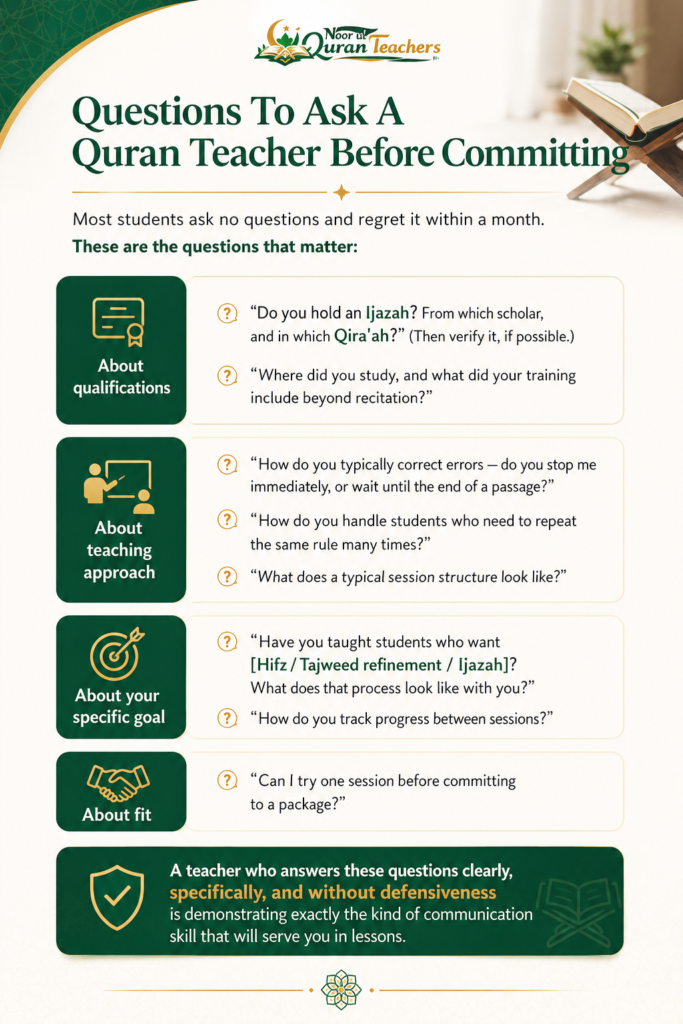
Most students ask no questions and regret it within a month. These are the questions that matter:
About qualifications:
- “Do you hold an Ijazah? From which scholar, and in which Qira’ah?” (Then verify it, if possible.)
- “Where did you study, and what did your training include beyond recitation?”
About teaching approach:
- “How do you typically correct errors — do you stop me immediately, or wait until the end of a passage?”
- “How do you handle students who need to repeat the same rule many times?”
- “What does a typical session structure look like?”
About your specific goal:
- “Have you taught students who want [Hifz / Tajweed refinement / Ijazah]? What does that process look like with you?”
- “How do you track progress between sessions?”
About fit:
- “Can I try one session before committing to a package?”
A teacher who answers these questions clearly, specifically, and without defensiveness is demonstrating exactly the kind of communication skill that will serve you in lessons.
Experience an Online Quran Lesson
Take a look inside a live online Quran session and discover how students learn with personalized instruction, step-by-step guidance, and a supportive learning atmosphere.
Learn Quran Online with Expert Teachers
Start your personalized journey with qualified tutors today. Flexible schedules tailored to your routine.
Book Your Free TrialFind A Verified Quran Teacher That Fits Your Goal
Finding a teacher who combines authentic credentials with real teaching skill for English speakers is the hardest part of this process.
The Online Quran Teachers directory connects you with verified instructors across specializations — Tajweed, Hifz, Ijazah, and Quranic Arabic — so you can browse, compare, and book a trial session without the guesswork.
Meet Your Quran Teacher and Book a Free Trial Today
You now know what to look for. The next step is simple: browse verified, dedicated Quran teachers — each evaluated on both recitation credentials and teaching ability for English-speaking students — and book a free trial session with no commitment.
One session is enough to know whether the fit is right.
Our Online Quran Teacher & Course Options
- Quran Teachers for Kids & Quran Course for Kids
- Female Quran Teachers & Quran Classes for Ladies
- Male Quran Teachers & Quran Classes for Men
- Quran Teachers for Beginners & Quran Course for Beginners
- Quran Teachers for Adults & Quran Classes for Adults
- Native Arab Quran Teachers
- Egyptian Quran Teachers & Al-Azhar Course
- Private One-on-One Quran Tutors & Private Classes
- Quran Teachers on Skype & Zoom & Online Classes
Enroll today and start learning the Quran with a dedicated teacher who matches your goals, schedule, and learning style.

Conclusion
Choosing a Quran teacher is not just a logistical decision — it’s a choice about how you’ll spend some of the most spiritually significant hours of your week.
The right teacher brings both verified knowledge and the ability to transmit it clearly, patiently, and in a way that deepens your relationship with the Quran rather than just your technical accuracy.
Knowing how to choose a Quran teacher comes down to a straightforward framework: define your goal first, then evaluate the two credentials separately (recitation qualification and teaching ability), assess the personality traits that drive long-term motivation, and ask the right questions before committing. For online study, add a check on teaching experience in the online format specifically.
The teacher who meets all these criteria isn’t just someone who can read the Quran well. They’re someone who can help you read it the way it deserves to be read.
Frequently Asked Questions
These are the questions most students ask before choosing a Quran teacher — and the ones that matter most to get right. Clear answers here save you weeks of trial and error.
1. What is the most important qualification to look for in a Quran teacher?
An Ijazah with a connected Sanad is the highest recitation qualification, confirming the teacher’s recitation has been certified through an unbroken chain back to the Prophet ﷺ. However, teaching ability for your background and level is equally important — both credentials need to be present for real progress to happen.
2. Can I learn the Quran properly from an online teacher?
Yes. Live one-on-one online sessions allow teachers to hear pronunciation in real time, correct errors immediately, and maintain the same structured progression as in-person classes. The key requirements are a qualified teacher, clear audio, and a consistent schedule.
3. How do I know if a Quran teacher is actually certified?
Ask for the name of the scholar or institution that issued their Ijazah, and if possible, verify it. Certificates from Al-Azhar University or scholars from recognized Islamic institutions are verifiable. Avoid teachers who describe their credentials vaguely or cannot name the issuing scholar.
4. Do I need a different teacher for Hifz versus Tajweed?
Ideally, yes. Hifz teachers structure sessions around memorization cycles, daily targets, and retention review — a very different session format from Tajweed correction classes. Some teachers are strong in both, but it’s worth asking specifically about their experience with your goal before enrolling.
5. What should I do if I try a teacher and feel something isn’t working?
Identify the specific problem — is it unclear explanations, a pace mismatch, or a personality fit issue? Communicate directly with the teacher first; many problems are solvable with a conversation. If the issue persists, change teachers. There is no benefit to continuing with a poor fit.
6. How many sessions per week do most students need?
Two to three sessions per week, combined with 15–20 minutes of independent daily practice, produces consistent progress for most adult learners. Students pursuing Hifz typically benefit from four to five sessions per week. Consistency across the week matters more than session length.






Leave a Reply