 Quran
Quran
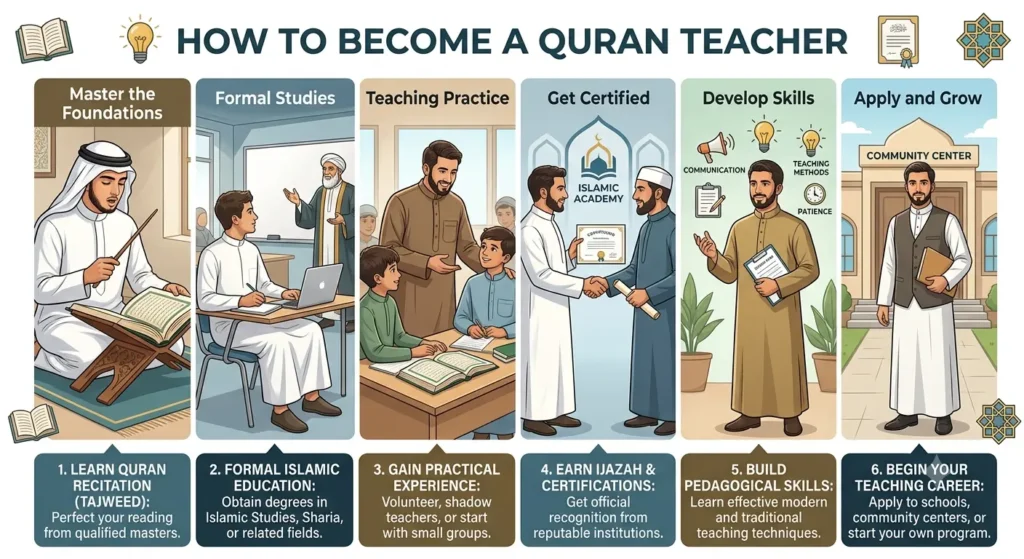
Most people who want to know how to become a Quran teacher already have the love for the Book. What they lack is a clear roadmap — and a realistic picture of what “qualified” actually means in practice.
This guide covers every step: the sacred knowledge you need to build, the teaching skills that distinguish a great instructor from a capable reciter, and how to move into online teaching and reach students across the world.
The Three Pillars Of A Qualified Quran Teacher
A complete, qualified Quran teacher is not built in one dimension. The following framework — the Three-Pillar Model — organizes what you need to develop so that nothing critical is missed.
1. Islamic Knowledge And Recitation Mastery
Sacred knowledge is the non-negotiable foundation. Without it, nothing else is valid.
Quran memorization and daily recitation practic
A Quran teacher must maintain continuous, living contact with the Quran — not as archived knowledge but as a daily practice.
Scholars describe this as mu’ayasha: the ongoing companionship of recitation and review that keeps what you teach constantly present in your mind and voice. A teacher who has let their Hifz deteriorate cannot serve their students with consistency or authority.
Tajweed mastery theoretical and applied
You must understand Tajweed rules both theoretically (naming and explaining Makharij, Sifaat, Nun Sakinah rules, Madd types) and practically (producing each sound correctly on demand and catching deviations in a student’s recitation by ear).
Theoretical knowledge without applied listening skill is the most common weakness in self-taught reciters who attempt to teach.
Ijazah with a connected chain
The Ijazah is your credential of authenticity. It should come from a recognized, verified scholar — not a short completion certificate from an online course.
The most widely recognized Ijazah for non-Arabic speakers teaching globally is Hafs ‘an Asim, though other Qira’at carry equal scholarly weight within their traditions.
Basic Quranic sciences
A working knowledge of Tafsir and elementary Arabic grammar strengthens your ability to explain why a word sounds a certain way — essential when students ask questions your recitation alone cannot answer.
2. Pedagogical And Teaching Skills
This is where most aspiring teachers underinvest — and where most of the gap between a good reciter and a good teacher lives.
Active listening for error detection
Teaching Tajweed requires a trained ear, not just a trained tongue. You must learn to listen diagnostically: hearing not only that an error occurred, but identifying which Makhraj is off, whether the Sifah is missing, and whether the error pattern repeats.
Correcting errors without this diagnostic precision leads to vague feedback that students cannot act on.
Differentiating instruction by studen
A child aged 8, an adult convert aged 40, and a non-Arabic speaker with no phonetic reference for letters like ع or ح all require completely different teaching approaches for the same rule. This is why our Quran teachers for adults follow a distinct methodology from our teachers for younger learners — the content is the same, the pedagogy is not.
Motivating students and building connection with the Quran
The most effective Quran teachers teach love for the Quran before they teach rules of recitation. Lesson planning should include moments that connect verses to meaning, story, or personal relevance — not just technical drilling. This matters especially for Quran beginners who need sustained encouragement before technical confidence arrives.
Lesson planning and session structure
A qualified teacher arrives at each session with a defined objective: “By the end of this session, this student will correctly apply Ikhfa with the letter ف in three different verses.” Without this structure, sessions drift — students feel progress but cannot measure it, and teachers cannot diagnose plateaus accurately.
Constructive error correction
The standard pedagogical rule in Quran education: correct the error, not the student. Feedback should identify what was incorrect, model the correct sound, invite the student to repeat, and confirm or correct again — without frustration, interruption, or comparison.
3. Online Delivery Skills
For aspiring online Quran teachers specifically, a third pillar applies that traditional teacher-training programs rarely address.
Platform fluency
Teaching via Zoom or Google Meet requires more than knowing how to join a call. You need to manage audio settings to minimize distortion — Tajweed depends on acoustic accuracy — know how to use screen sharing to display Mushaf or Tajweed charts, and understand how to conduct recitation checks when audio connection creates even minor delay.
Adapting Makhraj correction for remote teaching
In a physical classroom, you can demonstrate tongue placement, observe a student’s mouth, and correct with proximity.
Online, you replace physical demonstration with exaggerated verbal description, recorded self-playback, and structured listening exercises. Teachers who simply transplant in-person methods to a video call plateau quickly — those who adapt their methodology to the medium consistently outperform them.
Language accessibility for non-Arabic speaking student
If you are teaching Muslims who do not speak Arabic, you need the ability to explain rules in clear English, connect Arabic sounds to phonetic reference points the student’s native language provides, and normalize mistakes that arise from language-transfer errors rather than carelessness.
Teaching Quran online to English speakers is a specialist skill, not a default extension of traditional halaqah instruction. The best online Quran teachers treat it as a distinct competency worth deliberate development.
Read Also: How to Choose a Quran Teacher
Watch a Real Online Quran Class
See how our online Quran lessons are conducted with this short class sample. Experience our interactive teaching approach, clear pronunciation guidance, and engaging learning environment before starting your own Quran learning journey.
Learn Quran Online with Expert Teachers
Start your personalized journey with qualified tutors today. Flexible schedules tailored to your routine.
Book Your Free TrialRead also: The Best Of You Are Those Who Learn The Quran And Teach It
How To Become A Tajweed Teacher?
Tajweed teaching is a specialization within Quran education, and the pathway has additional requirements beyond general Quran instruction.
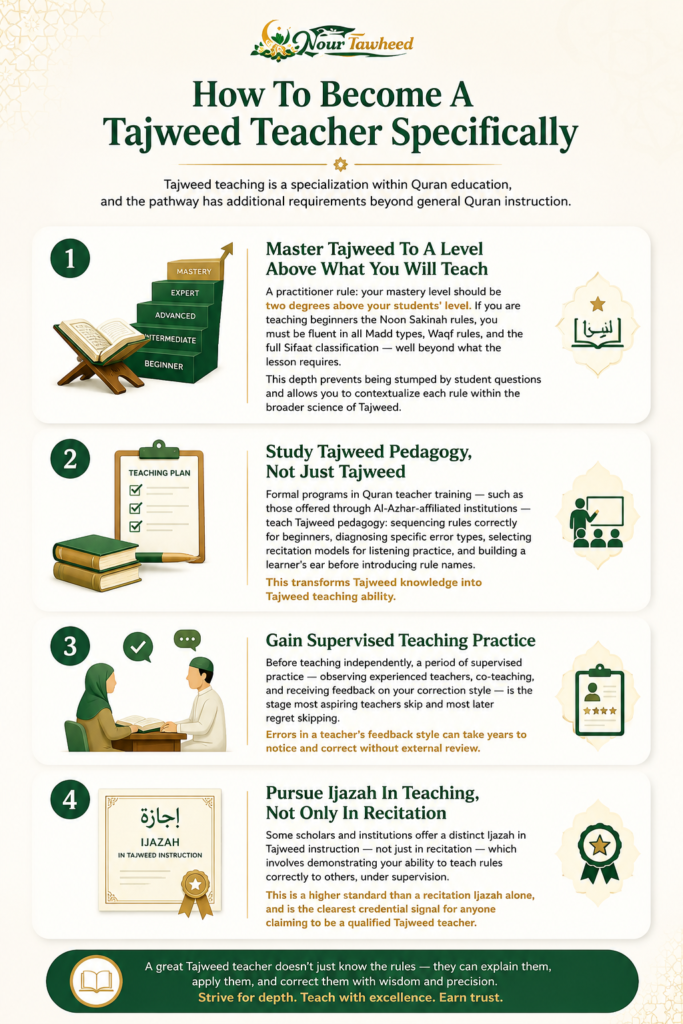
1. Master Tajweed To A Level Above What You Will Teach
A practitioner rule: your mastery level should be two degrees above your students’ level. If you are teaching beginners the Noon Sakinah rules, you must be fluent in all Madd types, Waqf rules, and the full Sifaat classification — well beyond what the lesson requires.
This depth prevents being stumped by student questions and allows you to contextualize each rule within the broader science of Tajweed.
2. Study Tajweed Pedagogy, Not Just Tajweed
Formal programs in Quran teacher training — such as those offered through Al-Azhar-affiliated institutions — teach Tajweed pedagogy:
sequencing rules correctly for beginners, diagnosing specific error types, selecting recitation models for listening practice, and building a learner’s ear before introducing rule names. This transforms Tajweed knowledge into Tajweed teaching ability.
3. Gain Supervised Teaching Practice
Before teaching independently, a period of supervised practice — observing experienced teachers, co-teaching, and receiving feedback on your correction style — is the stage most aspiring teachers skip and most later regret skipping.
Errors in a teacher’s feedback style can take years to notice and correct without external review.
4. Pursue Ijazah In Teaching
Some scholars and institutions offer a distinct Ijazah in Tajweed instruction — not just in recitation — which involves demonstrating your ability to teach rules correctly to others, under supervision.
This is a higher standard than a recitation Ijazah alone, and is the clearest credential signal for anyone claiming to be a qualified Tajweed teacher.
The Best Way to Teach the Quran
The best way to teach the Quran combines three principles that consistently produce the strongest student outcomes: sound before rules, consistency before speed, and relationship before performance.
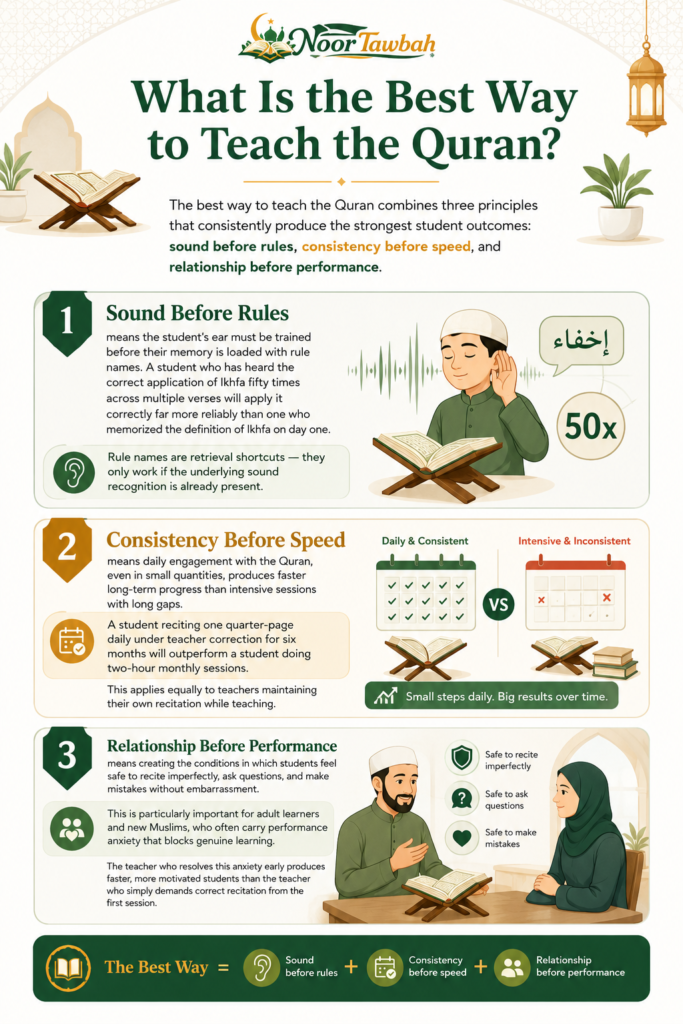
1. Learning Through Pronunciation
means the student’s ear must be trained before their memory is loaded with rule names. A student who has heard the correct application of Ikhfa fifty times across multiple verses will apply it correctly far more reliably than one who memorized the definition of Ikhfa on day one.
Rule names are retrieval shortcuts — they only work if the underlying sound recognition is already present.
2. Maintaining A Daily Recitation Routine
means daily engagement with the Quran, even in small quantities, produces faster long-term progress than intensive sessions with long gaps.
A student reciting one quarter-page daily under teacher correction for six months will outperform a student doing two-hour monthly sessions. This applies equally to teachers maintaining their own recitation while teaching.
3. Creating A Safe And Supportive Environment For The Student
means creating the conditions in which students feel safe to recite imperfectly, ask questions, and make mistakes without embarrassment.
This is particularly important for adult learners and new Muslims, who often carry performance anxiety that blocks genuine learning. The teacher who resolves this anxiety early produces faster, more motivated students than the teacher who simply demands correct recitation from the first session.
How We Choose Our Teachers at Online Quran Teachers
Understanding how a reputable platform selects its instructors gives you a practical benchmark for your own development — and transparent visibility into the standard you are working toward.
At Online Quran Teachers, every instructor goes through a five-stage vetting process before teaching a single student.
- Credential Verification: Documented Ijazah with a verifiable chain of transmission (Sanad) — no self-declared certificates accepted.
- Live Recitation Assessment: A senior instructor tests Makharij accuracy, Hafs ‘an Asim application, Waqf and Ibtida’, and Sifaat consistency in real time.
- Teaching Demonstration: A simulated lesson evaluated for error diagnosis accuracy, correction style, lesson structure, and adaptability.
- Language and Communication Check: English fluency and the ability to explain Tajweed rules clearly to non-Arabic speakers — assessed separately from Islamic qualification.
- Ongoing Quality Review: Student feedback is collected after every session. No credential permanently exempts a teacher from continued performance monitoring.
This is what “qualified Quran teacher” means at Online Quran Teachers — not a certificate, not a self-assessment, but a verified and continuously monitored standard. You can browse our verified female Quran teachers or explore our male Quran teachers and review each instructor’s credentials directly before booking.
Experience an Online Quran Lesson
Take a look inside a live online Quran session and discover how students learn with personalized instruction, step-by-step guidance, and a supportive learning atmosphere.
Learn Quran Online with Expert Teachers
Start your personalized journey with qualified tutors today. Flexible schedules tailored to your routine.
Book Your Free TrialStart Teaching Quran Online with Online Quran Teachers
If you have completed your Ijazah, developed your pedagogical skills, and are ready to teach — Online Quran Teachers connects verified, qualified instructors with students from across the English-speaking world.
Our students are committed learners seeking qualified teachers, not casual browsers looking for the cheapest option.
Apply Today and Reach Students Who Are Ready to Learn
They arrive ready to commit — adults pursuing structured Quran classes, complete beginners taking their first steps, sisters seeking female-only Quran instruction, and brothers looking for qualified male teachers. They deserve instructors who have genuinely met the standard this article describes.
Apply to teach at Online Quran Teachers and bring your knowledge to students who need it most.
Our Online Quran Teacher & Course Options
- Quran Teachers for Kids & Quran Course for Kids
- Female Quran Teachers & Quran Classes for Ladies
- Male Quran Teachers & Quran Classes for Men
- Quran Teachers for Beginners & Quran Course for Beginners
- Quran Teachers for Adults & Quran Classes for Adults
- Native Arab Quran Teachers
- Egyptian Quran Teachers & Al-Azhar Course
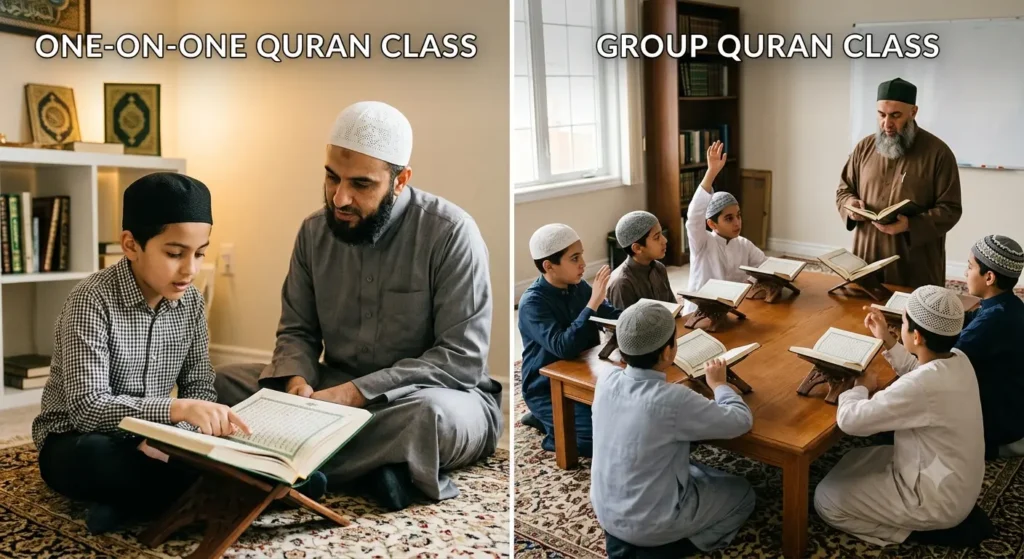
- Private One-on-One Quran Tutors & Private Classes
- Quran Teachers on Skype & Zoom & Online Classes
Enroll today and start learning the Quran with a dedicated teacher who matches your goals, schedule, and learning style.
Conclusion
Becoming a qualified Quran teacher is a journey through three tracks at once: building your sacred knowledge and Ijazah, developing genuine pedagogical skill, and — for online teachers specifically — mastering the delivery competencies the digital classroom demands.
The credential that matters most is not the certificate on your wall. It is the quality of your students’ recitation, the accuracy of your error correction, and the depth of love for the Quran you leave with every person you teach.
Whether you are beginning your Tajweed mastery, working toward your first Ijazah, or already reciting fluently and now developing your teaching methodology — the path is clear, and the need is real. The Muslim community globally has far more students seeking qualified Quran teachers than it has teachers who have genuinely met that standard.
Frequently Asked Questions About How to Become a Quran Teacher
The questions below address what aspiring teachers most commonly ask — covering credentials, timelines, specializations, and what platforms like Online Quran Teachers actually expect from their instructors.
1. Do you need to be a Hafiz to become a Quran teacher?
No. Being a Hafiz is not a prerequisite for teaching the Quran. Many excellent Quran teachers have memorized portions of the Quran rather than the full text. What is required is mastery of what you teach: accurate recitation with correct Tajweed, a verifiable Ijazah in at least one recognized Qira’ah, and the pedagogical skills to teach it effectively.
2. What is the difference between an Ijazah in recitation and a qualification to teach the Quran?
An Ijazah in recitation certifies that your own recitation meets a verified scholarly standard. A qualification to teach additionally requires pedagogical training — the ability to diagnose student errors, correct them constructively, structure lessons, and adapt to different learners. Many reciters with valid Ijazah have never received formal teacher training. Both credentials matter; they test different things.
3. How long does it take to become a qualified Quran teacher?
The timeline varies by starting point. A student who begins with no Arabic reading ability typically needs two to three years to reach recitation standard sufficient for Ijazah candidacy, plus additional time for pedagogical training. Someone with existing Quranic fluency who pursues formal Tajweed study and teacher training can reach qualified teacher status within one to two years.
4. Can women become qualified Quran teachers online?
Yes — and female Quran teachers are in specific, high demand. Many families seek female Quran teachers for their daughters, and many adult Muslim women prefer female instructors for their own Quran classes. Online platforms have significantly expanded access for qualified female scholars previously limited to local student pools. Qualifications, skill requirements, and vetting standards are identical to those for male teachers.
5. What is the best online platform to teach Quran?
The best platform for a qualified teacher verifies credentials rigorously, matches you to students at the appropriate level, and maintains a quality review process that protects both students and instructors. Platforms that accept any applicant with a self-declared certificate devalue qualified teachers and harm students. Look for platforms that conduct live recitation assessments and teaching demonstrations before placing you with students.
6. Do I need to speak English to teach the Quran to English-speaking students?
Yes. Tajweed concepts require explanation, and a teacher who cannot explain Ikhfa or Qalqalah clearly in the student’s language is limited to modeling and imitation — which is insufficient for most online learners. English-language Quran platforms require demonstrable English communication ability as a separate, non-negotiable qualification alongside Islamic credentials.





Leave a Reply