 Quran
If you want to learn Arabic and understand Quran directly, you’re asking the right question. Have you ever recited Al-Fatiha in Salah and wondered what each word actually means, not just in translation, but in the language Allah chose to reveal the Quran with? Allah Almighty says:
إِنَّا أَنزَلْنَاهُ قُرْآنًا عَرَبِيًّا لَّعَلَّكُمْ تَعْقِلُونَ
“Indeed, We have sent it down as an Arabic Quran so that you may understand”
Learning Arabic for the Quran is different from learning Arabic to order food or chat with friends. It follows a specific order: vocabulary rooted in the Quran itself, then grammar, then eloquence.
This guide shows you that order, the classical books scholars recommend at each stage, the mistakes that slow most learners down, and how to measure real progress.
Why You Need To Learn Arabic And Understand Quran In Its Original Language
Learning Arabic to understand the Quran means studying the language in which the Quran was revealed so you can grasp its meanings, rulings, and style without depending entirely on translation. The Quran describes itself as revealed
بِلِسَانٍ عَرَبِيٍّ مُّبِينٍ
“in a clear Arabic tongue”
(Surah Ash-Shu’ara -195), so its meaning is tied to Arabic vocabulary, structure, and style.
Two problems appear when a reader relies only on translation: meaning gets flattened, and grammar-dependent meaning gets lost entirely.
Why Translations Can’t Carry The Full Meaning Of The Quran
A translation is an interpretation, not the Quran itself. Translators must choose one English word where the Arabic carries several layers. Take the root ر-ح-م (r-ḥ-m): Ar-Raḥmān and Ar-Raḥīm both come from it, yet classical scholars explain different shades between them, a distinction most translations compress into “the Merciful.”
When you know the root system, you see these connections across the whole Quran, not just in one verse.
How A Single Vowel Can Change The Meaning Of A Verse
Arabic grammar (nahw) is the system of word endings that tells you who does what in a sentence. In the Quran, one short vowel can reverse the meaning. Allah Almighty says:
إِنَّمَا يَخْشَى اللَّهَ مِنْ عِبَادِهِ الْعُلَمَاءُ ۗ
“Those who truly fear Allah, among His Servants, who have knowledge”
“Innamā yakhshā Allāha min ‘ibādihi al-‘ulamā’u”, (Surah Fatir -28).
The ending on Allāha marks Him as the one feared, and the ending on al-‘ulamā’u marks the scholars as those who fear. Reverse the vowels and the sentence says something no Muslim would accept.
Classical accounts also report that a misreading of this Ayah:
أَنَّ اللَّهَ بَرِيءٌ مِّنَ الْمُشْرِكِينَ ۙ وَرَسُولُهُ ۚ
“And [it is] an announcement from Allah and His Messenger to the people on the day of the greater pilgrimage that Allah is disassociated from the disbelievers, and [so is] His Messenger”.
“Wa-adhānun mina-llāhi wa-rasūlihī ilā-nnāsi Yawma-l-Ḥajji-l-Akbari anna-llāha barī’um-mina-l-mushrikīna wa-rasūluh”
(Surah At-Tawbah -3) , changing wa rasūluhu to wa rasūlihi, made the verse sound as though Allah disowned His Messenger. That error is often cited as one reason early scholars like Abu al-Aswad al-Du’ali began formalizing Arabic grammar.
If you want a teacher who points out these meaning-changing details as you read, the Arabic for Understanding the Quran course at Online Quran Teachers Academy builds grammar directly from Quranic verses, not from textbook sentences about the weather.
Read also: Easily Get Your Quran Qira’aat Ijazah – 4 Proven Levels And 4 Core Requirements
Watch our Real Online Quran Class
See how our online Quran lessons are conducted with this short class sample. Experience our interactive teaching approach, clear pronunciation guidance, and engaging learning environment before starting your own Quran learning journey.
Learn Quran Online with Expert Teachers
Start your personalized journey with qualified tutors today. Flexible schedules tailored to your routine.
Book Your Free TrialThe Word, Sentence, Eloquence Ladder – Three Levels Of Understanding The Quran
The fastest way to learn Arabic and understand Quran is to know which level you’re aiming for. Understanding Quranic Arabic happens on three levels, and each one builds on the one before it.
We call this the Word, Sentence, Eloquence ladder. It’s a simple way to diagnose where you are and what to study next.
1. Understanding Words And Roots
At this level, you recognize the meaning of individual Quranic words. Most Arabic words grow from a three-letter root, so learning one root opens a family of related words.
From ع-ل-م (ʿ-l-m) you get ʿilm (knowledge), ʿālim (one who knows), maʿlūm (known), and ʿallama (he taught). Learners at this level can follow the general topic of a passage in Salah.
2. Understanding Sentences Through Nahw And Sarf
At this level, you understand how words connect. Nahw (syntax) explains word endings and sentence roles, while sarf (morphology) explains how word patterns change meaning, such as fāʿil (doer) versus mafʿūl (the one acted upon).
This is where you stop guessing and start reading. You can tell the subject from the object and follow conditional sentences, which is exactly what the Fatir 35:28 example requires.
3. Understanding Eloquence Through Balagha
At this level, you see why a verse is phrased the way it is. Balagha (rhetoric), which includes ʿilm al-bayān and ʿilm al-badīʿ, studies word order, emphasis, and imagery.
A classic example is in:
إِيَّاكَ نَعْبُدُ
“It is You we worship”.
“Iyyāka naʿbudu”
(Surah Al-Fatiha -5), the object “You” comes before the verb. Arabic speakers recognize this fronting as exclusivity: You alone we worship. A plain translation often loses that emphasis.
Read also: Easily Earn Al-Jazariyyah Poem Ijazah – 6 Simple Proven Steps
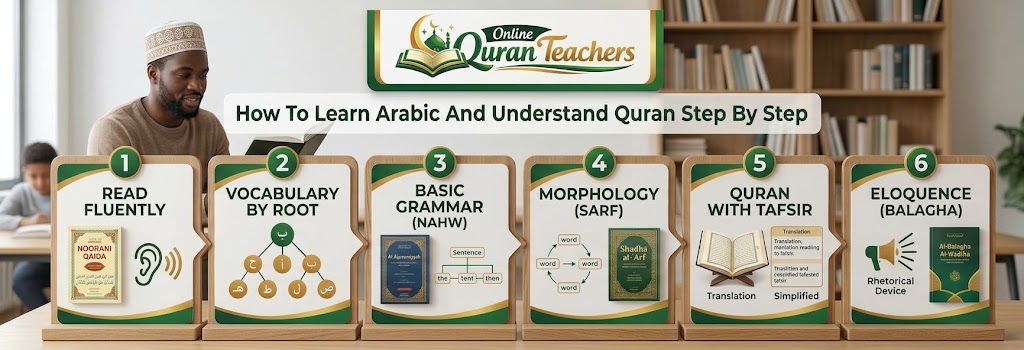
How To Learn Arabic And Understand Quran Step By Step
The study path below follows the order recommended by traditional scholars: start with small knowledge before large, and take it gradually. Each step names the trusted resources used for that stage.
1. Read The Arabic Script Fluently With Full Vowel Marks
Before vocabulary or grammar, you need to read letters, short vowels (fatḥah, kasrah, ḍammah), sukūn, and shaddah without pausing. If you still decode letter by letter, grammar study will feel twice as hard. Beginners usually cover this through the Noorani Qaida.
2. Learn High-Frequency Quranic Vocabulary By Root
Start with the words that repeat most in the Quran, especially in the surahs you recite daily. Learn them as root families, not isolated word lists. A practical rule: every new word should be linked to a verse you already know.
3. Study Basic Nahw With Al-Ajurrumiyyah
Al-Ajurrumiyyah by Ibn Ajurrum is the classic first text in Arabic grammar. Scholars recommend studying it with a simplified explanation, such as the commentary of Shaykh Muhammad Muhyiddin Abdul-Hamid or Shaykh Muhammad ibn Salih al-Uthaymeen.
4. Move To Sarf After A Foundation In Grammar
Once you understand sentence roles, study how words change form. Shadhā al-ʿArf fī Fann al-Ṣarf by Ahmad al-Hamalawi is a widely used reference, though beginners benefit from a teacher simplifying it first.
5. Read The Quran Alongside A Simplified Tafsir
Pair your recitation with a clear, concise tafsir such as Al-Tafsir al-Muyassar or Al-Mukhtasar fi Tafsir al-Quran. Read a short passage, try to parse it yourself, then check the tafsir. This turns passive reading into active comprehension.
6. Add Balagha With Al-Balagha Al-Wadiha
When grammar feels comfortable, begin rhetoric. Al-Balagha al-Wadiha by Ali al-Jarim and Mustafa Amin is one of the clearest introductions, with examples drawn from the Quran and classical Arabic.
At Online Quran Teachers Academy, the free trial is a live assessment, not a sales call. Your teacher checks your reading and current level, then tells you exactly which of these steps to start from, so you don’t waste months repeating what you already know.
Read also: Quran Recitation with Tajweed
Common Mistakes That Slow Down Quranic Arabic Learners
Most learners, when they want to learn Arabic and understand Quran, don’t fail from lack of effort. They stall because they study in the wrong order or with the wrong material. These are the patterns teachers see most often.
1. Starting With Conversational Or Dialect Arabic
Egyptian or Levantine dialects and everyday conversational Arabic differ significantly from Quranic Arabic in vocabulary and grammar. If your goal is the Quran, start with Quranic vocabulary and classical grammar.
2. Memorizing Word Lists Without Roots
Isolated vocabulary fades quickly. A learner who memorizes kataba, kitāb, and maktab as three unrelated words works three times harder than one who learns the root ك-ت-ب once.
3. Jumping To Balagha Before Grammar
Rhetoric is attractive because it reveals the beauty of the Quran, but balagha depends on nahw. Without grammar, rhetorical points become memorized facts rather than something you can see in the text yourself.
4. Studying Without Feedback
Self-taught learners often build grammar misunderstandings that stay hidden for months, such as confusing a verbal sentence with a nominal one. A qualified teacher catches these early, before they become habits.
Read also: Study Quran Online & Receive Recitation Ijazah
Self-Study Or A Teacher – How To Choose The Right Route
Both routes can work. The right one depends on your goal and your discipline. Use this decision rule:
| Your situation | Better fit |
| You want general familiarity with Quranic words | Self-study with apps and word lists |
| You want to understand verses you recite in Salah | Teacher-guided study, at least for grammar |
| You’ve tried self-study before and stalled | Teacher with a fixed weekly schedule |
| You want tafsir-level understanding | Teacher plus classical texts |
Scholars have long advised taking this knowledge from qualified people, even through modern means like recorded explanations and online lessons. A live teacher adds what recordings can’t: answers to your questions about your mistakes.
Online Quran Teachers Academy keeps the same teacher with you from the free trial to the end of the course, and you receive a written progress report after every completed level, so you always know what you’ve mastered and what comes next.
Read also: Ijazah In Reading Tohfat Al-Atfal – 5 Easy And Proven Steps To Success
Experience our Online Quran Lesson
Take a look inside a live online Quran session and discover how students learn with personalized instruction, step-by-step guidance, and a supportive learning atmosphere.
Learn Quran Online with Expert Teachers
Start your personalized journey with qualified tutors today. Flexible schedules tailored to your routine.
Book Your Free TrialStart Understanding The Quran In Arabic With Your Own Teacher Today
If you want to learn Arabic and understand Quran, stop reading translations and wondering what you’re missing. With the Arabic for Understanding the Quran course at Online Quran Teachers Academy, you learn vocabulary, grammar, and sentence structure directly from Quranic text in private one-on-one sessions.
Your teacher is Al-Azhar-certified, explains every rule in clear English, and fits sessions around your weekly routine in any time zone. Female teachers are available for sisters on request.
Book your free trial, find your real starting level, and begin understanding what you recite.
Our Online Quran Teacher & Course Options
- Quran Teachers for Kids & Quran Course for Kids
- Female Quran Teachers & Quran Classes for Ladies
- Male Quran Teachers & Quran Classes for Men
- Quran Teachers for Beginners & Quran Course for Beginners
- Quran Teachers for Adults & Quran Classes for Adults
- Native Arab Quran Teachers
- Egyptian Quran Teachers & Al-Azhar Course
- Private One-on-One Quran Tutors & Private Classes
- Quran Teachers on Skype & Zoom & Online Classes
Enroll today and start learning the Quran with a dedicated teacher who matches your goals, schedule, and learning style.
Learn Quran Online with Expert Teachers
Start your personalized journey with qualified tutors today. Flexible schedules tailored to your routine.
Book Your Free TrialConclusion
Learning Arabic is the most direct way to understand the Quran as it was revealed. Translations help, but they can’t show you how a single vowel changes who fears whom in a verse, or why word order turns a statement into an expression of exclusive worship.
The path is clear: read the script fluently, learn vocabulary through roots, build grammar with Al-Ajurrumiyyah, add sarf, read with a simplified tafsir, then study balagha. Climb the Word, Sentence, Eloquence ladder one level at a time.
If you want to learn Arabic and understand Quran without wasting months on the wrong material, start with the right order and, ideally, the right teacher.
Frequently Asked Questions
Can I Understand The Quran Without Learning Arabic?
You can understand the general message of the Quran through translation and tafsir in your language. However, grammar-dependent meanings, word roots, and rhetorical emphasis are only fully visible in Arabic, which is why scholars encourage learning it.
Is Quranic Arabic The Same As Modern Standard Arabic?
No. Quranic Arabic is Classical Arabic, while Modern Standard Arabic is its modern descendant. They share grammar and much vocabulary, but Quranic Arabic includes classical words and styles that modern courses rarely cover.
What Is The First Book To Study For Quranic Arabic Grammar?
Al-Ajurrumiyyah by Ibn Ajurrum is the traditional first book in Arabic grammar. Study it with a simplified commentary, such as the explanation by Shaykh Muhammad ibn Salih al-Uthaymeen, or with a qualified teacher.
How Long Does It Take To Learn Arabic To Understand The Quran?
The time depends on your starting level, study hours, and whether you have a teacher. Measure progress by milestones instead: reading fluently, recognizing roots in Salah surahs, then parsing short verses on your own.
Is Learning Arabic For The Quran Difficult For Non-Arabic Speakers?
Learning Arabic for the Quran is very achievable when you study in the right order. Starting with Quranic vocabulary and basic grammar, rather than conversational Arabic, keeps every lesson connected to verses you already recite.







[…] Read also: Learn Arabic And Understand Quran – 6 Easy Steps To Success […]