 Ijazah
Learning how to easily get your Quran Qira’aat Ijazah begins with understanding its true value. An Ijazah in memorizing and reading Quran with Qira’aat is the certification that connects your recitation, teacher by teacher, back to the Prophet Muhammad ﷺ. For many huffaz, finishing memorization raises a direct question: what comes next, and how do I become qualified to teach?
At its core, an Ijazah is an oral and written certification from a qualified teacher with a connected chain (sanad), confirming that the student has recited the entire Quran with full accuracy in a specific riwayah or qira’ah and granting them permission to recite and teach it to others.
This guide answers that question by explaining what the Ijazah certifies, the four levels of transmission every Qira’aat student must understand, the main types of Ijazah, the conditions scholars set, and how to earn it in person or online.
What The Ijazah Certifies
When you learn how to easily get your Quran Qira’aat Ijazah, it helps to understand what the certificate actually validates. The Ijazah certifies the transmission of the Quran’s sound from one generation to the next. The teacher (mujiz) testifies that the student’s (mujaz) recitation has become fully correct for the riwayah or riwayat he is authorizing. This covers tajweed rules, the articulation points of the letters (makharij), and their characteristics (sifat).
The Ijazah is tied to what was actually recited. A student who recites only Hafs ‘an ‘Asim receives an Ijazah in Hafs, not in the other readings, however skilled he may be.
What The Science Of Qira’aat Is
To easily get your Quran Qira’aat Ijazah, mastering the foundational science behind it is essential. The science of Qira’aat is the discipline that studies how the words of the Quran are pronounced. It covers where the readings agree and differ, and attributes each variation to the person who transmitted it. Its subject is the words of the Quran in terms of how they are pronounced and performed.
This science draws on authentic, mass-transmitted (mutawatir) reports from the scholars of recitation, reaching back to the Prophet ﷺ. Scholars classify learning and teaching it as fard kifayah, a communal obligation. Its benefit is protecting the Quran’s words from error and distortion, and distinguishing between readings that are accepted and those that are not.
Read also: Ijazah in Reading the Poem of Al-Jazariyyah
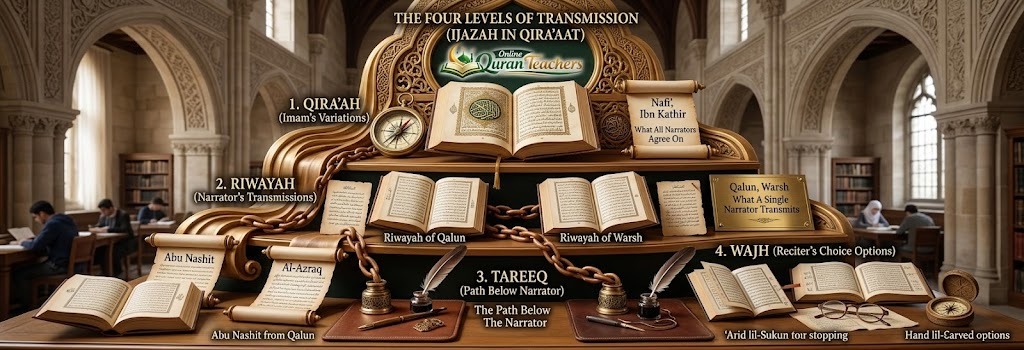
Qira’ah, Riwayah, Tareeq And Wajh – The Four Levels Of Transmission
Every Ijazah in Qira’aat is described using four technical terms. Understanding them tells you exactly what a certificate covers. A full description reads like this: the qira’ah of Nafi‘, the riwayah of Qalun, by the tareeq of Abu Nashit.
1. Qira’ah – What All Narrators From An Imam Agree On
A qira’ah is any variation attributed to one of the ten imams of recitation, on which all narrators from that imam agree. For example, reciting the basmalah between two surahs is the qira’ah of Ibn Kathir, because all narrators from Ibn Kathir agree on it.
2. Riwayah – What A Single Narrator Transmits
A riwayah is a variation attributed to a narrator who transmits from the imam, directly or through an intermediary. For example, reading the word ḍaʿf with a fatḥah in Surat Ar-Rum is the riwayah of Shu‘bah from ‘Asim. Hafs, the other narrator from ‘Asim, has two options here: fatḥah and ḍammah.
3. Tareeq – The Path Below The Narrator
A tareeq is a variation attributed to the person who took from the narrator, however far down the chain. Continuing the example, reading ḍaʿf with a fatḥah for Hafs comes through the tariq of ‘Ubayd ibn al-Sabbah from Hafs.
4. Wajh – Options Left To The Reciter’s Choice
A wajh is an option the reciter may freely choose among permissible alternatives. An example is the ways of stopping on a word with an incidental sukun (‘arid lil-sukun). Choosing any one of them is sufficient, and it is not considered a gap in the student’s learning.
Sanad – The Chain Of Teachers
The sanad is the chain of people who transmitted the Quran orally. Each one recited to his teacher, who recited to his teacher, back to the Prophet ﷺ, from Jibril, from Allah. An Ijazah without a connected sanad is not an Ijazah in the technical sense used by reciters.
At Online Quran Teachers, these distinctions are taught before you begin your recitation, so you know exactly which riwayah and tariq your certificate will name.
Read also: Ijazah The Certification
Watch our Real Online Quran Class
See how our online Quran lessons are conducted with this short class sample. Experience our interactive teaching approach, clear pronunciation guidance, and engaging learning environment before starting your own Quran learning journey.
Learn Quran Online with Expert Teachers
Start your personalized journey with qualified tutors today. Flexible schedules tailored to your routine.
Book Your Free TrialTypes Of Quran Ijazah
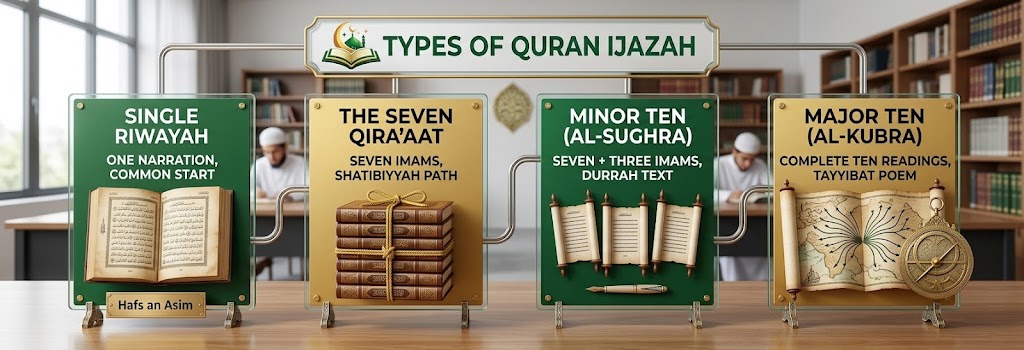
Understanding the different types available is a crucial step when planning how to easily get your Quran Qira’aat Ijazah. Ijazah programs differ by how many readings they cover and which classical poem (matn) they follow. Each level builds on the one before it, so the right choice depends on your goal.
1. Ijazah In A Single Riwayah
This Ijazah covers one narration, such as Hafs ‘an ‘Asim or Warsh ‘an Nafi‘. It is the most common starting point, and Hafs is the riwayah most Muslims recite today. Students usually study the Jazariyyah, Imam Ibn al-Jazari’s poem on tajweed, alongside it.
2. Ijazah In The Seven Qira’aat
This Ijazah covers the seven imams through the tariq of the Shatibiyyah, Imam al-Shatibi’s poem. The seven imams are Nafi‘, Ibn Kathir, Abu ‘Amr, Ibn ‘Amir, ‘Asim, Hamzah, and al-Kisa’i, each with two narrators.
3. Ijazah In The Minor Ten (Al-‘ashr Al-Sughra)
This Ijazah covers the seven readings of the Shatibiyyah plus the three that complete them from al-Durrah al-Mudiyyah by Ibn al-Jazari. The three added imams are Abu Ja‘far, Ya‘qub, and Khalaf al-‘Ashir.
4. Ijazah In The Major Ten (Al-‘ashr Al-Kubra)
This Ijazah covers the ten readings through Tayyibat al-Nashr by Ibn al-Jazari. It includes far more turuq than the Shatibiyyah and Durrah, which makes it the most demanding level of Qira’aat study.
Which Ijazah Should You Pursue First?
A practical decision rule: start with the riwayah you already recite daily, usually Hafs. Move to the Seven only after your single-riwayah Ijazah is complete, then to the Minor Ten, and finally the Major Ten. Skipping levels is the most common reason advanced students stall, because the Shatibiyyah assumes you have mastered usul (general rules) in one riwayah first.
Read also: Quran Memorization with Tajweed
Requirements To Easily Get Your Quran Qira’aat Ijazah
If you want to know how to easily get your Quran Qira’aat Ijazah, fulfilling the scholars’ prerequisites is necessary. Scholars of recitation set four core conditions for a valid Ijazah. Missing any one of them changes what the certificate means.
1. Complete Memorization Of The Quran
The traditional Ijazah requires memorizing the entire Quran firmly and reciting it from memory (ghaiban). Scholars such as Safwat Salim, in his commentary on the Jazariyyah, list reciting the Quran from memory to a qualified teacher as a condition of Ijazah.
2. Mastery Of Tajweed In Practice
The student must study tajweed and apply its rules correctly in live recitation. Theory alone is not enough. Makharij, sifat, rules of noon and meem, madd and waqf must all be accurate under the teacher’s ear.
3. Study Of The Classical Texts
Students memorize or study the matn that matches their Ijazah level. That means the Jazariyyah for tajweed, the Shatibiyyah for the Seven, the Durrah for the Minor Ten, or the Tayyibah for the Major Ten.
4. A Full Recitation To A Teacher With A Connected Sanad
The student must complete a full khatmah to a teacher whose sanad is connected to the Prophet ﷺ. The teacher listens to the entire recitation, corrects it, and grants the Ijazah only when the recitation is sound.
Read also: Quran Recitation with Tajweed
Ijazah From Memory Vs. A Recitation Certificate From The Mushaf
As you explore how to easily get your Quran Qira’aat Ijazah, distinguishing between an authentic Ijazah and a standard recitation certificate is vital. A recitation Ijazah from the Mushaf is a certificate given to someone who recites accurately while reading, not from memory. This is a frequent source of confusion, and it affects what the holder can do afterward.
According to an Islamweb fatwa, the Ijazah in the reciters’ terminology requires reciting the whole Quran from memory. Earlier scholars did not recognize an Ijazah based on reading from the Mushaf. A certificate of accurate reading is permissible, but it is not an Ijazah in the technical sense.
The practical consequence: someone certified for reading from the Mushaf should not grant Ijazah to others. Reputable teachers state on the certificate whether the recitation was from memory or by sight. Check this line before you accept any certificate.
How To Easily Get Your Quran Qira’aat Ijazah – In Person Or Online
Knowing how to easily get your Quran Qira’aat Ijazah comes down to understanding the two accepted paths available today. There are two accepted ways to earn an Ijazah in memorizing and reading the Quran with Qira’aat. Both rely on the same core condition: direct oral recitation (mushafahah) to a qualified teacher.
1. In-Person Ijazah
The student sits face-to-face with the teacher and recites the Quran from memory according to tajweed and the rules of the riwayah or qira’ah. This happens in mosques, Quran circles (katatib), and specialized institutes.
2. Online Ijazah
Online Ijazah takes place through live video. The teacher sees and hears the student clearly in real time, and the student sees and hears the teacher the same way. The student recites from memory exactly as in a physical session. An Islamweb fatwa states there is no objection to earning an Ijazah through the internet, though face-to-face recitation is preferred where possible.
Recorded audio sent for review does not meet this condition. The live, two-way connection is what preserves the oral nature of the transmission.
Read also: Study Quran Online & Receive Recitation Ijazah
The Sanad Verification Checklist
Before committing to any teacher, confirm four points:
1. The teacher holds an Ijazah in the exact riwayah or qira’ah you want to study.
2. The teacher can show the full written sanad back to the Prophet ﷺ.
3. The teacher’s own Ijazah was earned from memory, not from the Mushaf.
4. Sessions are live and two-way, with clear audio and video.
Online Quran Teachers pairs students with teachers for live one-to-one sessions from home, so you can recite your full khatmah without relocating or giving up your work and family schedule.
Experience our Online Quran Lesson
Take a look inside a live online Quran session and discover how students learn with personalized instruction, step-by-step guidance, and a supportive learning atmosphere.
Learn Quran Online with Expert Teachers
Start your personalized journey with qualified tutors today. Flexible schedules tailored to your routine.
Book Your Free TrialCommon Mistakes Students Make On The Way To Ijazah
Avoiding common pitfalls is essential when figuring out how to easily get your Quran Qira’aat Ijazah. The most frequent mistakes are not about talent. They come from poor planning and unclear expectations.
1. Starting Recitation Before Memorization Is Solid
Students often begin the Ijazah khatmah while weak sections remain. Each correction then turns into a revision session, and progress slows. Revise to fluency first, then recite for Ijazah.
2. Treating The Certificate As The Goal
An Ijazah confirms accuracy at the time of recitation. Without continued revision, that accuracy fades. Plan a daily revision routine that continues after you receive the certificate.
3. Assuming Teaching Requires An Ijazah
Imam al-Suyuti wrote that an Ijazah from a teacher is not a condition for teaching. Whoever knows he is qualified may teach, as the early generations did. The Ijazah strengthens trust in your recitation, but it should not stop a capable reciter from teaching.
Learn with Expert Online Quran Teachers
You have spent years memorizing the Quran. When you figure out how to easily get your Quran Qira’aat Ijazah, the next step is making your recitation part of a connected chain that reaches the Prophet ﷺ and earning the right to pass it on.
With Online Quran Teachers, you recite live, one-to-one, to a teacher who corrects every letter. You study from home, on a schedule that fits your life, in the riwayah or qira’ah you choose.
Book your first session now and begin your khatmah.
Our Online Quran Teacher & Course Options
- Quran Teachers for Kids & Quran Course for Kids
- Female Quran Teachers & Quran Classes for Ladies
- Male Quran Teachers & Quran Classes for Men
- Quran Teachers for Beginners & Quran Course for Beginners
- Quran Teachers for Adults & Quran Classes for Adults
- Native Arab Quran Teachers
- Egyptian Quran Teachers & Al-Azhar Course
- Private One-on-One Quran Tutors & Private Classes
- Quran Teachers on Skype & Zoom & Online Classes
Enroll today and start learning the Quran with a dedicated teacher who matches your goals, schedule, and learning style.
Learn Quran Online with Expert Teachers
Start your personalized journey with qualified tutors today. Flexible schedules tailored to your routine.
Book Your Free TrialConclusion
Knowing how to easily get your Quran Qira’aat Ijazah brings you to a clear understanding of its ultimate value. An Ijazah in memorizing and reading Quran with Qira’aat certifies that you have recited the entire Quran from memory, with accurate tajweed, to a teacher whose sanad is connected to the Prophet ﷺ. It names a specific qira’ah, riwayah and tariq, and it ranges from a single riwayah to the Major Ten through the Tayyibah.
The path is clear: firm memorization, practical tajweed, the right classical text, and a full recitation to a qualified teacher, in person or through live video. Verify your teacher’s sanad, start with the riwayah you already recite, and keep revising after the certificate is in your hands.
Frequently Asked Questions On How To Easily Get Your Quran Qira’aat Ijazah
What Is An Ijazah In Quran?
An Ijazah in Quran is a certification from a teacher with a connected sanad confirming that you recited the whole Quran to him accurately. It grants you permission to recite and teach the specific riwayah or qira’ah you completed.
Can I Get An Ijazah In Qira’aat Online?
Yes, you can get an Ijazah in Qira’aat online if the sessions are live, with two-way audio and video. You must recite from memory directly to the teacher. Recorded audio does not meet this condition.
Do I Need To Memorize The Whole Quran To Get An Ijazah?
Yes, the traditional Ijazah requires memorizing the whole Quran and reciting it from memory. A certificate for reading from the Mushaf exists, but scholars do not consider it an Ijazah in the technical sense.
What Is The Difference Between The Minor Ten And The Major Ten?
The Minor Ten follows the Shatibiyyah for seven readings and the Durrah for the remaining three. The Major Ten follows Tayyibat al-Nashr, which includes many more turuq and is more demanding.
Do I Need An Ijazah To Teach The Quran?
No, an Ijazah is not a condition for teaching the Quran. Imam al-Suyuti stated that anyone who knows he is qualified may teach. An Ijazah adds trust and a documented chain to your recitation.


[…] Read also: Ijazah in Memorizing and Reading Quran with (Qira’aat) […]