 Ijazah
An ijazah in reading the poem of Ash-Shatibiyya connects thousands of students to the most studied Qira’at text globally, allowing them to recite all seven canonical readings of the Quran from a single poem.
This formal certification with a connected chain (sanad) proves you have recited the text of the Quran through its route and are qualified to teach it. Traceable back through Imam al-Shatibi to the Prophet ﷺ, this credential goes beyond a basic course certificate.
This guide covers its types, requirements, sheikh conditions, suitable paths, and common mistakes to avoid.
Who Wrote The Shatibiyyah And What Is Its Full Title?
The Shatibiyyah was written by Imam Abu al-Qasim ibn Firruh ibn Khalaf al-Shatibi al-Ru’ayni of al-Andalus, who died in 590 AH. Its full title is Hirz al-Amani wa Wajh al-Tahani fi al-Qira’at al-Sab’ (“The Stronghold of Wishes and the Face of Congratulations in the Seven Readings”). The poem is named after the Imam’s hometown of Shatiba (Xàtiva, in present-day Spain).
Understanding its origins is essential for anyone seeking an ijazah in reading the poem of Ash-Shatibiyya, as it remains the core text taught in Qira’at departments at Islamic universities, including Al-Azhar.
What Does The Shatibiyyah Poem Contain?
The Shatibiyyah contains 1,173 verses in the al-Tawil meter, and every verse rhymes on the letter lam, which is why it is also called al-Lamiyyah. It versifies al-Taysir fi al-Qira’at al-Sab’ by Imam Abu ‘Amr al-Dani.
Mastering its contents is the core requirement to earn an ijazah in reading the poem of Ash-Shatibiyya, as it covers the seven mutawatir readings of Nafi’, Ibn Kathir, Abu ‘Amr, Ibn ‘Amir, ‘Asim, Hamzah, and al-Kisa’i. Each Imam has two narrators, giving 14 riwayat in total, including Hafs ‘an ‘Asim and Warsh ‘an Nafi’.
How Does The Shatibiyyah Symbol System Work?
The Shatibiyyah uses letters of the abjad sequence as symbols, each standing for a reader or a narrator. Imam al-Shatibi grouped them in sets of three: the first letter for the Imam, the next two for his two narrators.
| Imam | Imam’s symbol | First narrator | Second narrator |
| Nafi’ | alif | Qalun (ba) | Warsh (jim) |
| Ibn Kathir | dal | al-Bazzi (ha) | Qunbul (zay) |
| Abu ‘Amr | ha (ḥ) | al-Duri (ṭa) | al-Susi (ya) |
| Ibn ‘Amir | kaf | Hisham (lam) | Ibn Dhakwan (mim) |
| ‘Asim | nun | Shu’bah (sad) | Hafs (‘ayn) |
| Hamzah | fa | Khalaf (dad) | Khallad (qaf) |
| al-Kisa’i | ra | Abu al-Harith (sin) | al-Duri (ta) |
A detail most summaries skip: the letter waw is left out of the sequence because it serves as the separator (“and”) between rulings inside a verse. The poem also uses group symbols, such as shin for Hamzah and al-Kisa’i together, and word symbols, such as suhbah for Hamzah, al-Kisa’i, and Shu’bah.
Memorizing the verses without decoding these symbols leaves a student able to recite the poem but unable to extract a single ruling from it.
Watch our Real Online Quran Class
See how our online Quran lessons are conducted with this short class sample. Experience our interactive teaching approach, clear pronunciation guidance, and engaging learning environment before starting your own Quran learning journey.
Learn Quran Online with Expert Teachers
Start your personalized journey with qualified tutors today. Flexible schedules tailored to your routine.
Book Your Free TrialTypes Of Ijazah In Reading The Poem Of Ash-Shatibiyya
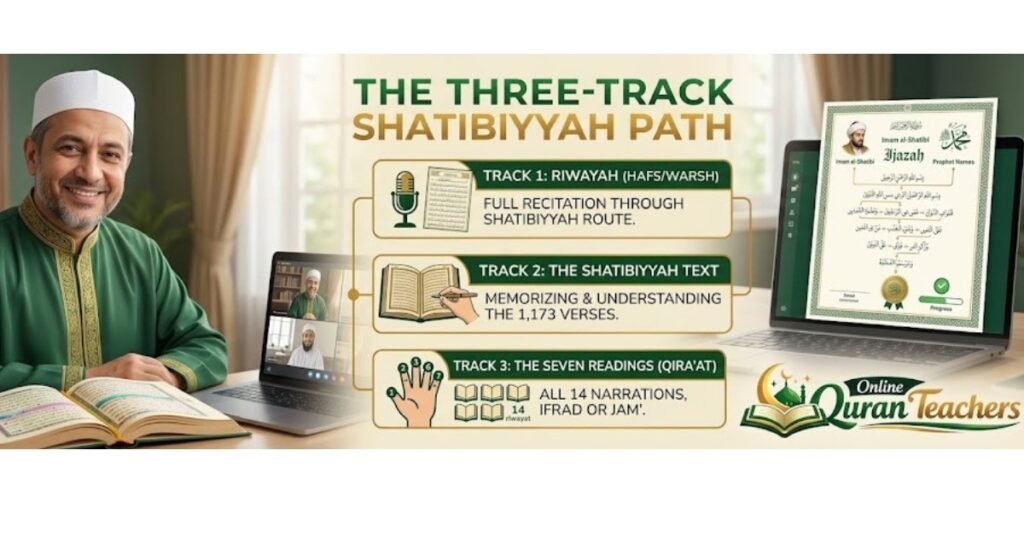
Three distinct ijazahs carry the Shatibiyyah name, and students often confuse them. Each one tests a different skill, so the right choice depends on whether your goal is the text, one riwayah, or all seven readings.
The framework below, which we call the Three-Track Shatibiyyah Path, separates them so you can plan your study honestly.
1. Ijazah In A Single Riwayah Through The Shatibiyyah Route
This ijazah certifies a full Quran recitation (khatmah) in one riwayah, such as Hafs ‘an ‘Asim or Warsh ‘an Nafi’, according to the Shatibiyyah’s route (tariq). It is the most common starting point and the one most Hafs ijazahs worldwide fall under.
The route matters in practice. For example, Hafs through the Shatibiyyah requires the separated prolongation (madd munfasil) at four or five counts; shortening it to two counts is valid only through the Tayyibah route. A student who mixes routes in a single khatmah can be stopped and asked to repeat sections.
2. Ijazah In The Text Of The Shatibiyyah Itself
This ijazah certifies that the student has recited the 1,173 verses to the sheikh, from memory or by reading, with correct meter, vowelling, and an understanding of the symbols. It grants a chain of narration for the poem itself back to Imam al-Shatibi.
Many sheikhs pair this with a standard commentary, such as al-Wafi fi Sharh al-Shatibiyyah by Sheikh ‘Abd al-Fattah al-Qadi or the classical Ibraz al-Ma’ani by Abu Shamah. Holding the text ijazah does not, on its own, certify you to teach the seven readings in recitation.
3. Ijazah In The Seven Readings, Separately Or Combined
This is the full Qira’at ijazah: completing the Quran in all 14 riwayat of the Shatibiyyah. It is done either separately (ifrad), with a khatmah for each riwayah, or combined (jam’), where the student recites a passage and repeats it for each variant before moving on.
Ifrad is slower but builds deep familiarity with each riwayah. Jam’ demands mastery of the poem first, because the student must know instantly which narrator differs at each word. Students who later want the ten readings add al-Durrah al-Mudiyyah by Ibn al-Jazari (for Abu Ja’far, Ya’qub, and Khalaf al-‘Ashir), or move to the more detailed Tayyibat al-Nashr.
Read also: Easily Get Your Quran Qira’aat Ijazah – 4 Proven Levels And 4 Core Requirements
Requirements For The Ijazah In Reading The Poem Of Ash-Shatibiyya
Every legitimate sheikh checks four conditions before writing an ijazah. They apply to all three tracks, though the weight of each shifts depending on the track.
Knowing them in advance lets you prepare for the assessment rather than discover gaps in the middle of a khatmah.
1. Memorization And Mastery
The student must have memorized the Quran (or the portion the ijazah covers), the Shatibiyyah text for Track 2 and Track 3, or both. Sheikhs test recall under pressure, including starting from an arbitrary verse.
2. Sound Recitation And Tajweed
The recitation must apply Tajweed rules with precise articulation points (makharij) and letter characteristics (sifat). Most teachers expect students to have already studied Tuhfat al-Atfal and al-Muqaddimah al-Jazariyyah before beginning the Shatibiyyah.
3. Oral Presentation To A Qualified Sheikh
The full khatmah or the full text must be recited face-to-face (mushafahah) to a sheikh who himself holds a connected ijazah in the same route. Live online sessions are accepted by many contemporary sheikhs, provided the entire recitation is heard and corrected in real time.
4. A Connected Chain Of Transmission
At completion, the student receives a document listing the sanad: each teacher up to Imam al-Shatibi, then through Imam al-Dani’s sources to the seven Imams and to the Prophet ﷺ. A chain with a gap, or one that passes through a different route than the one recited, does not certify a Shatibiyyah reading.
At Online Quran Teachers Academy, every teacher holds Al-Azhar certification and a traditional Ijazah with a verified chain, and your teacher’s credentials are confirmed before you are assigned. That makes the fourth condition something you can check on day one, not after months of study.
Read also: Study Quran Online & Get Recitation Ijazah – 6 Easy Steps To Excellence
How Long The Shatibiyyah Ijazah Takes And How To Plan It
Timelines depend on your starting level, weekly hours, and track, so no honest teacher gives one fixed number. What you can do is calculate your own path from the size of the material.
The examples below show the arithmetic, which is more useful than a promised timeframe.
1. Estimating The Text Memorization Phase
At five verses a day, the 1,173 verses take about 235 study days, or roughly eight months. At ten verses a day, the figure drops to about four months, but only if earlier verses are reviewed daily, since the symbol-dense verses of the farsh (word-by-word variants) fade fastest.
2. Estimating The Recitation Phase
For Track 1, a student presenting one juz’ per week finishes a khatmah in about 30 weeks. Track 3 multiplies the material across 14 riwayat, and combined recitation commonly stretches over several years of steady sessions.
Private one-on-one classes shorten this phase because the teacher sets the pace around your retention, not a group’s. Online Quran Teachers Academy schedules sessions across all time zones and issues a written progress report after each level, so you can see exactly how far you are from the finish.
Experience our Online Quran Lesson
Take a look inside a live online Quran session and discover how students learn with personalized instruction, step-by-step guidance, and a supportive learning atmosphere.
Learn Quran Online with Expert Teachers
Start your personalized journey with qualified tutors today. Flexible schedules tailored to your routine.
Book Your Free TrialCommon Mistakes Students Make On The Shatibiyyah Path
Most delays come from planning errors rather than lack of effort. These four come up repeatedly in Qira’at classes. Avoiding them early saves the most time, because each one forces repetition later.
- Memorizing Verses Without Decoding The Symbols: Students who memorize the poem as sound only cannot apply it in recitation. Decode the symbols of each verse on the day you memorize it, and write out which narrator holds which reading.
- Choosing A Sheikh Without Checking His Route: A sheikh with a Hafs ijazah through the Tayyibah cannot grant a Shatibiyyah-route ijazah in that riwayah. Ask to see the ijazah document and confirm the words “from the route of al-Shatibiyyah” (min tariq al-Shatibiyyah) appear on it.
- Starting Combined Recitation Too Early: Jam’ before the text is secure leads to constant stopping and correction. A practical decision rule: begin combining only when you can recall the ruling for any given verse of the poem without looking.
- Treating The Text Ijazah As A Teaching License For The Readings: The Track 2 ijazah certifies transmission of the poem, not recitation in the seven readings. If your goal is to teach Qira’at, plan for Track 3 from the start.
Read also: Ijazah In Reading Tohfat Al-Atfal – 5 Easy And Proven Steps To Success
Start Your Shatibiyyah Ijazah With An Ijazah-Holding Teacher Today
You don’t need to guess which track fits you or whether your Tajweed is ready. Book a free trial, and an Al-Azhar-certified, Ijazah-holding teacher will listen to your recitation, assess your makharij and Tajweed, and place you at the right entry point before you pay anything.
The teacher assigned at your trial stays with you for the entire course, from your first verse of the poem to the final page of your khatmah. Female teachers are available for sisters on request.
Explore Our Tajweed & Quran Courses
- Tajweed Course
- Tajweed for Ladies Course
- Tajweed for Kids Course
- Quran with Tajweed Course (with Expert Teachers)
- Advanced Tajweed Course
- Hifz for Adults Course
- Hifz for Ladies Course (with Female Hifz Teachers)
Enroll today and take the next step toward beautiful Quran recitation with confidence.
Learn Quran Online with Expert Teachers
Start your personalized journey with qualified tutors today. Flexible schedules tailored to your routine.
Book Your Free TrialConclusion
The Shatibiyyah is a 1,173-verse poem by Imam al-Shatibi that versifies al-Dani’s al-Taysir and preserves the seven mutawatir readings through a precise symbol system. Three ijazahs carry its name: one riwayah through its route, the text itself, and the full seven readings.
Each requires memorization, sound Tajweed, a complete oral presentation, and a connected sanad from a sheikh who holds the same route. The takeaway is simple: decide your track first, then choose your teacher by his chain. That order is what turns the ijazah in reading the poem of Ash-Shatibiyya from a long-term hope into a planned, achievable goal.
Frequently Asked Questions
How Many Verses Are In The Shatibiyyah?
The Shatibiyyah contains 1,173 verses. All of them are on the al-Tawil meter and rhyme on the letter lam, which is why the poem is also known as al-Lamiyyah.
Can I Get The Shatibiyyah Ijazah Online?
Yes, many qualified sheikhs grant the Shatibiyyah ijazah through live online sessions. The condition is that the full recitation is heard and corrected in real time by a teacher whose own sanad covers the Shatibiyyah route.
Do I Need To Memorize The Whole Quran First?
You need the full Quran memorized for a Hafs or Warsh khatmah ijazah by heart, though some sheikhs accept reading from the mushaf for certain ijazahs. For the text-only ijazah, the requirement is memorizing or reciting the poem itself.
What Is The Difference Between The Shatibiyyah And The Tayyibah?
The Shatibiyyah covers seven readings through the routes of al-Dani’s al-Taysir. Tayyibat al-Nashr by Ibn al-Jazari covers ten readings through many more routes, which is why some rulings, such as shortening madd munfasil for Hafs, are valid only through the Tayyibah.
What Should I Study Before The Shatibiyyah?
Most teachers expect a solid Tajweed foundation first, usually through Tuhfat al-Atfal and al-Muqaddimah al-Jazariyyah. A completed ijazah in one riwayah, typically Hafs, is also a common prerequisite for starting the seven readings.







[…] Read also: Ijazah in Reading the Poem of Ash-Shatibiyya […]