 Quran
Most people who ask how to memorise Surah Al-Kahf don’t fail because the Surah is too long. The passage that most commonly breaks a learner’s momentum is the Musa and al-Khidr section, where the three trials start blending into each other while the earlier verses slip away at the same time.
Surah Al-Kahf is the 18th chapter of the Quran: 110 verses spread over roughly eleven and a half pages of the Madani Mushaf (pages 293–304), sitting across juz 15 and 16.
It is almost entirely narrative, which is the single biggest advantage you have stories carry memory in a way that isolated sentences never do.
This guide answers how to memorise Surah Al-Kahf in sequence: where to start, how to split the Surah by story rather than by page, which passages will confuse you before they do, and how to build revision so the first half survives while you learn the second.
1. Start Memorising Surah Al-Kahf With The First And Last Ten Verses
Begin with the first ten verses, then the last ten before touching anything in the middle. The first decision in how to memorise Surah Al-Kahf is where to begin, and the hadith settles it. The Prophet ﷺ said:
“مَنْ حَفِظَ عَشْرَ آيَاتٍ مِنْ أَوَّلِ سُورَةِ الْكَهْفِ عُصِمَ مِنَ الدَّجَّالِ “
“If anyone learns by heart the first ten verses of the Surah al-Kahf, he will be protected from the Dajjal.” (Sahih Muslim 809a).
Another narration of the same hadith reports it as the last ten verses (Sahih Muslim 809b), which is why most huffaz secure both. There is a practical reason too. Twenty verses is a reachable target most learners finish them in under a week.
You end that week holding the most virtuous passage of the Surah and the closing verses, which means every later attempt at full recitation has a firm start and a firm finish. The middle then fills inward toward the ground you already own.
2. Map Surah Al-Kahf By Story Before You Memorise A Single Line
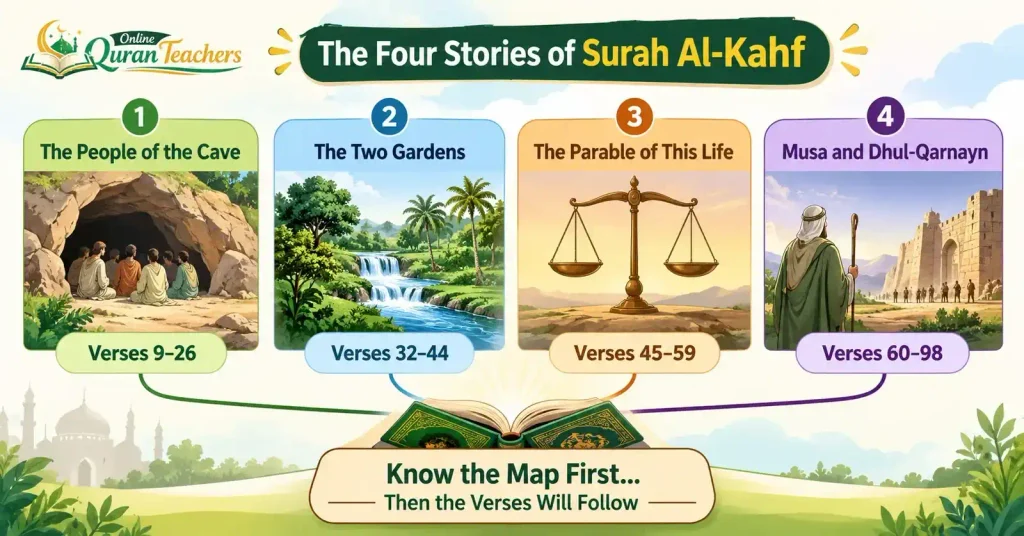
Surah Al-Kahf is built from four narratives separated by passages of reflection. Learn the map first; the verses will follow the plot.
Call this the Four-Story Anchor Method: you never memorise “verse 58,” you memorise “the fourth verse of the parable section, just before the Day of Judgment passage.” Position inside a story is far easier to recall than a number.
| Verses | Section |
| 1–8 | Opening: the Book, the warning, the adornment of the earth |
| 9–26 | The People of the Cave |
| 27–31 | Patience with the believers, and the reward of each group |
| 32–44 | The two gardens and the man proud of his wealth |
| 45–59 | The parable of this life, the Day of Judgment, and Iblis |
| 60–82 | Musa and the knowledgeable servant (al-Khidr) |
| 83–98 | Dhul-Qarnayn |
| 99–110 | The final scenes and the closing verses |
Before each new block, read a short tafsir or translation of that block only. Once you know that Musa sets out with his companion, loses the fish, meets the servant, and then the boat, the boy and the wall come in that order, you are no longer memorising a sequence you are following one.
3. Set A Daily Target In Lines, Not Pages
Surah Al-Kahf runs to about 169 lines in the Madani Mushaf. Setting your target in lines gives you an honest completion date instead of a hopeful one.
Before choosing your daily target, consider how much time you can dedicate to memorisation and revision without rushing. A smaller, consistent portion is often more effective than memorising several lines quickly and struggling to retain them later.
| New lines per day | Days of new memorisation |
| 3 lines (a few lines) | 57 days |
| 5 lines (a third of a page) | 34 days |
| 7 lines (half a page) | 25 days |
| 10 lines (two thirds of a page) | 17 days |
| 15 lines (a full page) | 12 days |
If fitting this around work and family is the obstacle, a structured schedule with a tutor removes the guesswork private one-on-one Quran classes are built around your available hours rather than a fixed class timetable, which is usually the difference between a plan that holds and one that stalls in week two.
4. Fix The Tajweed Of A Passage Before You Memorise It
Memorise a word wrongly and you have not learned one thing you have learned one thing plus a habit that takes months to break. Read each new portion aloud from the Mushaf until it is fluent and correct, then start committing it to memory.
The rules that appear most often in Surah Al-Kahf are ghunnah on the doubled noon and meem, ikhfa after noon sakinah, idgham at several verse boundaries, and the madd types that set the rhythm of the long narrative passages.
The reliable fix is correction by ear from someone qualified. Recording yourself and comparing against a reciter catches obvious errors, but it will not catch a subtly wrong makhraj which is exactly the kind of mistake that survives for years.
Learning with native Arab Quran teachers solves this at the source, because the correction happens in the same session as the mistake.
5. Use The Chunk-And-Link Cycle On Every New Portion
Work in chunks of three to five verses, and never leave a chunk floating on its own. Breaking the Surah into smaller sections makes memorisation less overwhelming and gives your mind enough time to absorb each passage.
Focus on mastering one chunk before moving to the next, paying attention to pronunciation, Tajweed rules, and the connection between verses.
This approach helps you build a strong, continuous recitation rather than memorising isolated verses that are difficult to recall together. For each chunk, run this cycle:
- Listen to the chunk from one reciter at least five times before you attempt it
- Recite it aloud slowly with the Mushaf open, watching your Tajweed
- Close the Mushaf and recite from memory, returning to the text the moment you slip
- Repeat until you reach three consecutive error-free recitations
- Recite the new chunk joined to the previous one, as a single run
Memorising chunks without linking them produces a learner who can recite any five verses on request and cannot recite thirty in sequence.
Read also: Quran Memorization With Tajweed
Watch our Real Online Quran Class
See how our online Quran lessons are conducted with this short class sample. Experience our interactive teaching approach, clear pronunciation guidance, and engaging learning environment before starting your own Quran learning journey.
Learn Quran Online with Expert Teachers
Start your personalized journey with qualified tutors today. Flexible schedules tailored to your routine.
Book Your Free Trial6. Drill The Mutashabihat Of Surah Al-Kahf Before They Trap You
Mutashabihat are verses that resemble each other closely in wording or structure. Surah Al-Kahf has three clusters of them, and they cause more lost memorisation than everything else combined which is why any serious answer to how to memorise Surah Al-Kahf has to deal with them early rather than after the damage.
When two passages sound similar, learners may accidentally replace a word, miss a phrase, or continue with the wording of another verse. Identifying these similarities early and studying the differences side by side helps prevent confusion and strengthens long-term retention.
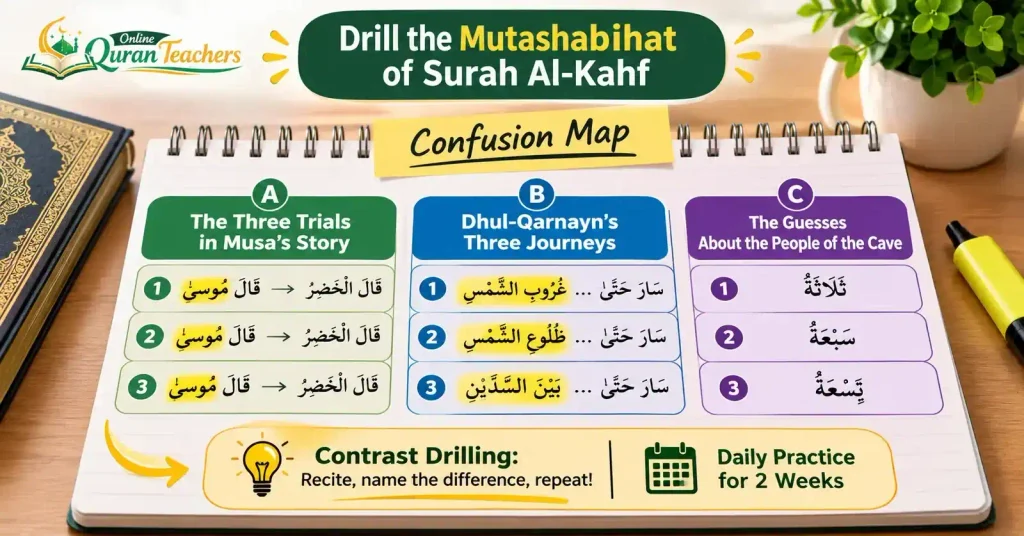
A. The three trials in the story of Musa
Each episode in verses 71–82 follows the same shape: they travel, the servant does something that appears wrong, Musa objects, the servant answers.
The wording of Musa’s objection and the reply shifts slightly each time. Write the three pairs side by side, mark the exact words that differ, and say the difference aloud before you recite “this is the second one, it begins differently.”
B. Dhul-Qarnayn’s three journeys
In verses 85–93, the same travel phrase opens each journey. Fix the order of destinations in your head first where the sun sets, where it rises, then between the two barriers and the wording stops competing for the same slot.
Visualising these three locations in their correct sequence creates a mental roadmap that makes the verses easier to distinguish and recall accurately during recitation.
C. The guesses about the People of the Cave
Verse 22 lists several estimates of how many were in the cave. Learn the order of the numbers before you learn the sentence around them.
Contrast drilling is the technique: recite two similar verses back to back deliberately, name the difference out loud, then move on. Keep a one-page “confusion map” of your own problem pairs and run it daily for two weeks.
The list is personal your trouble spots will not match anyone else’s, which is why generic advice on memorizing surah kahf rarely helps at this stage.
7. Drill The Transitions Between Stories Separately
The seams between stories are the weakest points in the entire Surah. Your mind indexes each story as a closed unit, so when you reach the end of one you hesitate before the next opens. The three places this happens are verses 26–27, 44–45 and 82–83.
Paying special attention to these transitions helps you maintain the correct sequence without relying on prompts.
Treat each seam as its own micro-portion: recite the last two verses of the outgoing story joined to the first two of the incoming one, five minutes a day, until the join is as smooth as the middle of a passage. Repeat the transition from both directions to strengthen your recall and make the connection more automatic.
This single habit is what separates someone who has memorised four stories from someone who has memorised Surah Al-Kahf.
8. Build The Weekly Revision System Before You Need It
Memorisation decays without reinforcement, and the decay is fastest in the first days after a portion is learned. Freshly memorised verses have not yet been recalled enough times to hold on their own. That is not weak memory; that is how memory works, and it is the point where how to memorise Surah Al-Kahf turns into how to keep it.
A structured weekly revision plan helps strengthen what you have already memorised, identify verses that need more attention, and prevent earlier portions from gradually fading. The following schedule balances daily revision with full-Surah recitation to help you maintain your progress over time.
| Day | Revision focus |
| Saturday | Verses 1–30 |
| Sunday | Verses 31–60 |
| Monday | Verses 61–90 |
| Tuesday | Verses 91–110 |
| Wednesday | Full Surah, continuous, no stopping |
| Thursday | Weak spots and mutashabihat drilling |
| Friday | Full recitation as Sunnah — ideally inside Salah |
9. Turn The Friday Recitation Into A Weekly Test
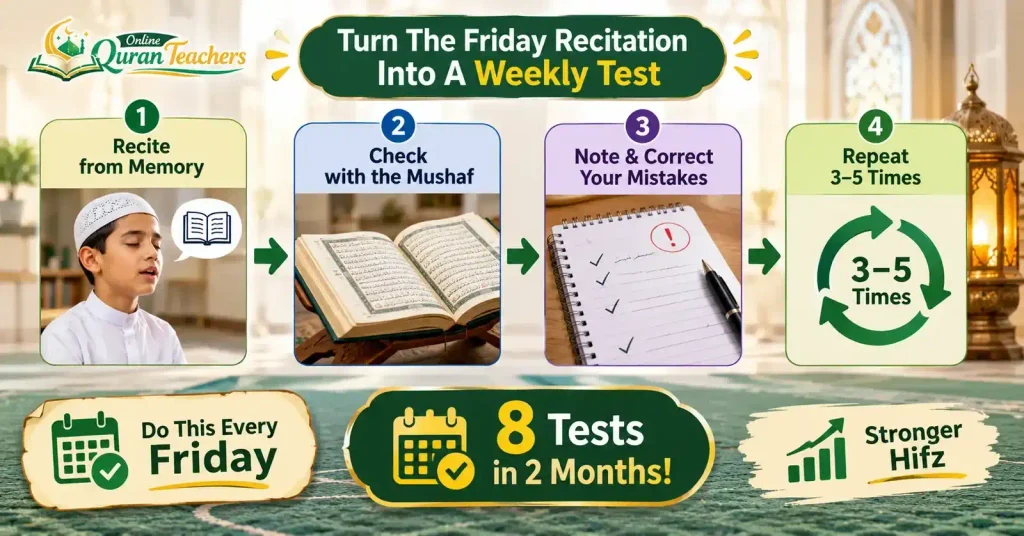
Reciting Surah Al-Kahf on Friday is a widespread practice, and it doubles as the best revision slot you will ever get for free.
Change one thing about how you do it: recite from memory first, and only open the Mushaf afterwards to check. Most people read it straight from the page, which revises their reading and not their hifz.
Recite what you hold, note where you stumbled, correct those lines three to five times, and you have converted a weekly habit into a weekly diagnostic without adding a minute to your schedule.
Over two months this produces something unusual surah kahf memorization that is tested eight times before you ever claim to have finished it.
10. Get Corrected By A Qualified Teacher On A Fixed Schedule
Self-assessment has a ceiling. You cannot hear the mistake you do not know exists. Submit your memorisation aloud to a qualified teacher at least weekly.
The teacher catches drift a vowel that has slowly shifted, a madd shortened by half a count, a verse ending that has quietly borrowed its wording from a similar verse elsewhere in the Surah.
These errors are invisible from the inside and trivial to fix from the outside, as long as someone is listening. Learning with an Azhar-qualified Egyptian Quran teacher gives you that correction with the sanad-based training behind it, which matters most in a Surah this long.
Read also: Quran Recitation With Tajweed
Experience our Online Quran Lesson
Take a look inside a live online Quran session and discover how students learn with personalized instruction, step-by-step guidance, and a supportive learning atmosphere.
Learn Quran Online with Expert Teachers
Start your personalized journey with qualified tutors today. Flexible schedules tailored to your routine.
Book Your Free TrialStart Your Hifz of Surah Al-Kahf With a Qualified Teacher This Week
You already have the method. What most learners are missing is the correction loop and someone holding the schedule steady when the second week gets hard.
Quran Online Academy pairs you with a qualified tutor, builds your daily portion around your actual availability, and tests your revision every session — so the verses you learned in week one are still there in week six. Book a free trial lesson and start Surah Al-Kahf with a plan instead of a hope.
Our Hifz & Quran Courses:
- Quran Memorization Course
- Hifz for Kids Course
- Hifz for Adults Course
- Hifz for Ladies Course (with Female Hifz Teachers)
- Quran Ijazah Program (with Certified Teachers)

Conclusion
Learning how to memorise Surah Al-Kahf comes down to four decisions: start with the first and last ten verses, split the Surah by story rather than by page, drill the mutashabihat and story transitions deliberately, and protect what you have learned with revision that runs before every new portion.
Set your daily target in lines so your timeline is real. Stay with one reciter. Use Friday as a test rather than a reading. And get corrected by someone qualified every week, because the mistakes that cost you most are the ones you cannot hear. Regular self-testing and teacher feedback will help you identify weak areas before they become deeply rooted.
Four weeks of half a page a day, or eight weeks at a gentler pace — either way, the Surah becomes something you carry rather than something you look up. The key is to choose a pace you can sustain and keep revising until the verses become firmly established in your memory.
Frequently Asked Questions
How long does it take to memorise Surah Al-Kahf?
Surah Al-Kahf takes about four weeks at half a page (seven lines) a day, or around eight weeks at a third of a page. The Surah is roughly 169 lines, so your daily line target sets your timeline. Add equal time for revision on top of new memorisation.
Should I memorise Surah Al-Kahf in order from verse 1?
No — start with the first ten verses, then the last ten, then return to verse 11 and work forward. The opening and closing verses carry the protection mentioned in Sahih Muslim 809, and securing both ends first gives every later full recitation a firm start and finish.
Which parts of Surah Al-Kahf are hardest to memorise?
The three trials of Musa and al-Khidr (verses 71–82), Dhul-Qarnayn’s three journeys (verses 85–93), and verse 22’s list of numbers are the hardest, because each repeats a near-identical structure. Drill these pairs side by side and name the difference aloud before reciting.
How often should I revise Surah Al-Kahf after memorising it?
Recite the full Surah once a week, ideally on Friday and from memory before checking the Mushaf. Use one section in your night prayer daily, and check the Musa and Dhul-Qarnayn passages against the text monthly — those fade first.
Do I need to understand Arabic to memorise Surah Al-Kahf?
No, You do not need to speak Arabic, but you do need to know what each passage says. Read a short translation or tafsir of a section before memorising it. Surah Al-Kahf is almost entirely narrative, so knowing the sequence of events makes the order of the verses follow naturally.
Can children memorise Surah Al-Kahf?
Yes, with shorter portions and more repetition. Three lines a day with a story summary before each section suits most children, and the narrative structure of Surah Al-Kahf holds their attention better than non-narrative Surahs of similar length.








Leave a Reply