 Quran
Quran
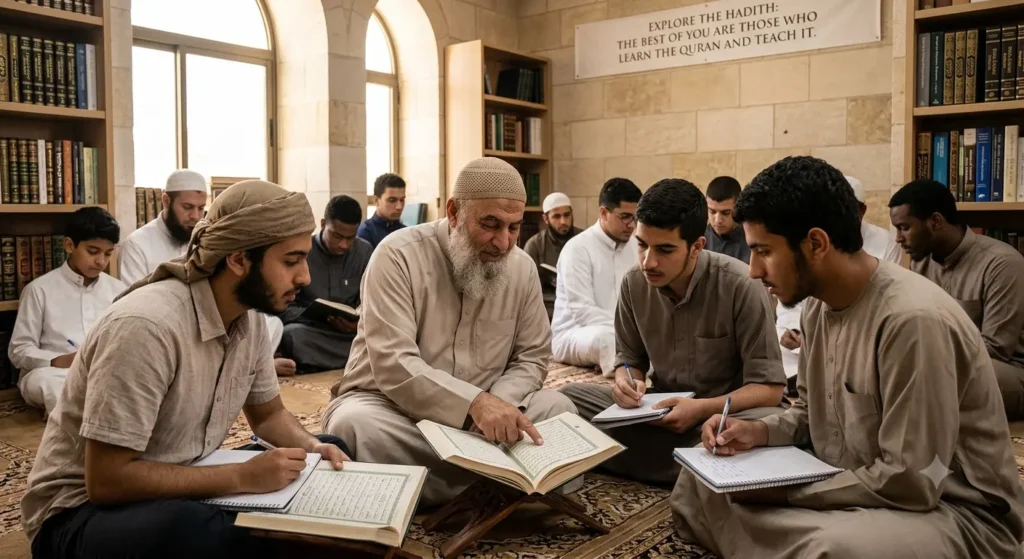
Most non-Arabic speakers learning the Quran reach a frustrating ceiling: they can read the letters, follow along with a recording, and even memorize passages — yet their recitation still sounds off. The gap isn’t effort. It’s the teacher.
Understanding the benefits of learning Quran with a native teacher is the first step toward a decision that will shape your recitation for years.
A native speaker grew up hearing Makharij points, absorbing the rhythm of Classical Arabic, and reading the Quran in the same living tradition in which it was revealed. That lived relationship with the language produces a caliber of instruction that textbooks and recordings cannot replicate — because Tajweed is not a ruleset you memorize. It is a sound you internalize from someone who has carried it since childhood.
If you are serious about reciting correctly and understanding the Quran deeply, the choice of a native Arab teacher is one of the most consequential decisions you will make on this path..
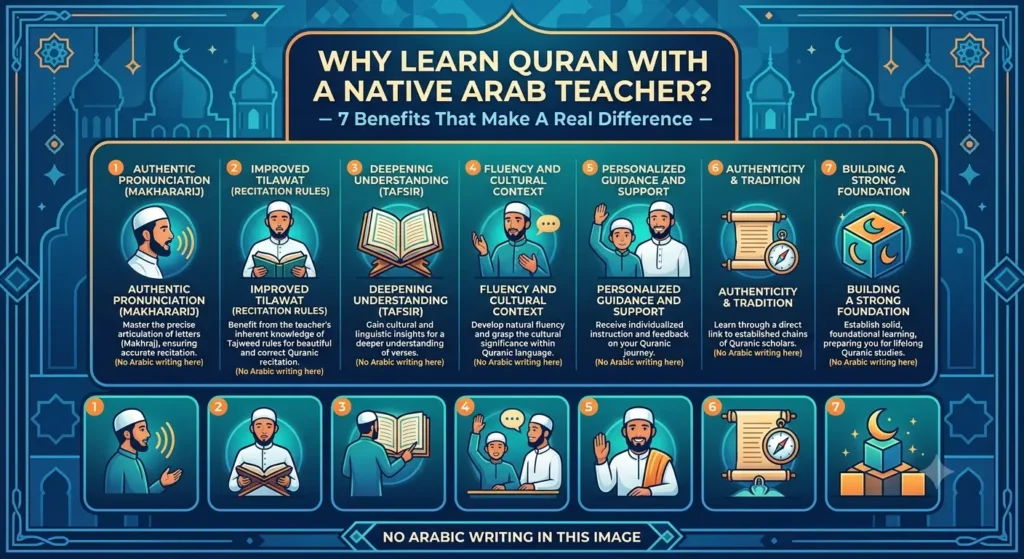
1. Learning Accurate Makharij From A Teacher Whose Mouth Mastered Them Naturally
Makharij — the precise articulation points where each Arabic letter originates — cannot be approximated. Arabic contains seventeen distinct points of articulation, from the deepest part of the throat to the lips. Several of these sounds have no equivalent in English, French, Urdu, or any other major non-Semitic language.
The letters ع (Ayn), ح (Ha), خ (Kha), غ (Ghayn), and ق (Qaf) are the most frequently mispronounced by non-native learners and they appear throughout the Quran.
A non-native teacher who never fully mastered these sounds themselves will pass the approximation to their students. A native Arab teacher produces these sounds automatically and can model them repeatedly until the student’s ear and mouth align.
This is not a minor technical detail. Pronouncing ح as a regular “h,” or ع as a glottal stop, changes words. In Quranic recitation, changed words mean changed meaning — and that carries weight beyond simple grammar.
Why Does Real-Time Correction Change Recitation?
The pedagogical mechanism that makes native teachers uniquely effective is immediate auditory correction. When a native Arab Quran teacher hears a mispronounced letter, they identify it within milliseconds — because it registers as wrong against their own internalized standard.
They can then model the correct sound, have the student repeat, and confirm or re-correct in the same breath.
Non-native teachers work from a memorized ruleset: they think about what the rule says and then apply it. Native teachers work from instinct. That difference in processing speed means more corrections per lesson, faster habit formation, and a higher ceiling for the student’s eventual recitation quality.
2. Receiving Authentic Tajweed Correction Backed By An Unbroken Chain
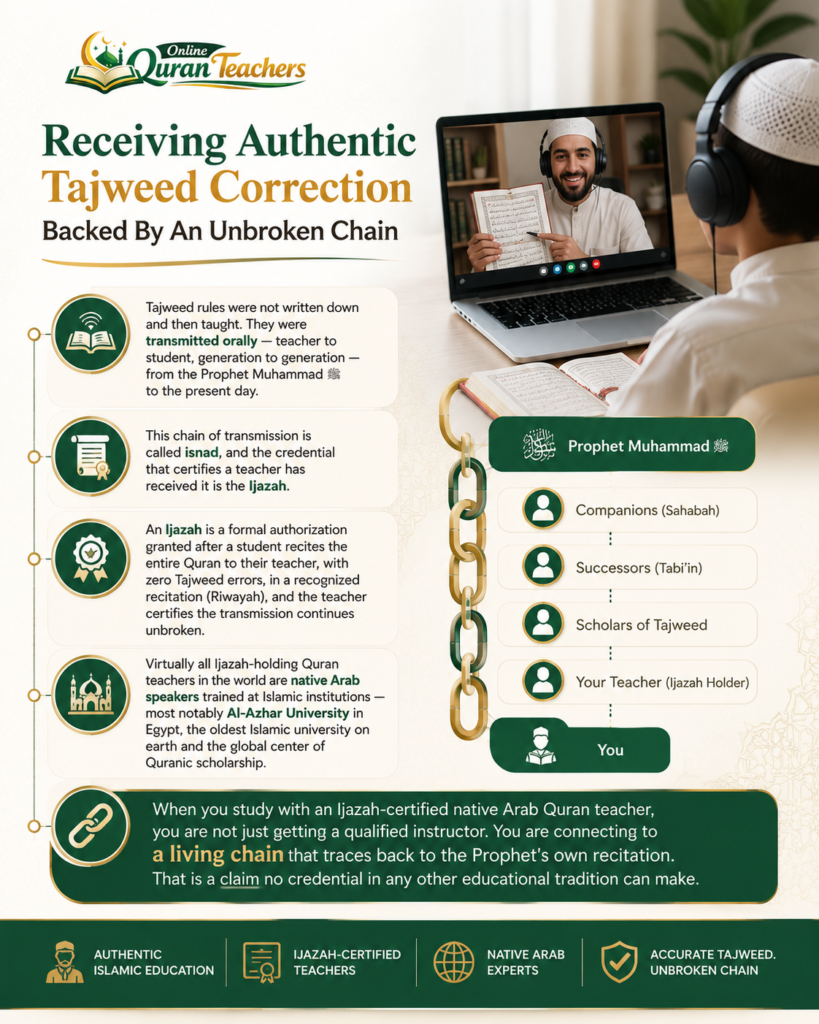
Tajweed rules were not written down and then taught. They were transmitted orally — teacher to student, generation to generation — from the Prophet Muhammad ﷺ to the present day.
This chain of transmission is called isnad, and the credential that certifies a teacher has received it is the Ijazah.
An Ijazah is a formal authorization granted after a student recites the entire Quran to their teacher, with zero Tajweed errors, in a recognized recitation (Riwayah), and the teacher certifies the transmission continues unbroken.
Virtually all Ijazah-holding Quran teachers in the world are native Arab speakers trained at Islamic institutions — most notably Al-Azhar University in Egypt, the oldest Islamic university on earth and the global center of Quranic scholarship.
When you study with an Ijazah-certified native Arab Quran teacher, you are not just getting a qualified instructor. You are connecting to a living chain that traces back to the Prophet’s own recitation. That is a claim no credential in any other educational tradition can make.
Online Quran Teachers connects students with native Arab Quran teachers who hold verified Ijazah certification, so you can be confident your recitation is rooted in the authentic tradition — not an approximation of it.
3. Understanding Linguistic Nuance That Translations Cannot Carry
The Quran was revealed in Classical Arabic — a language of extraordinary rhetorical precision. Its words carry layers of meaning that developed over centuries of oral tradition and scholarship.
Many of these layers are invisible in translation and inaccessible to a teacher who did not grow up inside the Arabic language. A native Arab teacher can explain why a specific word was used rather than its synonym.
They can draw attention to the rhetorical structure of a verse (balaghah), explain the linguistic weight of a particular root word (jidhr), or show how a verse’s meaning shifts depending on the grammatical reading — a distinction that Quranic Arabic allows and that translations flatten into a single sentence.
Read also: How Long Does It Take to Learn the Quran with a Teacher?
How Meaning Gets Lost Without a Native Guide?
Consider the word tawakkul (توكل). A non-native teacher might translate it as “reliance on God.”
A native Arab scholar of Quran will explain that tawakkul carries the connotation of complete surrender after exhausting your own means — not passive inaction, but active trust following action. That distinction changes how a student understands the verse and applies the teaching to their life.
This depth of linguistic transmission is what serious Quran students mean when they say they want to “understand the Quran in Arabic.” They mean this layer — the one that only survives intact with a native Arab teacher guiding the reading.
Read Also: How to Become a Quran Teacher
Experience an Online Quran Lesson
Take a look inside a live online Quran session and discover how students learn with personalized instruction, step-by-step guidance, and a supportive learning atmosphere.
Learn Quran Online with Expert Teachers
Start your personalized journey with qualified tutors today. Flexible schedules tailored to your routine.
Book Your Free Trial4. Benefiting From The Egyptian Teacher Tradition And Al-Azhar’s Scholarly Standard
Among native Arab Quran teachers, Egyptian teachers trained at Al-Azhar University carry a specific and widely recognized distinction.
Al-Azhar has been the world’s most authoritative center of Islamic and Quranic scholarship for over a millennium. Its teachers have produced the global standard for Tajweed instruction, and the Egyptian Arabic dialect — due to Egypt’s dominant media and cultural output — is the most widely understood across the Arab world.
Read also: Quran Teacher Near Me — Why Online Is the Better Answer?
What Makes Egyptian Quran Teachers Stand Apart?
Egypt’s Al-Azhar University has been the world’s most authoritative center of Islamic and Quranic scholarship for over a millennium. Teachers who graduate from its Quran faculties do not simply hold a qualification — they carry a living pedagogical tradition refined across centuries of teaching the Quran to students from every corner of the world. That tradition produces three compounding advantages you will not find combined in any other teaching background.
A. The Most Rigorous Quran Curriculum on Earth
Al-Azhar’s curriculum for Quran instruction covers not just recitation but Tafsir (exegesis), Quranic sciences (Ulum al-Quran), and the ten recognized Qira’at (recitation traditions) — a scope no other institution matches in depth or breadth.
B. Centuries of Teaching Non-Native Speakers
Egyptian teachers have the longest documented history of teaching the Quran to non-native learners. Egypt has been a destination for Islamic scholarship from Sub-Saharan Africa, South Asia, Southeast Asia, and the Western world for centuries. Al-Azhar’s teachers developed pedagogical approaches for non-Arabic learners that institutions in other countries simply have not had the time or volume of students to refine.
C. The Most Widely Understood Arabic Dialect
The Egyptian Arabic dialect is the most comprehensible across the Arab world due to Egypt’s dominant media and cultural output. This means Egyptian teachers explain, clarify, and connect concepts across diverse student backgrounds more clearly than teachers from any other dialect region.
If you are specifically seeking an Egyptian Quran teacher trained at Al-Azhar, that combination — native speaker, formal certification, Al-Azhar methodology — represents the highest available standard for Quran education.

Read also: Learning Quran With A Teacher Vs Apps & Self-Study – Which Actually Works?
5. Building Arabic Intuition Through Immersive Instruction
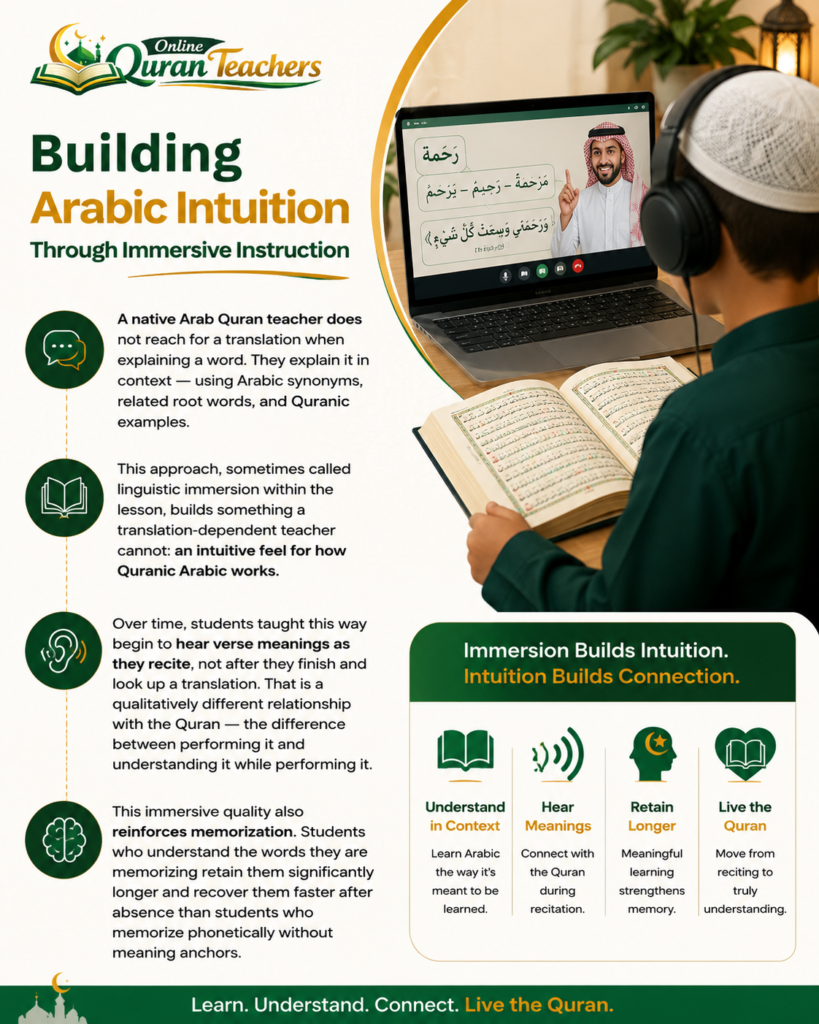
A native Arab Quran teacher does not reach for a translation when explaining a word. They explain it in context — using Arabic synonyms, related root words, and Quranic examples. This approach, sometimes called linguistic immersion within the lesson, builds something a translation-dependent teacher cannot: an intuitive feel for how Quranic Arabic works.
Over time, students taught this way begin to hear verse meanings as they recite, not after they finish and look up a translation. That is a qualitatively different relationship with the Quran — the difference between performing it and understanding it while performing it.
This immersive quality also reinforces memorization. Students who understand the words they are memorizing retain them significantly longer and recover them faster after absence than students who memorize phonetically without meaning anchors.
6. Preventing Entrenched Mistakes Through Immediate Error Detection
There is a principle in skill acquisition sometimes called the error window: the longer an incorrect motor pattern goes uncorrected, the more neural pathways it builds, and the harder it becomes to override.
In Quran recitation, this means a mispronounced letter practiced daily for months becomes genuinely difficult to correct — not just embarrassing, but neurologically resistant to change.
Native Arab Quran teachers minimize the error window because they detect mistakes the moment they happen. Non-native teachers often let small errors pass because they do not register as wrong against their own internalized standard. By the time the student reaches a more qualified teacher, the error is deeply embedded.
For Quran classes for adults — where learners often come with years of self-taught or poorly supervised recitation — native Arab teachers are not just preferable. They are necessary for genuine correction to occur.
What Correct Error Detection Looks Like In Practice?
A trained native teacher hears the difference between ض and ظ instantly. They stop the student mid-word, not at the end of the verse.
They model the correct sound, have the student repeat it in isolation, then reintegrate it into the word, then the phrase. This micro-correction loop — stop, model, isolate, reintegrate — is the standard method used by Al-Azhar-trained teachers and produces measurably faster improvement than end-of-session feedback.
Read Also: How to Choose a Quran Teacher
7. Gaining A Deep Foundation In Islamic Ethics And Quranic Understanding
The Quran is not only a book of recitation. It is the foundational text of Islamic belief, ethics, and law. Native Arab teachers trained in the Islamic scholarly tradition bring contextual knowledge that lifts a student’s relationship with the Quran beyond pronunciation — into understanding and application.
This includes explaining the reasons behind a verse’s revelation (asbab al-nuzul), identifying which verses were revealed in Makkah versus Madinah and what that distinction means for interpretation, and connecting the linguistic content to the broader body of Islamic scholarship.
A native Arab teacher with formal Islamic education is not just a recitation coach — they are a guide to the text’s full dimension.
For students working through private one-on-one Quran lessons, this depth of engagement is what distinguishes a transformative Quran education from a functional one.
Experience an Online Quran Lesson
Take a look inside a live online Quran session and discover how students learn with personalized instruction, step-by-step guidance, and a supportive learning atmosphere.
Learn Quran Online with Expert Teachers
Start your personalized journey with qualified tutors today. Flexible schedules tailored to your routine.
Book Your Free TrialStart Learning Quran with a Verified Native Arab Teacher Today
Online Quran Teachers connects you with Ijazah-certified native Arab tutors — including Al-Azhar-trained Egyptian Quran teachers — for private, one-on-one lessons built around your schedule, your level, and your goals.
Whether you are a complete beginner, an adult returning to Quran study, or someone serious about mastering Tajweed, your teacher is selected to match exactly where you are.
Your first lesson is free. No commitment. No pressure. Just the clearest Quran instruction you have ever experienced.
Book Your Free Trial Lesson with Online Quran Teachers.
Our Online Quran Teacher & Course Options
- Quran Teachers for Kids & Quran Course for Kids
- Female Quran Teachers & Quran Classes for Ladies
- Male Quran Teachers & Quran Classes for Men
- Quran Teachers for Beginners & Quran Course for Beginners
- Quran Teachers for Adults & Quran Classes for Adults
- Native Arab Quran Teachers
- Egyptian Quran Teachers & Al-Azhar Course
- Private One-on-One Quran Tutors & Private Classes
- Quran Teachers on Skype & Zoom & Online Classes
Enroll today and start learning the Quran with a dedicated teacher who matches your goals, schedule, and learning style.
Conclusion
The case for learning Quran with a native Arab teacher is not sentimental — it is structural. Native speakers carry the sounds of Classical Arabic in their muscle memory, hold the Ijazah chains that verify authentic transmission, and bring linguistic depth to Quranic meaning that no translation or non-native teacher can fully provide.
Egyptian teachers trained at Al-Azhar add a layer of pedagogical precision refined over a thousand years of teaching the Quran to the world.
If your goal is correct Tajweed, genuine understanding, and a relationship with the Quran that grows deeper over time — the native Arab teacher is not one option among several. It is the standard worth pursuing.
Frequently Asked Questions
The questions below address what students most commonly ask before choosing a native Quran teacher. Each answer is written to give you a clear, direct response you can act on.
1. What is the benefit of learning Quran with a native Arab teacher?
A native Arab Quran teacher provides accurate Makharij modeling, real-time Tajweed correction, and linguistic access to the Quran’s Classical Arabic meanings — all of which are significantly harder to achieve with a non-native instructor. Their lifelong immersion in Arabic allows them to detect and correct errors instantly, preventing the entrenched mispronunciations that stall student progress.
2. What is an Ijazah and why does it matter for Quran teachers?
An Ijazah is a formal certification granted to a teacher who has recited the entire Quran to their own Ijazah-holding teacher with zero Tajweed errors. It represents an unbroken oral chain of transmission from the Prophet Muhammad ﷺ to the present. Almost all Ijazah holders are native Arab speakers trained at institutions like Al-Azhar. Studying with an Ijazah-certified teacher connects your recitation to that authenticated chain.
3. Why are Egyptian Quran teachers considered among the best?
Egyptian Quran teachers trained at Al-Azhar University carry the benefit of the world’s oldest and most rigorous Islamic scholarly tradition. Al-Azhar’s Tajweed curriculum is among the most comprehensive available, and Egyptian teachers have centuries of experience teaching non-native speakers. The Egyptian Arabic dialect is also the most widely understood across the Arab world, making communication and explanation clearer for diverse students.
4. Can I learn Quran correctly from a non-native teacher?
A non-native teacher can provide a useful introduction, but they carry a significant risk: they may pass on their own Makharij approximations and Tajweed gaps without realizing it. For students who want to recite correctly in Salah, pursue Hifz, or eventually seek Ijazah certification, a native Arab teacher is necessary. The longer you practice incorrect sounds, the harder they are to unlearn.
5. Is online Quran learning with a native Arab teacher effective?
Yes — provided the sessions are live and one-on-one, not pre-recorded. Real-time instruction allows the teacher to hear your recitation, detect errors in the moment, and correct them immediately. That correction loop is the engine of Tajweed improvement. Online Quran Teachers delivers exactly this: live, private sessions with verified native Arab tutors available globally.
6. At what level should I start learning with a native Arab Quran teacher?
From the very beginning. Foundational habits — how you position your tongue for ع, how you distinguish ص from س, how you elongate Madd letters — form in your earliest lessons and are difficult to change later. Starting with a native Arab Quran teacher from day one means building a correct foundation rather than spending months or years correcting an incorrect one.






Leave a Reply