 Quran
Quran
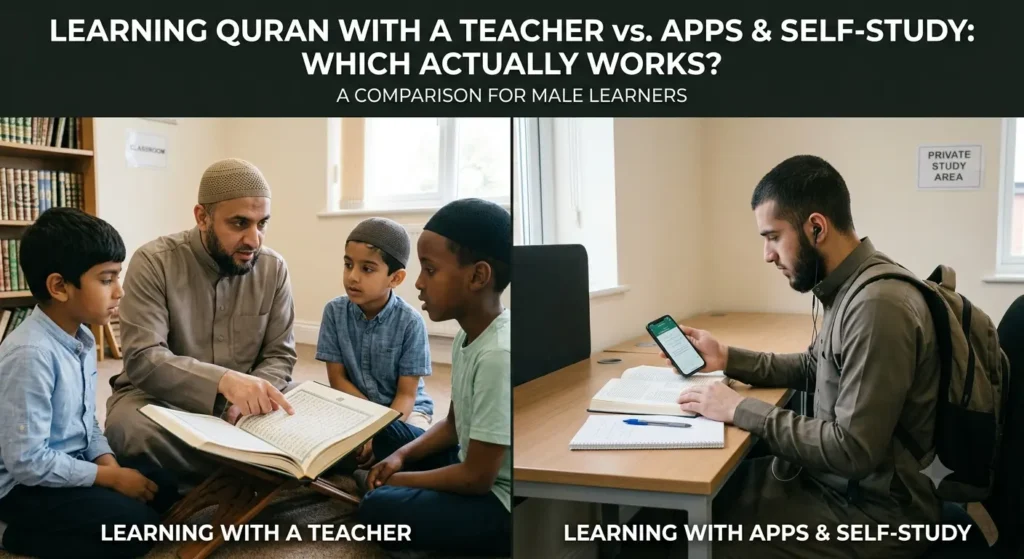
You opened a Quran app, completed a few lessons, and felt good about the progress — then stalled. Or maybe you’re still deciding how to begin, and the sheer number of options is the problem. Either way, the core question is the same: can you really learn the Quran without a teacher, or does an app eventually hit a wall?
The difference between learning Quran with a teacher and learning through apps or self-study is this: a teacher corrects your recitation in real time and transmits the Quran the way it has always been transmitted — orally, directly, and with verified accuracy.
Apps provide flexibility and daily practice support, but they cannot hear you, correct your articulation, or certify that what you are reciting is correct.
This article compares both paths honestly — what each does well, where each falls short, and why the best way to learn Quran online almost always places a live instructor at the center.
A. What Quran Apps Do Well?
Apps occupy a genuine and valuable role in a learner’s toolkit. Dismissing them entirely misses what they actually deliver.
1. Flexibility And Daily Habit Formation
A Quran app is available at 6 a.m. before work, during a commute, or in a five-minute window between tasks. For building a daily review habit — which Islamic tradition itself recommends — that flexibility is hard to beat. Consistent short sessions of even 10–15 minutes consolidate memorization more effectively than occasional long sittings.
2. Translation, Tafsir Access, And Vocabulary Building
Apps like Quran.com give learners instant access to word-by-word translations, multiple Tafsir commentaries, and transliterations. For someone building Quranic Arabic vocabulary or deepening understanding of meaning (tadabbur), this is genuinely useful — and something a weekly teacher session alone cannot fully cover.
3. Revision And Repetition Between Teacher Sessions
This is where apps provide their clearest value: between live classes. A student who meets their teacher twice a week can use an app to revise assigned verses daily, listen to a preferred reciter’s audio, and reinforce what the teacher has already corrected. The app maintains the gains the teacher creates.
B. Where Self-Study and Apps Fall Short
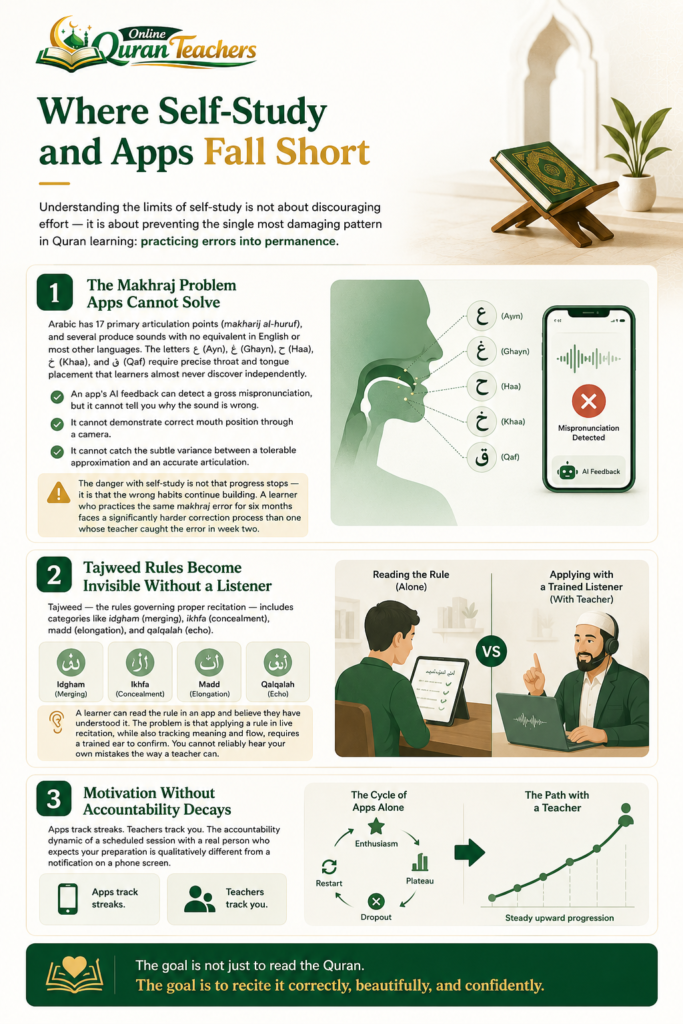
Understanding the limits of self-study is not about discouraging effort — it is about preventing the single most damaging pattern in Quran learning: practicing errors into permanence.
1. The Makhraj Problem Apps Cannot Solve
Arabic has 17 primary articulation points (makharij al-huruf), and several produce sounds with no equivalent in English or most other languages. The letters ع (Ayn), غ (Ghayn), ح (Haa), خ (Khaa), and ق (Qaf) require precise throat and tongue placement that learners almost never discover independently. An app’s AI feedback can detect a gross mispronunciation, but it cannot tell you why the sound is wrong, demonstrate correct mouth position through a camera, or catch the subtle variance between a tolerable approximation and an accurate articulation.
The danger with self-study is not that progress stops — it is that the wrong habits continue building. A learner who practices the same makhraj error for six months faces a significantly harder correction process than one whose teacher caught the error in week two.
2. Tajweed Rules Become Invisible Without a Listener
Tajweed — the rules governing proper recitation — includes categories like idgham (merging), ikhfa (concealment), madd (elongation), and qalqalah (echo). A learner can read the rule in an app and believe they have understood it. The problem is that applying a rule in live recitation, while also tracking meaning and flow, requires a trained ear to confirm. You cannot reliably hear your own mistakes the way a teacher can.
3. Motivation Without Accountability Decays
Apps track streaks. Teachers track you. The accountability dynamic of a scheduled session with a real person who expects your preparation is qualitatively different from a notification on a phone screen. Most learners who rely on apps alone experience recurring motivation cycles — enthusiasm, plateau, dropout, restart — rather than the steady upward progression that teacher-guided learning produces.
Read also: Why Learn Quran With A Native Arab Teacher?
C. Can You Learn the Quran Without a Teacher?
You can learn about the Quran without a teacher — vocabulary, translations, basic surah memorization, and general context.
What you cannot reliably do without a teacher is develop correct recitation: pronunciation accurate at the makhraj level, Tajweed-compliant, and free of embedded errors. For most learners, particularly non-Arabic speakers, self-study alone produces recitation that sounds fluent but contains technical flaws that become harder to correct over time.
The scholarly position is consistent: Quran recitation is acquired through listening and oral correction, not reading and guessing. Apps can support that process. They cannot replace it.
Read Also: Best Practices for Teaching the Quran Online
Experience a Real Classroom
Curious about how we teach? This video offers a glimpse into a real class, showcasing our interactive approach, qualified teachers, and child-friendly learning experience.
Fun & Engaging Islamic Classes for Kids
Start your child’s journey today with interactive lessons designed to make learning Islam loved and easy.
Get Your Child a Free TrialRead also: How Long Does It Take to Learn the Quran with a Teacher?
D. When To Use Each Method?
Rather than choosing one path permanently, the most practical approach is matching the tool to your current stage.
1. Complete Beginner (Arabic alphabet unknown)
Use a live teacher from day one. Start with the Noorani Qaida under direct instruction. Makhraj errors formed at this stage are the hardest to correct later.
2. Basic Reader (letters known, recitation developing)
Use a live teacher as the primary method and an app for daily practice between sessions. At this stage, the app reinforces what the teacher is building — it does not lead.
3. Intermediate (reading fluently, Tajweed learning)
Use a teacher for Tajweed correction and rule application, and an app for revision of memorized material and vocabulary deepening. This is the stage where apps provide their clearest supplementary value.
4. Hifz / Memorization Goal
Use a teacher consistently and without substitution. Hifz without a teacher creates undetected errors in memorized material that surface — often during prayer — later on.
5. Advanced (Tafsir, Qiraat, Ijazah pursuit)
Use a qualified, Ijazah-certified teacher exclusively. No app provides the chain of transmission required for this level.
This framework answers the question most comparison articles avoid: it is not whether to use an app — it is what role the app plays at each stage of your development.
Read also: Quran Teacher Near Me
E. What a Live Quran Teacher Provides That Cannot Be Replicated
Learning the Quran with a teacher delivers specific, concrete benefits that go beyond general guidance.
1. Real-Time Error Correction with Explanation
A teacher does not just flag that a sound is wrong — they explain why it is wrong and give you a physical or auditory reference point to self-correct. “Your ع is coming too far forward — pull it deeper into the throat” is the kind of specific instruction that transforms pronunciation in a single session. Apps produce a red flag. Teachers produce understanding.
2. Accountability That Sustains Progress
The scheduled commitment, the teacher’s expectation, and the student-teacher relationship all function as accountability structures that apps cannot recreate. Learners working with a live teacher consistently show more sustained, measurable progress than self-study learners across the same period.
3. Adapting to Your Specific Weaknesses
Every learner has a unique error profile. One student struggles with madd elongation; another conflates ق and ك; a third rushes through ikhfa rules. A qualified teacher identifies the pattern behind errors — not just the errors themselves — and targets instruction accordingly. This is personalized learning in its most meaningful form.
If you’re looking to learn Quran with a teacher online, Online Quran Teachers connects you with certified instructors across recitation, Tajweed, Hifz, and Tafsir — with flexible scheduling built around your time zone and availability.
Read also: One-On-One Vs Group Quran Classes – Which Format Actually Gets Results?
F. Quran App vs Teacher
The table below breaks down the key differences across the factors that matter most to learners: correction quality, accountability, flexibility, and suitability for specific goals like Hifz and Ijazah. Use it as a quick reference when deciding how to structure your own learning path.
| Factor | Quran App / Self-Study | Live Quran Teacher |
| Makhraj correction | Limited / inaccurate | Real-time, precise |
| Tajweed application | Rule reference only | Applied and verified |
| Accountability | Notification-based | Scheduled relationship |
| Flexibility | Anytime, anywhere | Scheduled sessions |
| Cost | Free or low cost | Ongoing investment |
| Hifz support | Cannot verify accuracy | Essential |
| Daily revision | Ideal | Supplement needed |
| Vocabulary / Tafsir | Strong | Varies by teacher |
| Isnad / transmission | Not applicable | Core to Quran learning |
| Best for beginners | Risk of embedding errors | Strongly recommended |
Read Also: Quran Teacher Near Me (Online Alternative)
G. The Best Way to Learn Quran Online
The most effective structure for online Quran learning places a teacher in the primary role and apps in the supporting role.
Meet with a certified teacher two to three times per week for live recitation correction, Tajweed instruction, and structured progression. Use an app daily in the sessions between: revision of assigned verses, listening to a trusted reciter, and vocabulary exploration. Let the teacher lead; let the app maintain.
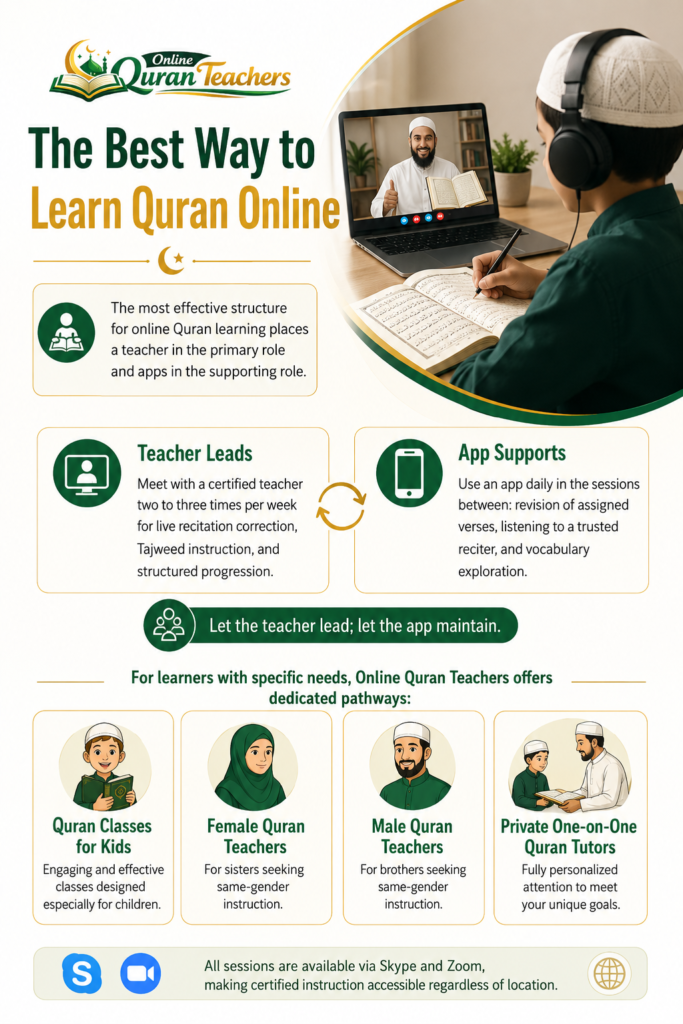
For learners with specific needs, Online Quran Teachers offers dedicated pathways: Quran classes for kids, female Quran teachers for sisters seeking same-gender instruction, male Quran teachers for brothers, and private one-on-one Quran tutors for learners who want fully personalized attention.
All sessions are available via Skype and Zoom, making certified instruction accessible regardless of location.
Watch a Sample Lesson from Our Academy
Get a firsthand look at how our students learn Islamic values, Quran, and essential knowledge through engaging and interactive online classes. See why families trust Islamic Studies for Kids Academy.
Fun & Engaging Islamic Classes for Kids
Start your child’s journey today with interactive lessons designed to make learning Islam loved and easy.
Get Your Child a Free TrialStart Learning Quran with a Certified Teacher Today
Your recitation is either growing or embedding errors — there is no neutral state in Quran learning.
If you’ve been relying on apps alone and feel you’ve plateaued, or if you’re starting fresh and want to build correct habits from the beginning, the next step is clear: connect with a qualified Quran teacher who can hear you, correct you, and guide you forward with the kind of attention no algorithm provides.
Online Quran Teachers match students with certified, experienced instructors for recitation, Tajweed, Hifz, and Tafsir — with scheduling that fits your life, not the other way around.
Our Islamic Studies Courses Include:
- Islamic Studies for Kids
- Islam Basics for Kids (Beginners)
- 5 Pillars of Islam for Kids
- 6 Pillars of Iman (Faith) for Kids
- Salah (Prayer) for Kids
- Wudu for Kids
- Dua for Kids
- Ramadan for Kids
- Zakat & Sadaqah for Kids
- Hajj for Kids
- Aqeedah (Islamic Belief) for Kids
- Islamic Manners & Akhlaq for Kids
- Good Deeds for Kids
- Cleanliness (Taharah) in Islam for Kids
- Angels in Islam for Kids
- Islamic History for Kids
- Seerah (Prophet’s Life) for Kids
- Prophets Stories for Kids
- Islamic Stories & Morals for Kids
- Fiqh for Kids (Islamic Jurisprudence Basics)
- Hadith for Kids
- Quran Tafseer Course for Kids
- Islamic Holidays & Events for Kids
- Islamic Identity for Kids
- Intensive Islamic Course for Kids
Enroll today and give your child the knowledge, values, and confidence to grow as a practicing Muslim with a strong connection to Allah and His teachings.
Conclusion
The comparison between learning Quran with a teacher versus apps and self-study comes down to a fundamental distinction: apps deliver content, while teachers deliver correction. Both matter — but they are not interchangeable, and treating them as equal alternatives leads most learners into a predictable pattern: early progress, stubborn plateau, and quietly embedded errors that compound over time.
Apps are genuinely useful. Flexibility, daily revision, Tafsir access, and vocabulary building are real strengths — and no serious learner should ignore them. But an app’s feedback loop is closed: it responds to what it can detect algorithmically, which is a narrow subset of what actually matters in Quranic recitation.
Makhraj accuracy, Tajweed application, the subtle difference between a rule understood and a rule correctly applied — these require a human ear, a trained one, listening to you specifically.
The oral-transmission principle (talaqqi) is not a historical quirk. It reflects something true about how the Quran is learned: through being heard, corrected, and confirmed by someone who carries that chain of knowledge directly. Apps can prepare you for that encounter and reinforce it between sessions.
They cannot replace it. For absolute beginners, intermediate learners refining Tajweed, students pursuing Hifz, or anyone working toward Ijazah, a certified live teacher is not optional — it is the foundation that every other learning tool works around. The best way to learn Quran online is to put that foundation first.
Frequently Asked Questions
The questions below reflect the most common concerns learners raise before choosing between a teacher and self-study — covering everything from beginners starting from zero to advanced students pursuing Hifz or Ijazah.
1. Can you learn Quran without a teacher?
You can build basic familiarity with the Quran through self-study — vocabulary, short surah memorization, and general understanding. However, developing correct recitation without a teacher is not reliably possible. Makhraj errors and Tajweed mistakes go undetected in self-study and become embedded over time. Islamic scholarly tradition requires direct oral transmission for authentic Quran learning precisely because the human ear catches what no text or algorithm can.
2. What is the best way to learn Quran online?
The most effective approach combines a certified live teacher — two to three sessions per week — with daily app-based revision between sessions. The teacher leads the learning; the app maintains it. Online Quran Teachers connects students with qualified instructors for all levels and goals, including recitation, Tajweed, Hifz, and Tafsir.
3. Is a Quran app good enough for a complete beginner?
Not as a primary learning method. Beginners are most vulnerable to forming incorrect makhraj habits, and apps cannot detect or correct subtle articulation errors. The strongly recommended starting point for complete beginners is a live teacher working through the Noorani Qaida — building correct sounds before any full Quranic text is attempted.
4. How do I choose an online Quran teacher?
Look for a verified Ijazah in Quran recitation, documented experience teaching non-Arabic speakers, and the ability to explain rules clearly in your language. Before committing, ask about their teaching approach, how they handle persistent errors, and whether a trial session is available. A teacher’s recitation credentials and their ability to teach are two separate qualities — confirm both before booking.
5. What is the difference between a Quran app and a teacher for Hifz?
For Hifz, a live teacher is non-negotiable. Memorizing with makhraj errors, incorrect Tajweed, or wrong verse boundaries produces recitation that feels fluent but contains embedded mistakes — often only discovered during prayer. A teacher verifies each page before it is committed to long-term memory, which is far more efficient than correcting errors after hundreds of verses have already been memorized.
6. Can women learn Quran online with a female teacher?
Yes. Online platforms make same-gender instruction straightforward to arrange. Online Quran Teachers maintains a dedicated directory of female Quran teachers and Quran classes for ladies — all certified and experienced in online delivery via Skype and Zoom.







Leave a Reply