 Ijazah
Have you ever wondered how a Quran teacher today can prove that their recitation matches the way the Prophet Muhammad ﷺ recited? The answer is the Ijazah, the certification that links a reciter to an unbroken chain of teachers going back more than fourteen centuries.
Ijazah, the certification in Quran recitation, is formal permission granted by a qualified Shaykh to a student who has recited the entire Quran to them with correct Tajweed and precision. It confirms the student’s mastery and authorizes them to teach and transmit that recitation to others.
This guide explains what an Ijazah is, the different types, the requirements, the step-by-step path to earning one, and how to choose a teacher whose Ijazah is genuine.
Definition Of Ijazah – The Certification In Quran Recitation
Before looking at types and requirements, it helps to understand what makes an Ijazah different from any other Quran certificate. The difference lies in two elements: the chain and the authorization to teach.
1. The Sanad – An Unbroken Chain To The Prophet ﷺ
The sanad is the documented chain of teachers through whom a recitation was transmitted. Each person in the chain recited to the one before them, and the chain ends with the Prophet Muhammad ﷺ, who received the Quran through Jibreel (Gabriel).
When you earn an Ijazah, your name is added to the end of your Shaykh’s sanad. This is why scholars describe an Ijazah holder as joining the line of those who carry the Book of Allah by connected transmission.
2. Authorization To Teach (Iqra’)
An Ijazah is also a license. It states that the student is qualified to teach others the specific riwayah (narration) or qira’ah (reading) they were certified in, and to grant Ijazah in it.
This authorization is limited to what was certified. A student certified in Hafs ‘an ‘Asim is authorized to teach Hafs, not Warsh or the ten readings.
3. How An Ijazah Differs From A Tajweed Or Hifz Certificate
Many academies issue Tajweed course certificates or Hifz completion certificates. These confirm that you finished a program, but they do not normally carry a sanad or authorize you to teach.
A useful test: if the document does not list the chain of teachers by name back to the Prophet ﷺ, it is a course certificate, not an Ijazah.
Watch our Real Online Quran Class
See how our online Quran lessons are conducted with this short class sample. Experience our interactive teaching approach, clear pronunciation guidance, and engaging learning environment before starting your own Quran learning journey.
Learn Quran Online with Expert Teachers
Start your personalized journey with qualified tutors today. Flexible schedules tailored to your routine.
Book Your Free TrialTypes Of Ijazah In The Quran
Ijazah types are classified in two ways: by how the recitation was received, and by which recitations are covered. Knowing both helps you choose the right goal from the start.
1. Types By Method Of Receiving The Recitation
The method describes how the student and teacher exchanged the recitation:
- ‘Ard and sama’ (presentation and listening): the Shaykh recites, and the student listens, then the student recites to the Shaykh. This is considered the strongest form.
- ‘Ard only (presentation): the student recites the entire Quran to the Shaykh, from memory or from the Mushaf. This is the most common form today.
- Sama’ only (listening): the Shaykh recites the whole Quran while the student listens. It is rare in Quran transmission and more common in Hadith.
- Ijazah by examination: granted after a detailed test by a specialized panel in memorization, Tajweed, or qira’at.
- Ijazah in part of the Quran: granted for specific Juz’ or surahs the student has mastered.
2. Types By Riwayah And Qira’at
The second classification covers the scope of recitations certified:
- Single riwayah: such as Hafs ‘an ‘Asim, Warsh ‘an Nafi’, or Qalun ‘an Nafi’. Hafs is the most widely studied worldwide.
- Two or more riwayat: for example, combining Hafs and Shu’bah, the two narrators from ‘Asim.
- The seven qira’at: studied through Ash-Shatibiyyah (Hirz al-Amani) by Imam Ash-Shatibi.
- The minor ten (al-‘Ashr as-Sughra): through Ash-Shatibiyyah plus Ad-Durrah by Ibn al-Jazari.
- The major ten (al-‘Ashr al-Kubra): through Tayyibat an-Nashr by Ibn al-Jazari, regarded as the highest level of qira’at Ijazah.
Ijazah In Memorization Vs Ijazah In Recitation
An Ijazah in memorization (hifz) requires reciting the whole Quran from memory. An Ijazah in recitation (tilawah) requires reciting the whole Quran from the Mushaf with complete Tajweed accuracy.
Some Shaykhs grant the recitation Ijazah to students who have not memorized the entire Quran. It is a realistic first goal for adults who want to teach correct recitation, and many later continue to a memorization Ijazah.
Read also: Easily Get Your Quran Qira’aat Ijazah – 4 Proven Levels And 4 Core Requirements
Requirements For Earning An Ijazah
Every Shaykh sets their own conditions, but the requirements below are what most teachers expect before they will begin the khatmah (full recitation) with a student.
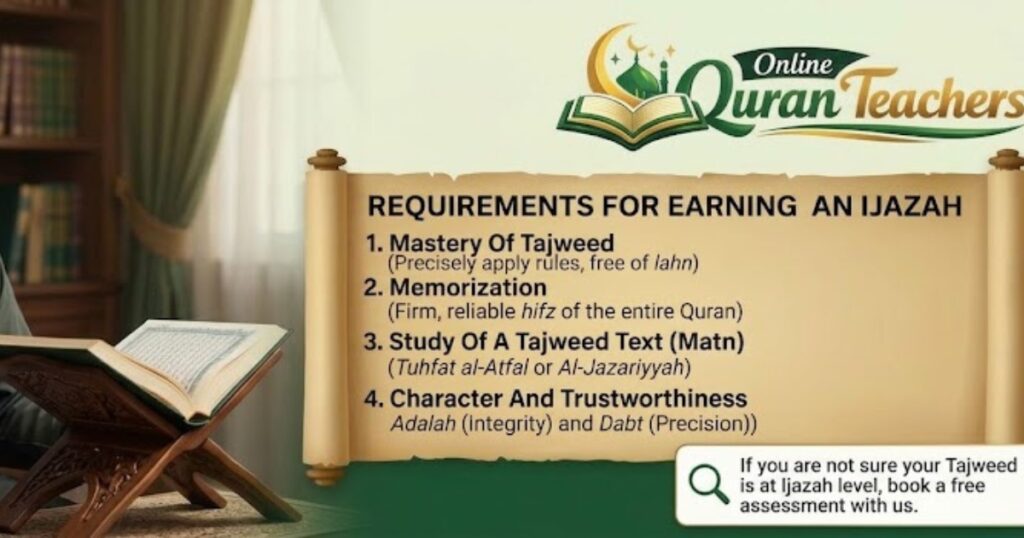
1. Mastery Of Tajweed
You must apply the rules of Tajweed precisely, including the correct makharij (articulation points) and sifat (characteristics) of each letter. The Shaykh listens for both lahn jali (clear errors that change a letter or vowel) and lahn khafi (subtle errors such as incomplete ghunnah or uneven madd lengths).
Lahn khafi is where most Ijazah candidates struggle. Clear errors are easy to hear; subtle ones require trained ears on both sides.
2. Memorization (For A Hifz Ijazah)
For a memorization Ijazah, you need firm, reliable hifz of the entire Quran. Shaykhs expect fluent recall without long pauses or frequent prompting.
3. Study Of A Tajweed Text (Matn)
Most Shaykhs expect you to study a classical Tajweed poem. Beginners often start with Tuhfat al-Atfal by Sulayman al-Jamzuri, and Ijazah candidates are usually expected to study Al-Muqaddimah al-Jazariyyah by Ibn al-Jazari.
Studying the matn means you can explain the rules, not just apply them. That matters because an Ijazah authorizes you to teach.
4. Character And Trustworthiness
Classical scholars required the student to have ‘adalah (integrity) and dabt (precision). A Shaykh is vouching for you to future students, so sincerity and reliability are part of the assessment.
If you are not sure your Tajweed is at Ijazah level yet, a one-to-one assessment with an Ijazah-holding teacher at Online Quran Teachers can show you exactly where you stand before you begin.
How To Get An Ijazah Step By Step
The path to Ijazah follows a clear sequence. Skipping the early steps is the main reason students stall halfway through their khatmah.
1. Correct your recitation and learn Tajweed rules: Fix makharij and sifat first, supported by a matn such as Tuhfat al-Atfal or Al-Jazariyyah.
2. Memorize the Quran (if aiming for a hifz Ijazah): Use the riwayah you plan to be certified in, such as Hafs or Warsh.
3. Find a qualified Shaykh with a verified sanad: You can study in person or online.
4. Recite the entire Quran to the Shaykh: The Shaykh listens to every verse and corrects errors in articulation and rules.
5. Complete the final assessment: After the khatmah, the Shaykh tests you and, once satisfied, grants the Ijazah document with the full sanad.
How Long Does It Take To Get An Ijazah?
The duration depends on your starting level, the strength of your memorization, and how many pages you recite per session. There is no fixed term, and no honest teacher can promise one before assessing you.
You can estimate your own timeline with simple arithmetic. The standard Madinah Mushaf has 604 pages. If you recite 5 pages per session, three sessions a week, the khatmah alone takes roughly 40 weeks, assuming your hifz and Tajweed are already solid.
The real variable is correction time. A student who arrives with weak Tajweed may spend more sessions fixing errors than reciting new pages, which is why preparation before the khatmah shortens the overall journey.
Read also: Study Quran Online & Get Recitation Ijazah – 6 Easy Steps To Excellence
Experience our Online Quran Lesson
Take a look inside a live online Quran session and discover how students learn with personalized instruction, step-by-step guidance, and a supportive learning atmosphere.
Learn Quran Online with Expert Teachers
Start your personalized journey with qualified tutors today. Flexible schedules tailored to your routine.
Book Your Free TrialCommon Mistakes That Delay An Ijazah
Several avoidable mistakes slow students down; you should be aware of:
- Starting the khatmah too early, before Tajweed is stable, so most sessions become correction lessons.
- Weak revision of earlier Juz’, leading to repeated stops for prompting.
- Changing teachers mid-khatmah, which usually means starting the recitation again with the new Shaykh.
- Choosing a teacher without checking the sanad, discovered only when the certificate arrives.
Students at Online Quran Teachers work with a fixed tutor and a consistent schedule, which removes the most common cause of restarted khatmahs.
Read also: Quran Recitation With Tajweed – 5 Critical Steps To Avoid Mistakes
How To Verify A Teacher’s Ijazah – The 3-V Check
Because an Ijazah is personal authorization, its value depends entirely on the person granting it. Before you commit months to a teacher, apply this simple three-part check.
1. Verify The Sanad
Ask to see the teacher’s own Ijazah document. It should name their Shaykh, the riwayah or qira’ah certified, and the full chain back to the Prophet ﷺ.
An authentic document will clearly display the teacher’s name and be signed or stamped by a recognized scholar. If a teacher hesitates to share their chain or if the document lacks clear details, treat it as a major red flag.
2. Verify The Recitation
Listen to the teacher recite a passage in the riwayah you want. Their recitation should be the standard you are aiming for.
Pay close attention to their Tajweed accuracy, letter articulation (makharij), and smooth flow during live recitation. Learning from a teacher whose practical application is flawless ensures you do not absorb subtle pronunciation errors during your khatmah.
3. Verify The Method
Ask how sessions work: will you recite the whole Quran to them verse by verse, and how are errors corrected? A genuine Ijazah requires a full recitation with live correction, not a short exam followed by a certificate.
Ensure the teacher conducts one-on-one sessions and provides real-time, detailed corrections for both obvious (lahn jali) and subtle (lahn khafi) mistakes. A reliable program will never offer shortcuts or grant a certification without hearing every single page directly from you.
Read also: Quran Memorization With Tajweed – 6 Brain-Friendly Ways For Masterful Hifz
Start Your Ijazah Journey With A Qualified Online Teacher Today
Earning your Ijazah is a commitment, and the teacher you choose shapes every session of it. With Online Quran Teachers, you study one-to-one with Ijazah-holding tutors, recite at a pace that fits your schedule, and receive live correction on every verse from home.
Whether you are aiming for an Ijazah in Hafs, in memorization or recitation, or planning toward the qira’at, you begin with an assessment that tells you exactly where you stand and what comes next.
Book your free assessment session now and take the first step toward your sanad.
Our Hifz & Quran Courses:
- Quran Memorization Course
- Hifz for Kids Course
- Hifz for Adults Course
- Hifz for Ladies Course (with Female Hifz Teachers)
- Quran Ijazah Program (with Certified Teachers)
Enroll today and take the next step toward beautiful Quran memorization with confidence.
Learn Quran Online with Expert Teachers
Start your personalized journey with qualified tutors today. Flexible schedules tailored to your routine.
Book Your Free TrialConclusion
Ijazah, the certification in Quran recitation, is more than a document. It is authorization from a qualified Shaykh, backed by a sanad connected to the Prophet ﷺ, confirming that you recite with precision and may teach others.
To earn one, master Tajweed, study a matn such as Al-Jazariyyah, complete your hifz if required, and recite the entire Quran to a Shaykh whose sanad you have verified. Preparation before the khatmah is the factor that most shortens the journey.
Frequently Asked Questions
What Is An Ijazah In The Quran?
An Ijazah is a certification from a qualified Shaykh confirming that a student recited the entire Quran with correct Tajweed. It includes a sanad connected to the Prophet ﷺ and authorizes the holder to teach that recitation.
Can I Get An Ijazah Online?
Yes, you can get an Ijazah online by reciting the entire Quran to a qualified Shaykh through live video sessions. The process is the same as in person: full recitation, live correction, and a final assessment.
Do I Need To Memorize The Whole Quran To Get An Ijazah?
You need to memorize the whole Quran only for a memorization (hifz) Ijazah. Some Shaykhs grant a recitation (tilawah) Ijazah to students who recite the full Quran from the Mushaf with complete Tajweed accuracy.
Which Ijazah Is Best For Beginners?
A single-riwayah Ijazah in Hafs ‘an ‘Asim is the most common starting point. Many students begin with a recitation Ijazah and later progress to memorization or the qira’at.
What Is The Highest Level Of Ijazah?
The highest level is the Ijazah in the major ten qira’at (al-‘Ashr al-Kubra) through Tayyibat an-Nashr by Ibn al-Jazari. It is usually pursued after completing a single riwayah and the seven or minor ten readings.
Is An Ijazah The Same As A Tajweed Certificate?
No, an Ijazah is not the same as a Tajweed course certificate. A Tajweed certificate confirms you completed a course, while an Ijazah carries a sanad and authorizes you to teach.





[…] Read also: Ijazah The Certification […]
[…] Read also: Ijazah The Certification […]