 Quran
Quran
You want your child — or yourself — to recite the Quran beautifully, with correct Tajweed, and to hold that knowledge for life. The question isn’t really whether to learn online. It’s how that learning is structured — and that structure determines everything.
The choice between one-on-one vs group Quran classes is the single biggest variable in how quickly a student progresses, how accurately they recite, and whether they stay motivated for the long term.
Both formats exist for good reasons. But they are not equal for every goal — and most guides don’t tell you clearly enough which one fits yours.
This article breaks down exactly how each format works, where each one wins, and how to make the right call for your situation.
How One-On-One Quran Classes Work?
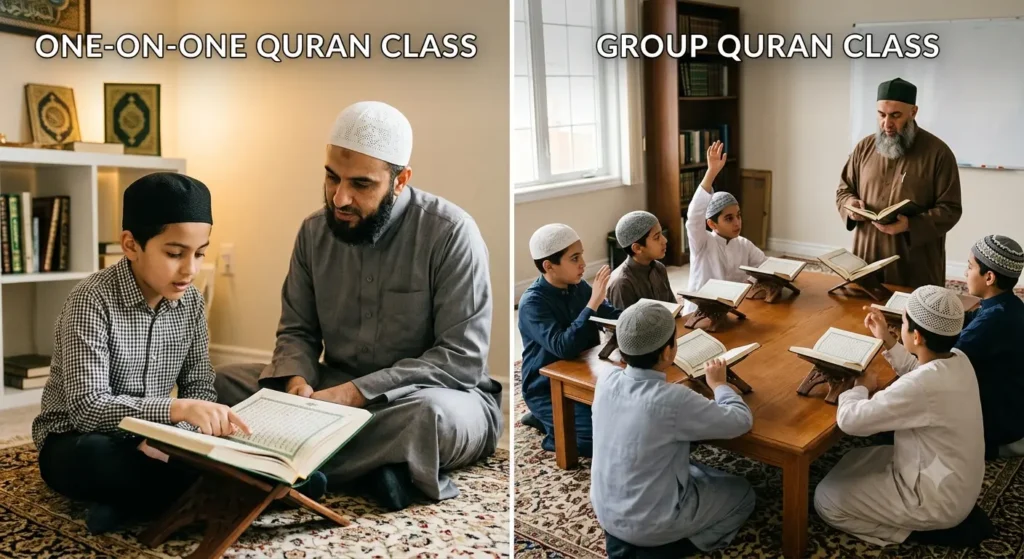
A one-on-one Quran class places one student with one certified teacher on a live online platform — typically Zoom or Skype — for a session that belongs entirely to that student.

The teacher assesses the student’s current level at the outset and builds a lesson plan around their specific weaknesses, learning pace, and goals. If the student is working through Noorani Qaida and struggling with the articulation points (Makharij) of a particular letter, the teacher can dedicate the full thirty minutes to that one sound without any pressure to move on.
This is the format used by private one-on-one Quran tutors and is the standard model for serious Tajweed work, Hifz programs, and students who need a fully flexible schedule. The teacher learns the student — their specific errors, what encourages them, what causes anxiety — and that individual knowledge compounds over time into genuinely tailored instruction.
One practitioner note worth knowing: errors that go uncorrected in the early stages of Quran learning tend to fossilize. A child who mispronounces ع (ayn) consistently for six months in a group class — where the teacher simply cannot catch every individual error every session — will carry that error forward into memorization. Correcting a fossilized Tajweed error takes significantly longer than preventing it.
Read Also: Learning Quran with a Teacher vs Apps & Self-Study
How Group Quran Classes Work?
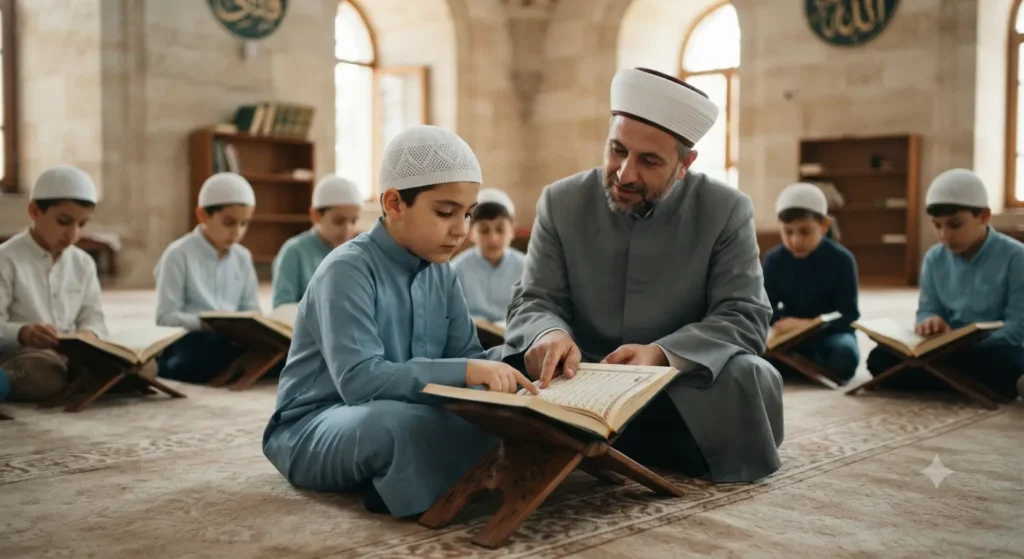
A group Quran class brings multiple students into a shared session with one teacher — usually between three and ten students, though mosque-based classes can reach fifteen or more.
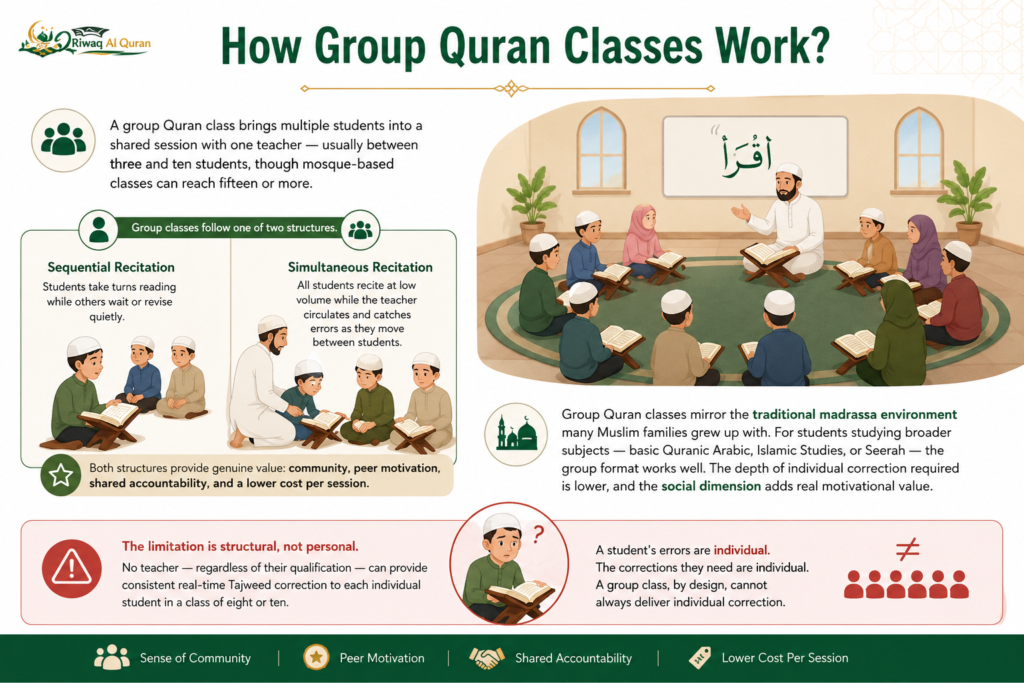
Group classes follow one of two structures. In sequential recitation, students take turns reading while others wait or revise quietly.
In simultaneous recitation, all students recite at low volume while the teacher circulates and catches errors as they move between students. Both structures provide genuine value: community, peer motivation, shared accountability, and a lower cost per session.
Group Quran classes mirror the traditional madrassa environment many Muslim families grew up with. For students studying broader subjects — basic Quranic Arabic, Islamic Studies, or Seerah — the group format works well. The depth of individual correction required is lower, and the social dimension adds real motivational value.
The limitation is structural, not personal. No teacher — regardless of their qualification — can provide consistent real-time Tajweed correction to each individual student in a class of eight or ten.
A student’s errors are individual. The corrections they need are individual. A group class, by design, cannot always deliver individual correction.
Experience a Real Classroom
Curious about how we teach? This video offers a glimpse into a real class, showcasing our interactive approach, qualified teachers, and child-friendly learning experience.
Fun & Engaging Islamic Classes for Kids
Start your child’s journey today with interactive lessons designed to make learning Islam loved and easy.
Get Your Child a Free TrialRead also: Why Choose A Female Quran Teacher?
One On One Quran Classes Vs Group
The two formats differ across every dimension that matters in Quran education — not just cost or class size. The table below maps both formats against the ten factors that most directly affect a student’s progress, accuracy, and long-term consistency.
| Factor | One-on-One Quran Classes | Group Quran Classes |
| Teacher attention | 100% dedicated to one student | Divided across 3–10+ students |
| Recitation time per session | Full session | Approx. 3–5 minutes per student |
| Tajweed correction | Every error, every session | Some errors, some sessions |
| Learning pace | Adapts to the individual student | Set by the group average |
| Schedule flexibility | Fully flexible — you choose the days and times | Fixed timetable; you fit their schedule |
| Cost | Mid-range investment | Generally lower / subsidised |
| Best for shy students | Yes — no peer performance pressure | Challenging — requires reciting in front of peers |
| Best for Hifz | Yes — essential for accurate memorization | Not recommended |
| Best for social motivation | Less applicable | Yes — peer dynamic is a genuine motivator |
| Progress speed | Significantly faster | Slower in precision skills |
Benefits Of Private Quran Lessons
The benefits of private Quran lessons are not just about what happens in a single class. They accumulate — and that compounding effect is what makes the format genuinely superior for precision-based goals.
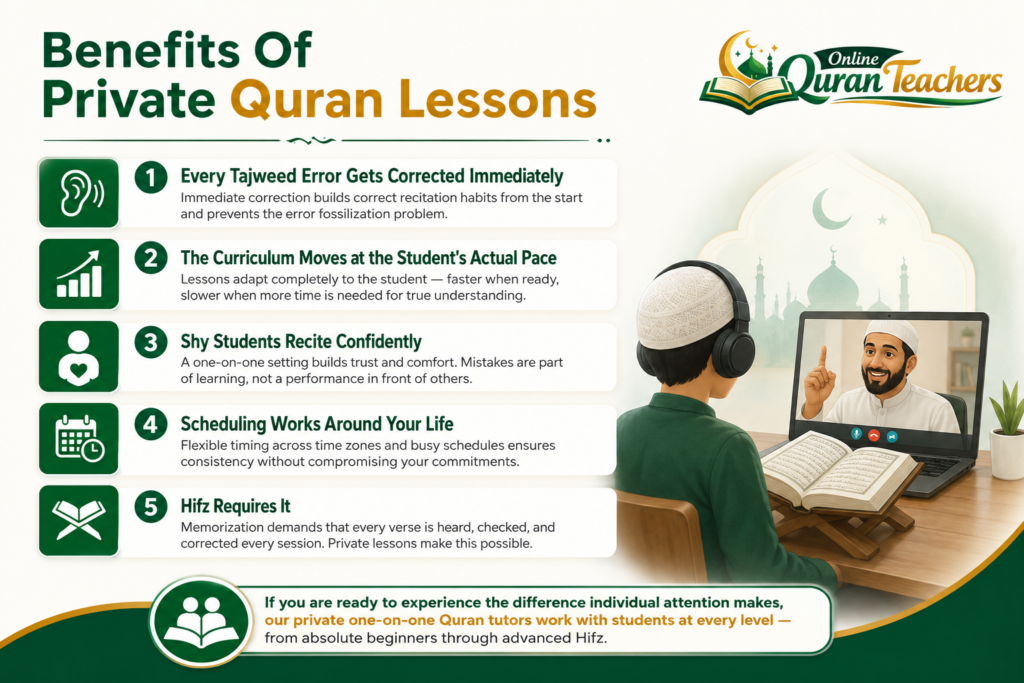
1. Every Tajweed Error Gets Corrected Immediately
Tajweed is a practical skill built through recitation and immediate correction. In a one-on-one session, the teacher hears every syllable and addresses every deviation in real time.
This is the only reliable way to build correct recitation habits from the start — and to prevent the error fossilization problem that plagues students who spend their early months in large group settings.
2. The Curriculum Moves at the Student’s Actual Pace
A student who grasps joining Arabic letters quickly should not wait for a group to catch up. A student who needs more time on a specific rule should not feel the pressure of the group moving on.
Private Quran lessons adapt completely faster when the student is ready, slower when they need consolidation, without any artificial group dynamic. This is why Quran teachers for beginners using the one-on-one model consistently produce faster foundational progress.
3. Shy Students Recite Confidently
Many beginning Quran learners — especially children — experience real anxiety about making mistakes in front of peers. In a group class, that anxiety can suppress participation and slow learning significantly.
In a private session, the student and teacher build a relationship of trust. Mistakes are part of the process, not a performance in front of others. This creates the psychological safety that genuine learning requires.
4. Scheduling Works Around Your Life
Between school schedules, work, time zones, and family commitments, a fixed weekly group timetable is often the first barrier to consistency.
One-on-one online Quran classes via Skype and Zoom allow students to choose their days and times, reschedule when needed, and maintain learning consistency across life’s interruptions — something group classes structurally cannot offer.
5. Hifz Requires It
Quran memorization — Hifz — demands that the teacher hear every verse of every recitation in every session and correct every error before it enters long-term memory. A memorized error is significantly harder to correct than a recitation error.
In a group class, this level of monitoring is structurally impossible. If Hifz is the goal, one-on-one instruction is not a preference — it is a requirement. Quran classes for adults pursuing memorization should treat private tutoring as non-negotiable for this reason.
If you are ready to experience the difference individual attention makes, our private one-on-one Quran tutors work with students at every level — from absolute beginners through advanced Hifz.
Read Also: Best Practices for Teaching the Quran Online
When Group Quran Classes Make Sense
Group Quran classes are not without genuine value. There are specific situations where they work well — and being honest about this is important.
1. As a community supplement
Students who receive one-on-one instruction for core Quran learning can attend a mosque group class alongside it for the community element, peer motivation, and the spiritual environment that group settings provide. The two formats serve different purposes and can complement each other effectively.
2. For social learners
Some students — particularly extroverted children — are genuinely motivated by peers. Friendly recitation competition, hearing classmates achieve milestones, and the accountability of showing up for a group can push these students in ways a private session alone cannot.
3. For broader Islamic subjects
Group classes work well for subjects like basic Quranic Arabic, Islamic Studies, and Seerah — where the precision demand on individual correction is lower, and the discussion dynamic adds value.
At Online Quran Teachers, our native Arab Quran teachers can create effective conversational environments for group Arabic classes in this format.
4. When budget is a genuine constraint
Group classes cost less per session. For families where any Quran education is better than none, the group format is a meaningful entry point.
5. Very small groups (2–3 students)
A class of two or three students with a qualified teacher approaches the effectiveness of one-on-one instruction while preserving a social element. This is qualitatively different from a class of twelve.
How to Choose According to Your Learning Objective
The right format depends entirely on what you are trying to achieve. Match your goal to the format below.
1. Learn to Read Quran from Scratch (Noorani Qaida / Beginner Quran Reading)
One-on-one. The foundational stage is where errors are easiest to prevent and hardest to fix once embedded. Individual correction at this stage protects every stage that follows.
A Quran course for beginners with a dedicated private teacher is the highest-return investment at this level.
2. Master Tajweed to a High Standard
One-on-one, with a teacher holding Ijazah. Tajweed precision requires that every error in every session be addressed.
An Egyptian Quran teacher trained at Al-Azhar in a one-on-one format is the gold standard for serious Tajweed work.
3. Memorize the Quran (Hifz)
One-on-one only. No exceptions. Memorized errors require months of unlearning. Group instruction cannot provide the monitoring Hifz demands.
4. Learn Basic Islamic Studies or Quranic Arabic in a Community Environment
Group classes are appropriate here. The correction demand is lower, and the peer dynamic adds genuine value to discussion-based subjects.
5. Maintain Recitation Level with Peer Motivation and Lower Cost
Group classes work well — provided the student already has a strong Tajweed foundation from earlier one-on-one instruction.
Watch a Sample Lesson from Our Academy
Get a firsthand look at how our students learn Islamic values, Quran, and essential knowledge through engaging and interactive online classes. See why families trust Islamic Studies for Kids Academy.
Fun & Engaging Islamic Classes for Kids
Start your child’s journey today with interactive lessons designed to make learning Islam loved and easy.
Get Your Child a Free TrialStart Learning Quran The Right Way
The format of your Quran class is not a secondary detail. It determines how quickly you progress, how accurately you recite, and whether the habits you build in the first months serve you for life — or need to be corrected later.
At Online Quran Teachers, our private one-on-one Quran tutors work with students from their very first lesson through advanced Hifz and Tajweed certification.
Every session is dedicated entirely to you — your pace, your errors, your goals. Whether you are a complete beginner or an adult student returning to the Quran after years away, individual attention produces results that group instruction simply cannot match.
Book your free trial class today and experience firsthand what one session of undivided attention delivers.
Our Islamic Studies Courses
- Islamic Studies for Kids in UK
- Islamic Studies for Kids in USA
- Islamic Studies for Kids in UAE
- Islamic Studies for Kids in Saudi Arabia
- Islamic Studies for Kids in Netherlands
- Islamic Studies for Kids in Germany
- Islamic Studies for Kids in Canada
- Islamic Studies for Kids in New Zealand
- Islamic Studies for Kids in Ireland
Join today and help your child grow with authentic Islamic knowledge, strong moral values, and confidence in their faith.
Conclusion
One-on-one and group Quran classes are not competing products — they are different tools designed for different purposes. Group classes build community, provide peer motivation, and offer an affordable entry point into Islamic education. They serve social learners and broader Islamic subjects well.
But for the goals most students actually hold — accurate Tajweed, confident recitation, Quran memorization, or building a strong foundation from scratch — private Quran lessons consistently produce faster, more accurate, and more durable results.
The structural reason is simple: every minute, every error, and every correction belongs to one student.
The format you choose in the early stages of Quran learning shapes every stage that follows. Choose it deliberately and choose Online Quran Teachers to guide every step.
Frequently Asked Questions
Still weighing your options? These are the questions students and parents ask most often before choosing between one-on-one and group Quran classes — answered directly.
1. Is one-on-one better than group for Quran classes?
For most learning goals — Tajweed accuracy, Hifz, and foundational reading — one-on-one is significantly more effective. The teacher hears every recitation, corrects every error in real time, and adapts the lesson to the individual student’s pace. In a group class, each student typically recites for three to five minutes per session, limiting the correction and personalization available.
2. What are the main benefits of private Quran lessons?
Private Quran lessons provide 100% of the teacher’s attention, immediate correction of every Tajweed error, fully flexible scheduling, and a curriculum that moves at the student’s exact pace. For students pursuing Hifz or precise Tajweed, these benefits are not optional — they are what the goal requires.
3. Can group Quran classes teach Tajweed correctly?
Group classes can introduce Tajweed rules and correct obvious errors. However, consistent individual Tajweed correction — catching every error in every session — is structurally difficult in a class of more than two or three students. Students who develop specific Tajweed errors in group settings often carry them forward for months before they are addressed.
4. What age should children start one-on-one Quran classes?
Most children are ready to begin Quran instruction between ages four and five, starting with basic Arabic letters through Noorani Qaida. At this age, one-on-one sessions of twenty-five to thirty minutes match young attention spans while delivering the individual correction that builds correct habits from the outset.
5. Can I combine one-on-one and group Quran classes?
Yes — and many students benefit from doing exactly this. The practical combination is one-on-one online sessions for structured Tajweed correction and individual progress, alongside a mosque group class for community, peer motivation, and the Islamic social environment. The two formats address different needs and work well together.
6. How much do online one-on-one Quran classes cost compared to group classes?
Group classes — particularly mosque-based sessions — are typically lower in cost because the teacher’s time is shared across multiple students. One-on-one online Quran classes require a greater per-session investment, but students in private instruction typically progress significantly faster — making the cost-per-outcome comparison more favorable than the headline price suggests.







Leave a Reply