 Quran
Quran
Most students learn to read the Quran correctly in 3 to 6 months with a qualified teacher. Full memorisation (Hifz) typically takes 1 to 5 years, depending on age, daily commitment, and the quality of instruction. The single biggest accelerator in both goals is working with a teacher — not self-study, not apps alone, but live, corrective guidance.
If you’ve been wondering how long it takes to learn to read Quran, or how long to learn Quran with a teacher specifically, this guide breaks it down by goal, by learner type, and by what actually determines your timeline — so you can plan realistically and start with confidence.
The answer depends entirely on what “learning the Quran” means to you. There are three distinct learning goals, and each has a different realistic timeline.
1. Basic Quran Reading Timeline (Beginners)
Who it’s for: Complete beginners with no Arabic background, children starting from the alphabet, and new Muslims learning to recite for the first time.
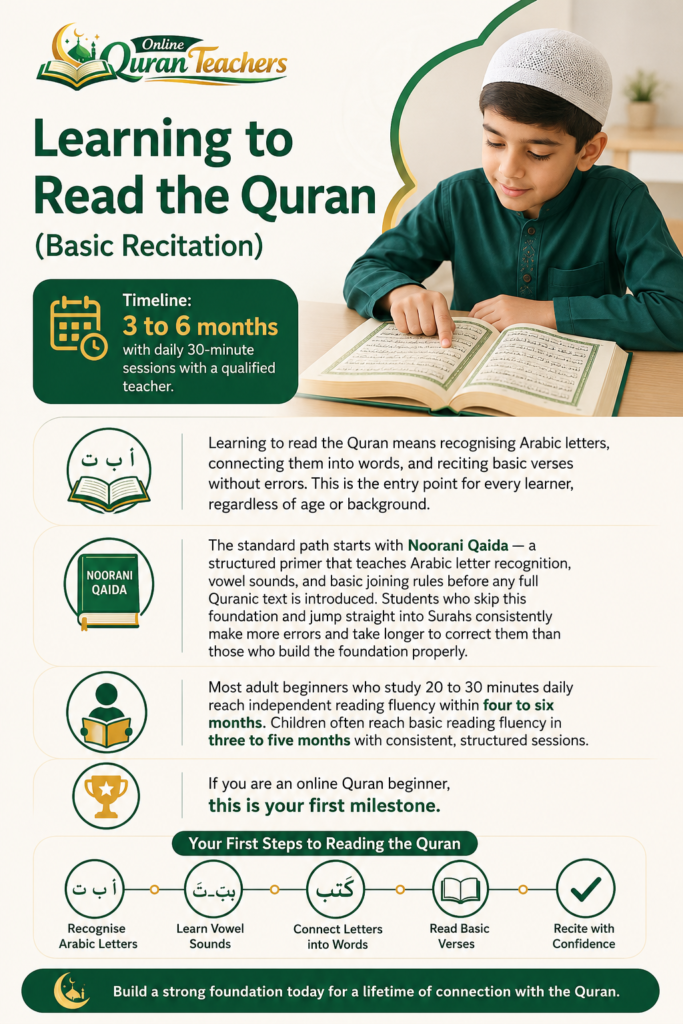
Timeline: 3 to 6 months with daily 30-minute sessions with a qualified teacher.
What you’ll cover: Arabic letter recognition via Noorani Qaida, vowel sounds, basic joining rules, and short Surahs.
Learning to read the Quran means recognising Arabic letters, connecting them into words, and reciting basic verses without errors.
This is the entry point for every learner, regardless of age or background. Students who skip Noorani Qaida and jump straight into Surahs consistently make more errors and take longer to correct them than those who build the foundation properly.
Most adult beginners who study 20 to 30 minutes daily reach independent reading fluency within four to six months. Children often get there in three to five months with consistent, structured sessions.
Matching courses:
- Quran Course for Beginners: structured from zero, no Arabic required.
- Quran Course for Kids: gamified Qaida lessons for children aged 4 and up.
2. Quran Reading with Tajweed Timeline
Who it’s for: Students who can already read basic Arabic and want to recite the Quran as it was revealed, with correct pronunciation and recitation rules.
Timeline: 6 to 18 months after completing basic reading, depending on session frequency.
What you’ll cover: Makharij (letter articulation points), Madd (elongation), Ghunnah (nasalisation), and rules including Ikhfa, Idgham, and Iqlab.
Tajweed errors are often undetectable by the learner without live correction — which is why a teacher is not optional at this stage. The practitioner insight that distinguishes good from poor Tajweed instruction: ear training must precede rule memorisation.
Students who learn what Qalqalah sounds like before learning its name apply the rule far more accurately than those who memorise the definition first. A qualified teacher drills the sound, then introduces the label — not the reverse.
Matching courses:
- Female Quran Teachers: Ijazah-certified sisters for Muslim women seeking a comfortable learning environment
- Male Quran Teachers: certified male instructors trained in sound-first Tajweed for English speakers
- Quran Classes for Adults: adult-paced Tajweed instruction that works around your schedule
Experience a Real Classroom
Curious about how we teach? This video offers a glimpse into a real class, showcasing our interactive approach, qualified teachers, and child-friendly learning experience.
Fun & Engaging Islamic Classes for Kids
Start your child’s journey today with interactive lessons designed to make learning Islam loved and easy.
Get Your Child a Free TrialRead also: Why Learn Quran With A Native Arab Teacher?
3. Full Quran Memorisation (Hifz) Timeline
Who it’s for: Students with solid reading fluency who want to memorise the complete Quran, whether as children in a dedicated program or adults committing part-time.
Timeline: 1 to 3 years for dedicated students; 3 to 5 years for part-time learners.
What you’ll cover: Systematic daily memorisation of new pages, teacher-supervised revision sessions, and spaced repetition cycles to prevent forgetting.
The Quran contains approximately 77,430 words across 604 pages divided into 30 Juz. The timeline is genuinely individual — but two variables dominate above all others: daily consistency and teacher-supervised revision.
A common and costly mistake in Hifz programs is rushing to memorise new pages while neglecting revision of what is already known.
Without structured review cycles, older memorisation degrades faster than new memorisation is added, a net loss disguised as progress. The most effective Hifz programs build revision time into every single session before introducing new material.
Matching courses:
- Quran Teachers for Kids: age-adapted Hifz techniques that maintain motivation across the full memorisation journey
- Quran Teachers for Adults: revision-first Hifz structure designed around adult schedules and memory patterns
Read Also: Learning Quran With A Teacher Vs Apps & Self-Study
The Five Factors That Determine Your Personal Timeline
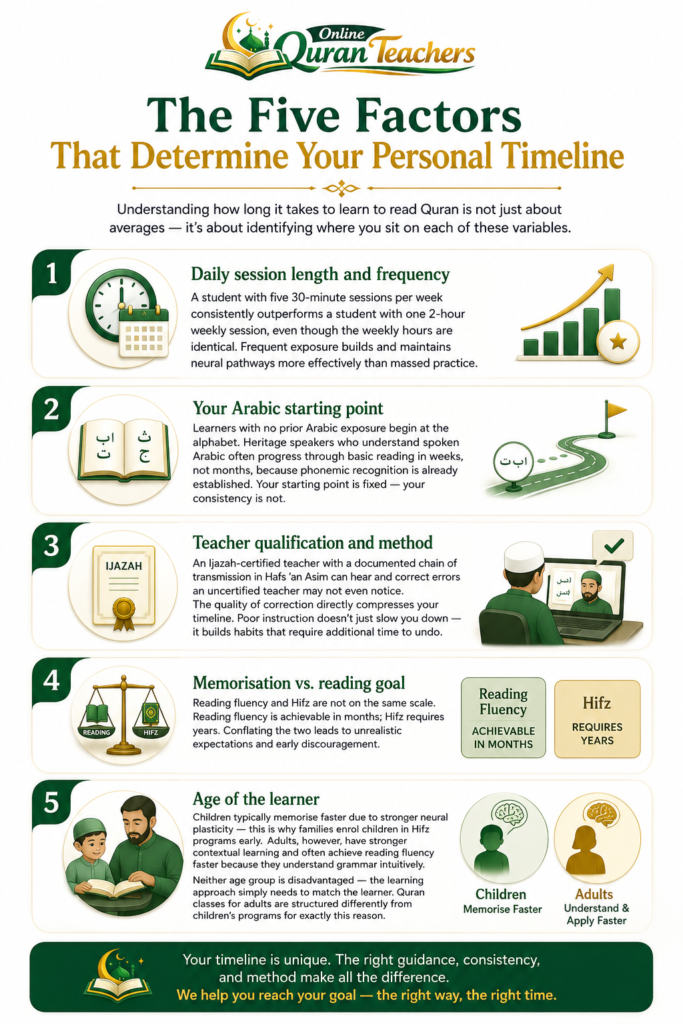
Understanding how long it takes to learn to read Quran is not just about averages — it’s about identifying where you sit on each of these variables.
1. Daily session length and frequency
A student with five 30-minute sessions per week consistently outperforms a student with one 2-hour weekly session, even though the weekly hours are identical. Frequent exposure builds and maintains neural pathways more effectively than massed practice.
2. Your Arabic starting point
Learners with no prior Arabic exposure begin at the alphabet. Heritage speakers who understand spoken Arabic often progress through basic reading in weeks, not months, because phonemic recognition is already established. Your starting point is fixed — your consistency is not.
3. Teacher qualification and method
An Ijazah-certified teacher with a documented chain of transmission in Hafs ‘an Asim can hear and correct errors an uncertified teacher may not even notice.
The quality of correction directly compresses your timeline. Poor instruction doesn’t just slow you down — it builds habits that require additional time to undo.
4. Memorisation vs. reading goal
Reading fluency and Hifz are not on the same scale. Reading fluency is achievable in months; Hifz requires years. Conflating the two leads to unrealistic expectations and early discouragement.
5. Age of the learner
Children typically memorise faster due to stronger neural plasticity — this is why families enrol children in Hifz programs early. Adults, however, have stronger contextual learning and often achieve reading fluency faster because they understand grammar intuitively.
Neither age group is disadvantaged — the learning approach simply needs to match the learner.
Read Also: Best Practices for Teaching the Quran Online
A Realistic Timeline Table by Learner Type
The following timelines assume consistent sessions with a qualified teacher and independent daily practice between lessons.
| Learning Goal | Children (5–14) | Teens (15–18) | Adults (18+) |
| Basic reading (Qaida + short Surahs) | 3–5 months | 3–6 months | 4–6 months |
| Reading with Tajweed rules | 6–12 months | 8–14 months | 10–18 months |
| Full Hifz (memorisation) | 1–3 years | 2–4 years | 2–5 years |
| Reading + Tajweed + partial Hifz | 1–2 years | 1.5–3 years | 2–4 years |
The upper end of each range reflects irregular study; the lower end reflects daily commitment with a qualified teacher.
Read also: Why Learn Quran With A Native Arab Teacher?
Why Does a Teacher Compress the Timeline Significantly?
Self-study, apps, and audio repetition all have real value — but they share a structural limitation: they cannot hear your errors in real time and correct them before they become habits.
A mispronounced letter in Surah Al-Fatiha, recited incorrectly five times daily across years of Salah, becomes deeply embedded. Correcting it later costs far more time than preventing it early. A qualified teacher identifies the error in the first or second session and addresses the Makharij directly before the habit forms.
Beyond error correction, a teacher provides something no app replicates: accountability and structured progression. The student who knows their teacher is reviewing their revision this week prepares differently than the student with no external checkpoint.
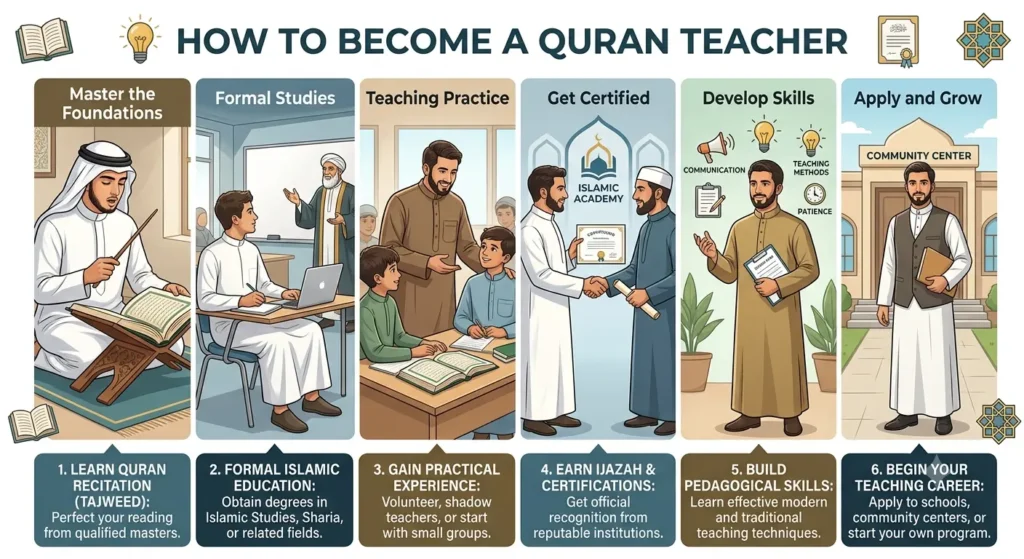
Online Quran teachers who are Ijazah-certified carry a verified chain of transmission connecting their recitation back to the Prophet ﷺ — this is not a credential detail but a quality indicator: it means their own recitation was scrutinised and approved to the same standard they now apply to yours.
Read also: The Best Of You Are Those Who Learn The Quran And Teach It
Fun & Engaging Islamic Classes for Kids
Start your child’s journey today with interactive lessons designed to make learning Islam loved and easy.
Get Your Child a Free TrialWatch a Sample Lesson from Our Academy
Get a firsthand look at how our students learn Islamic values, Quran, and essential knowledge through engaging and interactive online classes. See why families trust Islamic Studies for Kids Academy.
Start Learning Quran with a Qualified Teacher Today
Whether your goal is reading, Tajweed, or full memorisation, the fastest path to any of these milestones runs through one-on-one, live teacher instruction — not self-study alone.
Online Quran Teachers connects you with Ijazah-certified, experienced instructors matched to your goal, age, and schedule. Whether you’re a child starting the alphabet, an adult learning to read for the first time, or someone working toward Hifz, there is a course and a teacher built for your exact situation.
Our Islamic Studies Courses Include:
- Islamic Studies for Kids
- Islam Basics for Kids (Beginners)
- 5 Pillars of Islam for Kids
- 6 Pillars of Iman (Faith) for Kids
- Salah (Prayer) for Kids
- Wudu for Kids
- Dua for Kids
- Ramadan for Kids
- Zakat & Sadaqah for Kids
- Hajj for Kids
- Aqeedah (Islamic Belief) for Kids
- Islamic Manners & Akhlaq for Kids
- Good Deeds for Kids
- Cleanliness (Taharah) in Islam for Kids
- Angels in Islam for Kids
- Islamic History for Kids
- Seerah (Prophet’s Life) for Kids
- Prophets Stories for Kids
- Islamic Stories & Morals for Kids
- Fiqh for Kids (Islamic Jurisprudence Basics)
- Hadith for Kids
- Quran Tafseer Course for Kids
- Islamic Holidays & Events for Kids
- Islamic Identity for Kids
- Intensive Islamic Course for Kids
Enroll today and give your child the knowledge, values, and confidence to grow as a practicing Muslim with a strong connection to Allah and His teachings.
Conclusion
How long it takes to learn Quran with a teacher comes down to your goal, your consistency, and the quality of instruction you receive. Basic reading takes 3 to 6 months. Reading with proper Tajweed takes 6 to 18 months beyond that.
Full memorisation is a 1-to-5-year commitment depending on how much time you invest daily. In every case, teacher-led learning cuts the timeline compared to self-study — because live correction prevents the habit errors that cost the most time to fix later.
The question isn’t whether you have enough time. It’s whether your daily practice is consistent enough to make that time count.
Frequently Asked Questions
These are the questions students and parents ask most often before starting their Quran learning journey. Each answer is based on real learning timelines, not idealised estimates — so you can set expectations that hold up in practice.
1. How long does it take to learn to read Quran from zero?
A complete beginner with no Arabic background can typically read basic Quranic text correctly within 3 to 6 months of daily 20–30-minute sessions with a qualified teacher. The path starts with Noorani Qaida, which builds letter recognition before any full Surahs are introduced.
2. How long to learn Quran with a teacher if I study part-time?
Part-time learners — two to three sessions per week — typically reach basic reading fluency in 6 to 9 months and Tajweed competence within 12 to 24 months. Hifz for part-time students realistically takes 3 to 5 years. Consistency matters more than total hours.
3. Is it too late to learn Quran as an adult?
No. Adults regularly reach strong Tajweed recitation and even complete Hifz. The Prophet’s companions began learning Quran at forty, fifty, and sixty years of age. Adults often reach reading fluency faster than children because contextual learning is stronger — the difference is in memorisation speed, not in the ability to learn. Quran classes for adults are designed around adult learning patterns.
4. How long does it take for a child to memorise the Quran?
Children studying in dedicated Hifz programs typically complete full memorisation in 1 to 3 years with daily sessions and consistent home revision. The younger the start and the more structured the daily practice, the faster the timeline. Quran courses for kids use age-adapted methods to sustain motivation across this period.
5. Do I need to learn Arabic to learn the Quran?
You do not need to understand Arabic to learn to recite the Quran correctly. Recitation is a phonetic skill — letter sounds, rules, and articulation — that does not require conversational Arabic fluency. Understanding meaning (Tafsir) and reading comprehension are separate skills that build on top of recitation.
6. What makes an online Quran teacher qualified?
The core credential to look for is an Ijazah — a documented authorisation to teach Quran recitation, issued by a recognised scholar after the teacher demonstrated their recitation meets the required standard. Graduation from a recognised Islamic institution such as Al-Azhar University is a strong secondary indicator. Experience teaching non-native Arabic speakers is a practical requirement for English-speaking students.






Leave a Reply